This is Clay’s conclusion about Orkut at the MSR Symposium. ::BLUSH:: (More later…)
Author Archives: zephoria
an aversion to mail
When i read an aversion to mail on Foe’s blog, it made me smile. And then i found myself repeating the story in diverse social settings all week. So it must be blogged cause i know this is something i’m going to want to re-read a few years from now.
“When he died, piles of letters, packages, and manuscripts sent by admirers were found, none of which he had opened. In fact, the only letters he did open were letters from publishers, and then only very cautiously: he would make a tiny slit in the envelope and then shake it to see if a check appeared. If it didn’t, then the letter would simply join all those other things that can wait forever.”
From an account of Faulkner in The Threepenny Review.
Like Foe, i despise the phone. With a passion. But i can’t say that i like mail that much more. In fact, i just got an email from a dear friend asking if i was going to attend her wedding. And i felt super uber guilty because i could bank money that her invitation was probably sitting in the pile of mail that i haven’t checked since November. It was. I rely on changing addresses so regularly that mail doesn’t follow. I read all of my bills online (i won’t sign up with anything that doesn’t have an online account system). I’ve also opened mail so late that the checks have expired. Then i feel stupid. Of course, that’s what direct deposit is for.
As i get older, i learn to despise all forms of mediated communication. The problem is that context is lost. When i look focused, my roommates know not to interrupt. With mediation, i can usually cue people that i can’t IM. But then there are the spammers. They’ve invaded. Every. Aspect. Of. Mediated. Communication. We’ve got the telemarketers and the junk mail. Email is crawling with them. I turned off SMS because of them. Hell, i have to do blog cleansing more often than car flyer cleansing these days.
Intimate communities: social/emotional support, technology and the gender divide
[Cross-posted to: Misbehaving.net.]
With social networks all the rage in places like Silicon Valley and the DoD, most of the focus has been on how social networks can help you access information, find jobs, track terrorists and, all to often, abuse your connections for personal gain. I just reread Claude Fischer’s “To Dwell Among Friends” and various other social network papers.
Historically and broadly speaking, men and women have different types of social networks and use them for different purposes. For example, most men don’t have any trusted emotional confidante other than their wife. Men use their social networks to address functional needs; women are more likely to use their networks for social/emotional needs. Women were classically the group who maintained a family’s community social ties.
While tools may not being built to explicitly help people people manage their social/emotional support networks, they are obviously being used that way. From soc.support Usenet groups to LiveJournal to mailing lists and IM/SMS, people are often using technology to reach out for social/emotional support. There’s nothing more calming than logging into AIM and seeing your buddies all displayed. Often, that peripheral display provides enough social support to not necessitate certain kinds of communication. This is shared context, an opportunity for intimacy.
When we talk about production of information, we’re often focused on the kinds of content that can be assigned metadata and useful to everyone. Yet, much of the content that we share in everyday life is about maintaining intimacy. We check in with one another. We share {{hugs}}.
So, i have to ask… what kinds of social/emotional support does technology provide you? How? Is this about supporting everyday interactions or providing access to a whole new world of support?
[This entry is based loosely on Joi Ito’s discussion of “Full-Time Intimate Computing.”]
monkey, ninja, pirate, robot?

Monkey!
You are a cheeky Monkey.
We find you funny.
Monkey, Ninja, Pirate, Robot?
brought to you by Quizilla
How on earth am i a monkey? Robot robot robot.
through kitsch and beyond
 Moose pointed me to Michelle’s personal path through kitsch and beyond in her art. There’s something really compelling about it for me… embedded in the description of her path through art is a discussion about growing up. Of course, it really helps that it starts out with an analysis of Ween because i really do adore those guys.
I know that i’m growing up. It’s a weird feeling to know that, with each breath, there’s a bit more change occurring (and a few more creases in the boyd). I mean, there has to be because all i can see is the big differences… i have to imagine that it’s a smoothed out interpolation. All the same, i find myself getting lamer. I don’t just stay out to stay out and i prefer sleep to caffeine. I no longer feel the compulsion to fit in with the freaks by actively following the social norms and i’ve stopped trying to make small talk with anyone whose initial discussion points involve drugs, sex or the music. Perhaps it’s just another shift, but it’s funny to taste the changes, to start accepting that i don’t have to be a caricature of myself. Ah, the new form of identity crisis… getting stuck in the identity that you constructed for yourself.
Of course, i still love kitsch and i still love Ween.
RELATIONSHIP: Context, Culture, Power
The brilliant Master Shirky offers a stunning critique on the limitations of RELATIONSHIP (with clarifications).
Key Shirky views:
– “a formal and explicit ontology for human relations is unworkable”
– “most human relations cannot be made explicit without changing the nature of the relationship”
– terms for classifying relationships are unbounded (and hell, people can’t do do it anyway)
– FOAF developers can’t develop their own ontology because of their insider role
Not only do i agree his views on the matter, i think that they need to be affirmed. I’m also SUPER psyched that he referenced that AI debates because this historical precedent is crucial for understanding why so many of the discussions around social software are flawed.
I would also like to add a few additional points to why this problem is unsolvable:
Relationships are situated within a CONTEXT.
Think about the times when you’ve introduced somebody differently to different people. Here’s an example. Said to boss: “Alex is my friend.” Said to best friend: “Alex is this girl i’m fucking.” Said to mom: “Alex is this nice girl i’m dating.” Which is it? All? None? Context!
Another context: time. Your relationship with someone changes over time. Duh. But guess what? It also changes over local periods of time. For example, i can label the person in my kitchen right now as my ex. I can also label him as tonite’s chef. When i’m done with this entry, i’ll probably label him my confidante. His role is not consistent.
Relationships are defined by CULTURE; their types are SOCIAL CONSTRUCTS.
The term “friend” means different things in different cultures. Hell, even the term cousin differs. In fact, if you want to have a field day, check out anthropology kinship research. For some cultures, what we might call “uncle” another culture would call “father” (an individual would have multiple fathers). To define a universal relationship structure is to project our cultural norms onto other peoples. Yet, without a universal structure, there’s no common language.
On a more personal level, how many of you have ever called your step-mum mum? Are you lying? How would you categorize her here? What about your adoptive mum? What are the implications for you, for her, for others? People label their step-mums and adoptive mums as mum as a social construct to indicate the value of the relationship, not simply a reflection of the biological term. Likewise, there’s nothing worse than telling someone “you’re just my step-mum” or “you’re not my real mother; you just adopted me.” What are the implications for using those terms in an ontology?
Relationships do not exist without POWER.
No relationship exists without power (see Foucault’s “History of Sexuality v1”). Power can be shared via turn-taking, but there is no such thing as pure equality in a relationship. There are times when one person has power over another; sometimes, the reverse is true. Relationships are a negotiated process.
While labeling some relationships, the power dynamic is unveiled. For example, i cannot be the mother of the person who is the mother of me. Inherently, there’s a mother/daughter relationship, marked explicitly by its power. Some such relationships are only 1-way: fan/stranger. The obsessed doesn’t know the obsessor.
Then there are the relationships that we’re determined to define equally. Friend-Friend. Do both people get the same thing out of the relationship? Does “Friend” mean the same thing to each person? Hell, think of all of your friends. Do you really mean the same thing when you label dozens of different people with that term? (If you do, please seek therapy.) We throw that word around because often the process of making explicit the power dynamic is neither socially acceptable nor something we want to own up to.
Relationships are often built on an undiscussed meeting of each other’s needs. “She’s my friend because she always gives me a ride home. In return, i listen to her bitching about her job.” Both people are getting something out of the relationship that they each need/want. It’s valuable to each of them, but neither really wants to make that explicit.
The best debate on this inevitably surrounds sex. Sex workers have the negotiation down. Money for sex. People may scoff at this explicit negotiation, but many of us have had sex for far less honorable reasons. Ever had sex with your lover so that s/he’ll go to sleep? Ever had sex to spite someone? To get what you want? Sexual relationships emerge from power dynamics. Rarely do people engage in sex for the exact same reason. To get off? To feel loved? To feel validated? The BDSM community recognizes this power dynamic and makes it explicit; most of us do not.
Given that most of us aren’t really able to address our power issues, how are we supposed to label them?
Update: Ideas Bazaar discusses this in terms of kinship terminology, anthro style. The focus is on lack of quality terminology. [via Foe]
why my robbery matters :: essential questions about blogging and social networks
Identity theft is supposedly the #1 crime in America right now, according to all of my creditors. Thousands (?millions?) of people have their identity (and associated materials) stolen every year. Yet, it is really hard to track down these criminals and most law enforcement has to focus on violent crimes. I mean, who really has time to go after petty criminals who used someone’s credit card to buy burgers?
Yet, this situation interests me beyond my personal investment. Don’t get me wrong.. on a personal level, i’m pretty pissed that these guys had the gaul to come to my party and steal my shit. But on a meta-level, there are some interesting questions.
If the United States really is a small world, the people that i know should know people [iterate to on average 5.5] that know these guys, right? If blogs can extend beyond the echo-chamber, shouldn’t we be able to use blogs to reach the people who know these guys?
We’re living in a society that is quickly becoming camera-phone enabled. We’re worried about privacy when these pictures are broadcast, understandably. But can we use the breaks in privacy to demand legal justice? We often talk about how the Interweb is affecting the regulation of social norms… Can the connected community around the Interweb also enforce law?
Already, through this situation, i’ve seen the power of care. I’ve seen amazing people who i barely know act up to say this isn’t cool and do what they can to acquire information, spread the word, repost those pictures, etc. I’ve heard from people who’ve gone through similar situations. I’m in awe of the strangers who are being supportive, of the number of people who have experienced similar crap, with no justice.
Can we go beyond support? Can the Interweb/blogosphere actually demand justice on a personal level? And if i can demand justice for me, can it demand justice for others in a similar predicament? Can citizens take control over the thieves?
Having your identity materials stolen is very disempowering. Having to wait for cops to maybe consider trying to solve this problem is depressing. I don’t know if anything will come out of my broadcasting this situation, but it sure is empowering to try. And it really makes me wonder just how powerful the Interweb can be.
Useful links:
– Pictures of the thieves
– Craigslist missed connections post
Feel free to spread the word and help me identify these people, particularly if you have contacts in Austin.
Update: I forgot to note that i feel badly for misusing the term robbery here. I hadn’t realized that robbery and theft were not synonymous until the discussion emerged from this post. More precisely, i didn’t realize that robbery had to involve force, which this incident did not.
pictures of my robbers
Last week, six guys came into a party that i was cohosting and stole my stuff. The six came together and left together. Tonight, a dear friend found a picture of one of the guys online:
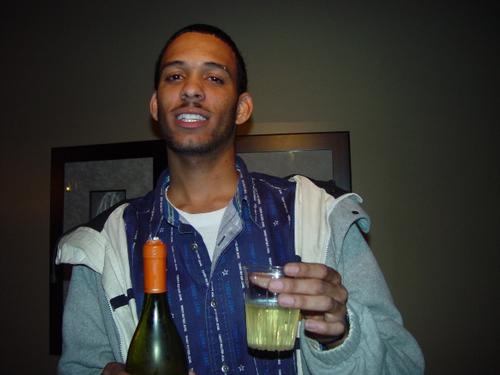
One party attender stated the this guy asked for the bathroom (where my purse was ripped apart for valuable items).
I contacted the photographer and he sent me the rest of the pictures where you can see more of the guys (time stamps: 1:24AM-1:39AM).
Another party attender accidentally walked in the bathroom when the actual robber was going through my bag. He didn’t realize what was going on at the time, but he was able to ID the actual robber from this picture:
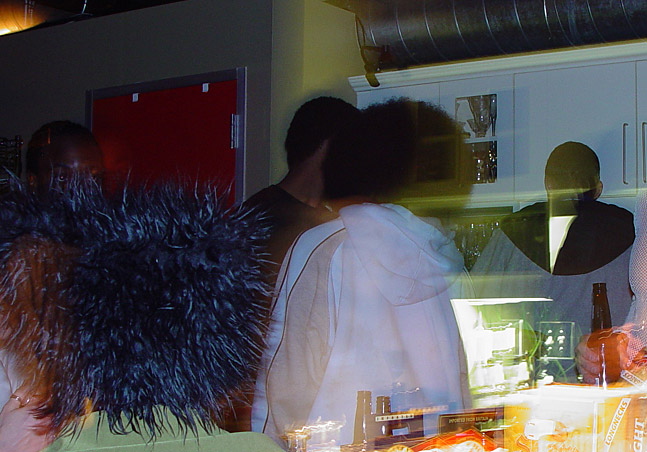
“He’s in this picture, but his face isn’t visible. He’s the one standing closest to the orange door with the short hair and the green t-shirt. He was the tallest, least hip, and most drunk of the group. I wish you had something more identifying. That is definitely him.”
Because these guys racked up my credit cards (and used the web from my phone), it’s now a felony fraud investigation as well as a robbery. Thanks everyone for helping me track down more information. If anyone has any clues, do let me know. Needless to say, the bloggers are going faster than the detectives. Thank you thank you thank you to those3 who are looking out for me!
Update 3/23: Detective Jewett (the detective on this case) said that i could post his email if anyone has additional information and wants to send it directly to him. (Be nice! Don’t send anything not related to the case, cause he’s being open and helpful.)
Detective Jewett: jason [dot] jewett [at] ci [dot] austin [dot] tx [dot] us
Austin Police Report Number: 2004-501-1946
how to solve problems with social networks
According to David, Eric Schmidt from Google said: “Social networks will get better as we figure out what problem they’re intended to solve.” In an attempt to learn from last week, i will try really hard to not take that literally and imagine that he meant to say that “social networking TOOLS will get better…”
But even still, there’s a bit of backwards logic here. Why are we asking: what can social networking tools solve? Why aren’t we asking: what problem do we have that social networks give us insight to? I remember when i first got involved in technology creation, there was always a technology-first, problem-second approach. A technology was created and then everyone was rushing around trying to put it to use. I find it very entertaining that social networks (which weren’t invented, but modeled) are being put to the same process.
The thing is that social network representations require nuance. We can either try to solve the nuances universally (not going to happen) or try to figure out what problems we’re trying to employ social networks in and figure out how to negotiate them there IN A CONTEXT. The latter is going to be far more successful. Haven’t we already learned that each YASNS models a different social network anyhow (and no, FOAF is not the answer here because the different models are often because people are segmenting their networks differently in order to represent different facets).
I don’t believe that social network tools will get better as we find our problems. I think that social networks will get embedded into tools simply because they help us solve specific problems. The focus won’t be on the network, but on the problem solving.
(::cringe:: I’m almost approaching activity theory here. Must stop.)
Clarification based on good question:
Q: What’s the diff? Either way you’re holding a hammer and looking for a nail, no?
A: The difference is key. When you are focused on building social networks just to build them, you make very different design decisions than when you are trying to design a tool the utilizes social networks as a concept employed to solve a task problem.
The difference has a lot to do with the amorphous discussion of what social network TOOLs are and what social networks are. They aren’t the same thing. RIght now, there’s no hammer. Just the shadow of a hammer, which doesn’t solve the same problems.
Furthermore, when you have a hammer, you try to find nails. You turn things that shouldn’t be nails into nails. This is a really really really bad thing when you’re dealing with people and their relationships. Instead of accidentally breaking the wooden post cause you thought it was a nail, you break people, their relationships, their trust and their willingness to participate.
thinking through a linked in request
First, i admit: i don’t get the business world. Thus, the social norms there are very lost on me. Recently i was faced with a Linked In request that brought this issue to the forefront.
I’m linked to two people that i barely know because of social politeness – Person B & D. Person B had a “friend” (A) that wanted to get person E (“friend” of D’s) to do something for him. I’ve never heard of A or E and only have vague name/product recognition of B&D. Person B passes me this note from A with an attached note saying that he doesn’t know him but it sounds reasonable.
So, as i saw it, i could have:
1) Passed it on, acknowledging that i barely know B to the barely known D and let it be his problem
2) Stopped it, saying that i don’t feel comfortable passing this on not knowing any of the parties
3) Pretended like i’m a ostrich and make it go away by sticking my head in the ground, fingers in ears, eyes closed screaming “i don’t see you”
Now, if you know me, you know that i chose 3. I *HATE* being stuck in the middle of socially awkward situations. All this made me wanna do is run very far away from Linked In. This in turn made me feel supremely guilty because i want Linked In to work for people.
The thing about helping people out in this context is that it’s supposed to make you feel empowered, like you did a good deed. But when you’re stuck in the middle of a chain of unknowns, you’re faced with the explicit feeling that your reputation is being forced through the ringer for people you don’t know. There are a lot of *friends* that i won’t vouch for on a professional level… why should i vouch for people that i don’t know?
I realized that the only way that i’m willing to help out a friend-of-a-friend is when i really care for the well-being of my friend and trust their relationship with that person. And that takes a lot more than a recognizable professional relationship. So, i had a little idea…
Orkut relieves my guilt by letting me mark that i don’t know a person who has be-friended me. I don’t have to say no – i can simply say i don’t know this person. They don’t know it and i don’t have to feel guilty. Although Orkut’s only purpose of this is guilt reduction, Linked In could actually use this approach to their advantage.
For example, why can’t i list all of the people that i know and rather than say how important they are to me, say what kind of requests i’m willing to receive from that end. For example:
1) Willing to take any requests that come down the chain from this person, no matter how many links
2) Willing to take requests from this person and their friends (or perhaps willing to take requests only from the friends who are of this level of value to them…)
3) Willing to take requests from this person only
4) Not willing to receive requests from this person no matter what (a.k.a. supreme guilt reduction based on having to accept them as a friend)
Of course, this would really screw with the graphs and who one could see. But i wonder if it would help people like me who want to run away because of the discomfort.