Hacking the Attention Economy

For most non-technical folks, “hacking” evokes the notion of using sophisticated technical skills to break through the security of a corporate or government system for illicit purposes. Of course, most folks who were engaged in cracking security systems weren’t necessarily in it for espionage and cruelty. In the 1990s, I grew up among teenage hackers who wanted to break into the computer systems of major institutions that were part of the security establishment, just to show that they could. The goal here was to feel a sense of power in a world where they felt pretty powerless. The rush was in being able to do something and feel smarter than the so-called powerful. It was fun and games. At least until they started getting arrested.

Hacking has always been about leveraging skills to push the boundaries of systems. Keep in mind that one early definition of a hacker (from the Jargon File) was “A person who enjoys learning the details of programming systems and how to stretch their capabilities, as opposed to most users who prefer to learn only the minimum necessary.” In another early definition (RFC:1392), a hacker is defined as “A person who delights in having an intimate understanding of the internal workings of a system, computers and computer networks in particular.” Both of these definitions highlight something important: violating the security of a technical system isn’t necessarily the primary objective.

Indeed, over the last 15 years, I’ve watched as countless hacker-minded folks have started leveraging a mix of technical and social engineering skills to reconfigure networks of power. Some are in it for the fun. Some see dollar signs. Some have a much more ideological agenda. But above all, what’s fascinating is how many people have learned to play the game. And in some worlds, those skills are coming home to roost in unexpected ways, especially as groups are seeking to mess with information intermediaries in an effort to hack the attention economy.

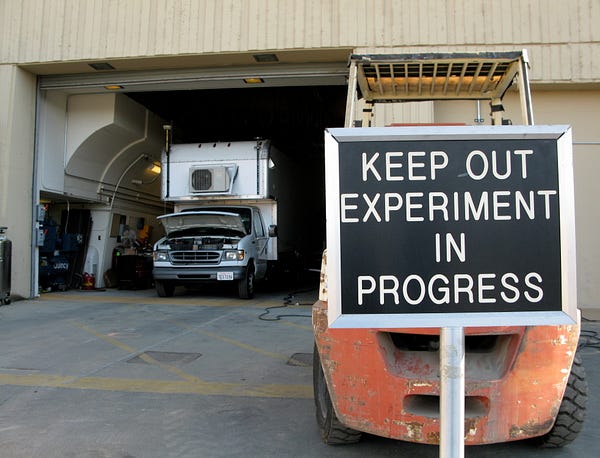
CC BY-NC 2.0-licensed photo by artgraff.

It all began with memes… (and porn…)

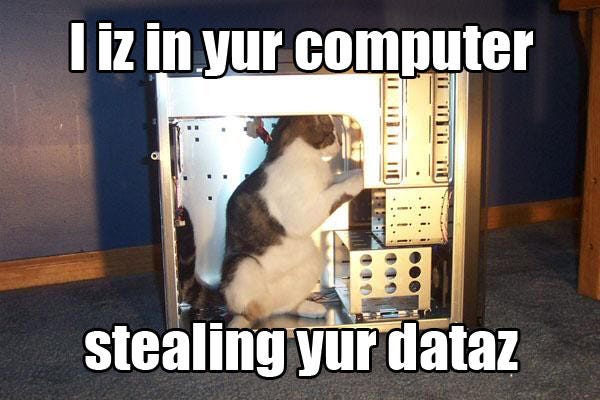
In 2003, a 15-year-old named Chris Poole started an image board site based on a Japanese trend called 4chan. His goal was not political. Rather, like many of his male teenage peers, he simply wanted a place to share pornography and anime. But as his site’s popularity grew, he ran into a different problem — he couldn’t manage the traffic while storing all of the content. So he decided to delete older content as newer content came in. Users were frustrated that their favorite images disappeared so they reposted them, often with slight modifications. This gave birth to a phenomenon now understood as “meme culture.” Lolcats are an example. These are images of cats captioned with a specific font and a consistent grammar for entertainment.
Those who produced meme-like images quickly realized that they could spread like wildfire thanks to new types of social media (as well as older tools like blogging). People began producing memes just for fun. But for a group of hacker-minded teenagers who were born a decade after I was, a new practice emerged. Rather than trying to hack the security infrastructure, they wanted to attack the emergent attention economy. They wanted to show that they could manipulate the media narrative, just to show that they could. This was happening at a moment when social media sites were skyrocketing, YouTube and blogs were challenging mainstream media, and pundits were pushing the idea that anyone could control the narrative by being their own media channel. Hell, “You” was TIME Magazine’s person of the year in 2006.

Taking a humorist approach, campaigns emerged within 4chan to “hack” mainstream media. For example, many inside 4chan felt that widespread anxieties about pedophilia were exaggerated and sensationalized. They decided to target Oprah Winfrey, who, they felt, was amplifying this fear-mongering. Trolling her online message board, they got her to talk on live TV about how “over 9,000 penises” were raping children. Humored by this success, they then created a broader campaign around a fake character known as Pedobear. In a different campaign, 4chan “b-tards” focused on gaming the TIME 100 list of “the world’s most influential people” by arranging it such that the first letter of each name on the list spelled out “Marblecake also the game,” which is a known in-joke in this community. Many other campaigns emerged to troll major media and other cultural leaders. And frankly, it was hard not to laugh when everyone started scratching their heads about why Rick Astley’s 1987 song “Never Gonna Give You Up” suddenly became a phenomenon again.

By engaging in these campaigns, participants learned how to shape information within a networked ecosystem. They learned how to design information for it to spread across social media.

They also learned how to game social media, manipulate its algorithms, and mess with the incentive structure of both old and new media enterprises. They weren’t alone. I watched teenagers throw brand names and Buzzfeed links into their Facebook posts to increase the likelihood that their friends would see their posts in their News Feed. Consultants starting working for companies to produce catchy content that would get traction and clicks. Justin Bieber fans ran campaign after campaign to keep Bieber-related topics in Twitter Trending Topics. And the activist group Invisible Children leveraged knowledge of how social media worked to architect the #Kony2012 campaign. All of this was seen as legitimate “social media marketing,” making it hard to detect where the boundaries were between those who were hacking for fun and those who were hacking for profit or other “serious” ends.

Running campaigns to shape what the public could see was nothing new, but social media created new pathways for people and organizations to get information out to wide audiences. Marketers discussed it as the future of marketing. Activists talked about it as the next frontier for activism. Political consultants talked about it as the future of political campaigns. And a new form of propaganda emerged.

The political side to the lulz

In her phenomenal account of Anonymous — “Hacker, Hoaxer, Whistleblower, Spy” — Gabriella Coleman describes the interplay between different networks of people playing similar hacker-esque games for different motivations. She describes the goofy nature of those “Anons” who created a campaign to expose Scientology, which many believed to be a farcical religion with too much power and political sway. But she also highlights how the issues became more political and serious as WikiLeaks emerged, law enforcement started going after hackers, and the Arab Spring began.
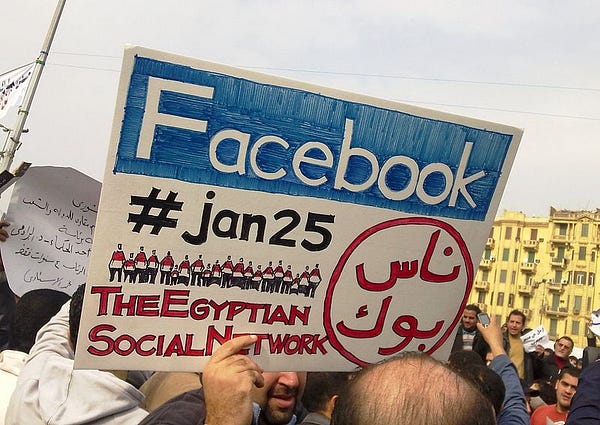
CC BY-SA 3.0-licensed photo by Essam Sharaf via Wikimedia Commons.

Anonymous was birthed out of 4chan, but because of the emergent ideological agendas of many Anons, the norms and tactics started shifting. Some folks were in it for fun and games, but the “lulz” started getting darker and those seeking vigilante justice started using techniques like “doxing”to expose people who were seen as deserving of punishment. Targets changed over time, showcasing the divergent political agendas in play.

Perhaps the most notable turn involved “#GamerGate” when issues of sexism in the gaming industry emerged into a campaign of harassment targeted at a group of women. Doxing began being used to enable “swatting” — in which false reports called in by perpetrators would result in SWAT teams sent to targets’ homes. The strategies and tactics that had been used to enable decentralized but coordinated campaigns were now being used by those seeking to use the tools of media and attention to do serious reputational, psychological, economic, and social harm to targets. Although 4chan had long been an “anything goes” environment (with notable exceptions), #GamerGate became taboo there for stepping over the lines.

As #GamerGate unfolded, men’s rights activists began using the situation to push forward a long-standing political agenda to counter feminist ideology, pushing for #GamerGate to be framed as a serious debate as opposed to being seen as a campaign of hate and harassment. In some ways, the resultant media campaign was quite successful: major conferences and journalistic enterprises felt the need to “hear both sides” as though there was a debate unfolding. Watching this, I couldn’t help but think of the work of Frank Luntz, a remarkably effective conservative political consultant known for reframing issues using politicized language.

As doxing and swatting have become more commonplace, another type of harassment also started to emerge en masse: gaslighting. This term refers to a 1944 Ingrid Bergman film called “Gas Light” (which was based on a 1938 play). The film depicts psychological abuse in a domestic violence context, where the victim starts to doubt reality because of the various actions of the abuser. It is a form of psychological warfare that can work tremendously well in an information ecosystem, especially one where it’s possible to put up information in a distributed way to make it very unclear what is legitimate, what is fake, and what is propaganda. More importantly, as many autocratic regimes have learned, this tactic is fantastic for seeding the public’s doubt in institutions and information intermediaries.

The democratization of manipulation

In the early days of blogging, many of my fellow bloggers imagined that our practice could disrupt mainstream media. For many progressive activists, social media could be a tool that could circumvent institutionalized censorship and enable a plethora of diverse voices to speak out and have their say. Civic minded scholars were excited by “smart mobs” who leveraged new communications platforms to coordinate in a decentralized way to speak truth to power. Arab Spring. Occupy Wall Street. Black Lives Matter. These energized progressives as “proof” that social technologies could make a new form of civil life possible.

I spent 15 years watching teenagers play games with powerful media outlets and attempt to achieve control over their own ecosystem. They messed with algorithms, coordinated information campaigns, and resisted attempts to curtail their speech. Like Chinese activists, they learned to hide their traces when it was to their advantage to do so. They encoded their ideas such that access to content didn’t mean access to meaning.

Of course, it wasn’t just progressive activists and teenagers who were learning how to mess with the media ecosystem that has emerged since social media unfolded. We’ve also seen the political establishment, law enforcement, marketers, and hate groups build capacity at manipulating the media landscape. Very little of what’s happening is truly illegal, but there’s no widespread agreement about which of these practices are socially and morally acceptable or not.

The techniques that are unfolding are hard to manage and combat. Some of them look like harassment, prompting people to self-censor out of fear. Others look like “fake news”, highlighting the messiness surrounding bias, misinformation, disinformation, and propaganda. There is hate speech that is explicit, but there’s also suggestive content that prompts people to frame the world in particular ways. Dog whistle politics have emerged in a new form of encoded content, where you have to be in the know to understand what’s happening. Companies who built tools to help people communicate are finding it hard to combat the ways their tools are being used by networks looking to skirt the edges of the law and content policies. Institutions and legal instruments designed to stop abuse are finding themselves ill-equipped to function in light of networked dynamics.

The Internet has long been used for gaslighting, and trolls have long targeted adversaries. What has shifted recently is the scale of the operation, the coordination of the attacks, and the strategic agenda of some of the players.

For many who are learning these techniques, it’s no longer simply about fun, nor is it even about the lulz. It has now become about acquiring power.

A new form of information manipulation is unfolding in front of our eyes. It is political. It is global. And it is populist in nature. The news media is being played like a fiddle, while decentralized networks of people are leveraging the ever-evolving networked tools around them to hack the attention economy.

I only wish I knew what happens next.

This post was first published as part of a series on media, accountability, and the public sphere. See also:


This post was also translated to Portuguese

Put an End to Reporting on Election Polls

We now know that the US election polls were wrong. Just like they were in Brexit. Over the last few months, I’ve told numerous reporters and people in the media industry that they should be wary of the polling data they’re seeing, but I was generally ignored and dismissed. I wasn’t alone — two computer scientists whom I deeply respect — Jenn Wortman Vaughan and Hanna Wallach — were trying to get an op-ed on prediction and uncertainty into major newspapers, but were repeatedly told that the outcome was obvious. It was not. And election polls will be increasingly problematic if we continue to approach them the way we currently do.

It’s now time for the media to put a moratorium on reporting on election polls and fancy visualizations of statistical data. And for data scientists and pollsters to stop feeding the media hype cycle with statistics that they know have flaws or will be misinterpreted as fact.

Why Political Polling Will Never Be Right Again

Polling and survey research has a beautiful history, one that most people who obsess over the numbers don’t know. In The Averaged American, Sarah Igo documents three survey projects that unfolded in the mid-20th century that set the stage for contemporary polling: the Middletown studies, Gallup, and Kinsey. As a researcher, it’s mindblowing to see just how naive folks were about statistics and data collection in the early development of this field, how much the field has learned and developed. But there’s another striking message in this book: Americans were willing to contribute to these kinds of studies at unparalleled levels compared to their peers worldwide because they saw themselves as contributing to the making of public life. They were willing to reveal their thoughts, beliefs, and ideas because they saw doing so as productive for them individually and collectively.

As folks unpack the inaccuracies of contemporary polling data, they’re going to focus on technical limitations. Some of these are real. Cell phones have changed polling — many people don’t pick up unknown numbers. The FCC’s ruling that limited robocalls to protect consumers in late 2015 meant that this year’s sampling process got skewed, that polling became more expensive, and that pollsters took shortcuts. We’ve heard about how efforts to extrapolate representativeness from small samples messes with the data — such as the NYTimes report on a single person distorting national polling averages.

But there’s a more insidious problem with the polling data that is often unacknowledged. Everyone and their mother wants to collect data from the public. And the public is tired of being asked, which they perceive as being nagged. In swing states, registered voters were overwhelmed with calls from real pollsters, fake pollsters, political campaigns, fundraising groups, special interest groups, and their neighbors. We know that people often lie to pollsters (confirmation bias), but when people don’t trust information collection processes, normal respondent bias becomes downright deceptive. You cannot collect reasonable data when the public doesn’t believe in the data collection project. And political pollsters have pretty much killed off their ability to do reasonable polling because they’ve undermined trust. It’s like what happens when you plant the same crop over and over again until the land can no longer sustain that crop.

Election polling is dead, and we need to accept that.

Why Reporting on Election Polling Is Dangerous

To most people, even those who know better, statistics look like facts. And polling results look like truth serum, even when pollsters responsibly report margin of error information. It’s just so reassuring or motivating to see stark numbers because you feel like you can do something about those numbers, and then, when the numbers change, you feel good. This plays into basic human psychology. And this is why we use numbers as an incentive in both education and the workplace.

Political campaigns use numbers to drive actions on their teams. They push people to go to particular geographies, they use numbers to galvanize supporters. And this is important, which is why campaigns invest in pollsters and polling processes.

Unfortunately, this psychology and logic gets messed up when you’re talking about reporting on election polls in the public. When the numbers look like your team is winning, you relax and stop fretting, often into complacency.When the numbers look like your team is losing, you feel more motivated to take steps and do something. This is part of why the media likes the horse race — they push people to action by reporting on numbers, which in effect pushes different groups to take action. They like the attention that they get as the mood swings across the country in a hotly contested race.

But there is number burnout and exhaustion. As people feel pushed and swayed, as the horse race goes on and on, they get more and more disenchanted. Rather than galvanizing people to act, reporting on political polling over a long period of time with flashy visuals and constantly shifting needles prompts people to disengage from the process. In short, when it comes to the election, this prompts people to not show up to vote. Or to be so disgusted that voting practices become emotionally negative actions rather than productively informed ones.

This is a terrible outcome. The media’s responsibility is to inform the public and contribute to a productive democratic process. By covering political polls as though they are facts in an obsessive way, they are not only being statistically irresponsible, but they are also being psychologically irresponsible.

The news media are trying to create an addictive product through their news coverage, and, in doing so, they are pushing people into a state of overdose.

Yesterday, I wrote about how the media is being gamed and not taking moral responsibility for its participation in the spectacle of this year’s election. One of its major flaws is how it’s covering data and engaging in polling coverage. This is, in many ways, the easiest part of the process to fix. So I call on the news media to put a moratorium on political polling coverage, to radically reduce the frequency with which they reference polls during an election season, and to be super critical of the data that they receive. If they want to be a check to power, they need to have the structures in place to be a check to math.

(This was first posted on Points.)

I blame the media. Reality check time.

For months I have been concerned about how what I was seeing on the ground and in various networks was not at all aligned with what pundits were saying. I knew the polling infrastructure had broken, but whenever I told people about the problems with the sampling structure, they looked at me like an alien and told me to stop worrying. Over the last week, I started to accept that I was wrong. I wasn’t.

And I blame the media.

The media is supposed to be a check to power, but, for years now, it has basked in becoming power in its own right. What worries me right now is that, as it continues to report out the spectacle, it has no structure for self-reflection, for understanding its weaknesses, its potential for manipulation.

I believe in data, but data itself has become spectacle. I cannot believe that it has become acceptable for media entities to throw around polling data without any critique of the limits of that data, to produce fancy visualizations which suggest that numbers are magical information. Every pollster got it wrong. And there’s a reason. They weren’t paying attention to the various structural forces that made their sample flawed, the various reasons why a disgusted nation wasn’t going to contribute useful information to inform a media spectacle. This abuse of data has to stop. We need data to be responsible, not entertainment.

This election has been a spectacle because the media has enjoyed making it as such. And in doing so, they showcased just how easily they could be gamed. I refer to the sector as a whole because individual journalists and editors are operating within a structural frame, unmotivated to change the status quo even as they see similar structural problems to the ones I do. They feel as though they “have” to tell a story because others are doing so, because their readers can’t resist reading. They live in the world pressured by clicks and other elements of the attention economy. They need attention in order to survive financially. And they need a spectacle, a close race.

We all know that story. It’s not new. What is new is that they got played.
Over the last year, I’ve watched as a wide variety of decentralized pro-Trump actors first focused on getting the media to play into his candidacy as spectacle, feeding their desire for a show. In the last four months, I watched those same networks focus on depressing turnout, using the media to trigger the populace to feel so disgusted and frustrated as to disengage. It really wasn’t hard because the media was so easy to mess with. And they were more than happy to spend a ridiculous amount of digital ink circling round and round into a frenzy.

Around the world, people have been looking at us in a state of confusion and shock, unsure how we turned our democracy into a new media spectacle. What hath 24/7 news, reality TV, and social media wrought? They were right to ask. We were irresponsible to ignore.

In the tech sector, we imagined that decentralized networks would bring people together for a healthier democracy. We hung onto this belief even as we saw that this wasn’t playing out. We built the structures for hate to flow along the same pathways as knowledge, but we kept hoping that this wasn’t really what was happening. We aided and abetted the media’s suicide.
The red pill is here. And it ain’t pretty.

We live in a world shaped by fear and hype, not because it has to be that way, but because this is the obvious paradigm that can fuel the capitalist information architectures we have produced.

Many critics think that the answer is to tear down capitalism, make communal information systems, or get rid of social media. I disagree. But I do think that we need to actively work to understand complexity, respectfully engage people where they’re at, and build the infrastructure to enable people to hear and appreciate different perspectives. This is what it means to be truly informed.

There are many reasons why we’ve fragmented as a country. From the privatization of the military (which undermined the development of diverse social networks) to our information architectures, we live in a moment where people do not know how to hear or understand one another. And our obsession with quantitative data means that we think we understand when we hear numbers in polls, which we use to judge people whose views are different than our own. This is not productive.

Most people are not apathetic, but they are disgusted and exhausted. We have unprecedented levels of anxiety and fear in our country. The feelings of insecurity and inequality cannot be written off by economists who want to say that the world is better today than it ever was. It doesn’t feel that way. And it doesn’t feel that way because, all around us, the story is one of disenfranchisement, difference, and uncertainty.

All of us who work in the production and dissemination of information need to engage in a serious reality check.

The media industry needs to take responsibility for its role in producing spectacle for selfish purposes. There is a reason that the public doesn’t trust institutions in this country. And what the media has chosen to do is far from producing information. It has chosen to produce anxiety in the hopes that we will obsessively come back for more. That is unhealthy. And it’s making us an unhealthy country.

Spectacle has a cost. It always has. And we are about to see what that cost will be.

(This was first posted at Points.)

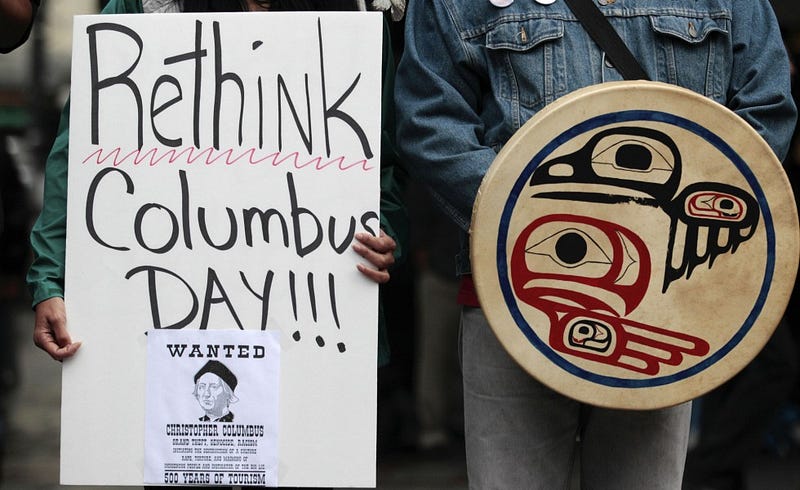
Columbus Day!?!? What the f* are we celebrating?

Today is Columbus Day, a celebration of colonialism wrapped up under the guise of exploration. Children around the US are taught that European settlers came in 1492 and found a whole new land magically free for occupation. In November, they will be told that there were small and disperse savage populations who opened their arms to white settlers fleeing oppression. Some of those students may eventually learn on their own about violence, genocide, infection, containment, relocation, humiliation, family separation, and cultural devaluation which millions of Native peoples experienced over centuries.

Hello, cultural appropriation!

Later this month, when everyone is excited about goblins and ghosts, thousands of sexy Indian costumes will be sold, prompting young Native Americans to cringe at the depictions of their culture and community. Part of the problem is that most young Americans think that Indians are dead or fictitious. Schools don’t help — children are taught to build teepees and wear headdresses as though this is a story of the past, not a living culture. And racist attitudes towards Native people are baked into every aspect of our culture. Why is it OK for Washington’s football team to be named the Redskins? Can you imagine a football team being named after the N-word?

Historically, Native people sit out Columbus Day in silence. This year, I hope you join me and thousands others by making a more active protest to Change what people learn!

In 2004, the Smithsonian’s National Museum of the American Indian was opened on the Mall in Washington DC as a cultural heritage institution to celebrate the stories of Native people and tell their story. I’m a proud trustee of this esteemed institution. I’m even more excited by upcoming projects that are focused on educating the public more holistically about the lives and experiences of Native peoples.

As a country, we’re struggling with racism and prejudice, hate that is woven deep into our cultural fabric. Injustice is at the core of our country’s creation, whether we’re talking about the original sin of slavery or the genocide of Native peoples. Addressing inequities in the present requires us to come to terms with our past. We need to educate ourselves about the limits of our understanding about our own country’s history. And we need to stop creating myths for our children that justify contemporary prejudice.

On this day, a day that we should not be celebrating, I have an ask for you. Please help me and NMAI build an educational effort that will change the next generation’s thinking about Native culture, past and present. Please donate a multiple of $14.91 to NMAI: http://nmai.si.edu/support/membership/ in honor of how much life existed on these lands before colonialist expansion. Help Indian nations achieve their rightful place of respect among the world’s nations and communities.

There was a bomb on my block.

I live in Manhattan, in Chelsea, on 27th Street between 6th and 7th, the same block in which the second IED was found. It was a surreal weekend, but it is increasingly becoming depressing as the media moves from providing information to stoking fear, the exact response that makes these events so effective. I’m not afraid of bombs. I’m afraid of cars. And I’m increasingly becoming afraid of American media.

After hearing the bomb go off on 23rd and getting flooded with texts on Saturday night, I decided to send a few notes that I was OK and turn off my phone. My partner is Israeli. We’ve been there for two wars and he’s been there through countless bombs. We both knew that getting riled up was of no help to anyone. So we went to sleep. I woke up on Sunday, opened my blinds, and was surprised to see an obscene number of men in black with identical body types, identical haircuts, and identical cars. It looked like the weirdest casting call I’ve ever seen. And no one else. No cars, no people. As always, Twitter had an explanation so we settled into our PJs and realized it was going to be a strange day.

Flickr / Sean MacEntree

As other people woke up, one thing became quickly apparent — because folks knew we were in the middle of it, they wanted to reach out to us because they were worried, and scared. We kept shrugging everything off, focusing on getting back to normal and reading the news for updates about how we could maneuver our neighborhood. But ever since a suspect was identified, the coverage has gone into hyperventilation mode. And I just want to scream in frustration.

The worst part about having statistical training is that it’s hard to hear people get anxious about fears without putting them into perspective. ~100 people die every day in car crashes in the United States. That’s 33,804 deaths in a year. Thousands of people are injured every day by cars. Cars terrify me.And anyone who says that you have control over a car accident is full of shit; most car deaths and injuries are not the harmed person’s fault.

The worst part about being a parent is having to cope with the uncontrollable, irrational, everyday fears that creep up, unwarranted, just to plague a moment of happiness. Will he choke on that food? What if he runs away and gets hit by a car? What if he topples over that chair? The best that I can do is breathe in, breathe out, and remind myself to find my center, washing away those fears with each breath.

And the worst part about being a social scientist is understanding where others’ fears come from, understanding the power of those fears, and understanding the cost of those fears on the well-being of a society. And this is where I get angry because this is where control and power lies.

Traditional news media has a lot of say in what it publishes. This is one ofthe major things that distinguishes it from social media, which propagates the fears and anxieties of the public. And yet, time and time again, news media shows itself to be irresponsible, motivated more by the attention and money that it can obtain by stoking people’s fears than by a moral responsibility to help ground an anxious public.

I grew up on the internet. I grew up with the mantra “don’t feed the trolls.” I always saw this as a healthy meditation for navigating the internet, for focusing on the parts of the internet that are empowering and delightful.Increasingly, I keep thinking that this is a meditation that needs to be injected into the news ecosystem. We all know that the whole concept of terrorism is to provoke fear in the public. So why are we not holding news media accountable for opportunistically aiding and abetting terroristic acts?Our cultural obsession with reading news that makes us afraid parallels our cultural obsession with crises.

There’s a reason that hate is growing in this country. And, in moments like this, I’m painfully reminded that we’re all contributing to the culture of hate.When we turn events like what happened this weekend in NY/NJ into spectacle, when we encourage media to write stories about how afraid people are, when we read the stories of how the suspect was an average person until something changed, we give the news media license to stoke up fear. And when they are encouraged to stoke fear, they help turn our election cycle into reality TV and enable candidates to spew hate for public entertainment. We need to stop blaming what’s happening on other people and start taking responsibility.

In short, we all need to stop feeding the trolls.

Be Careful What You Code For

Most people who don’t code don’t appreciate how hard it is to do right.Plenty of developers are perfectly functional, but to watch a master weave code into silken beauty is utterly inspiring. Unfortunately, most of the code that underpins the tools that we use on a daily basis isn’t so pretty. There isa lot of digital duct tape.

CC BY-NC 2.0-licensed photo by Dino Latoga.

I’m a terrible programmer. Don’t get me wrong — I’m perfectly capable of mashing together code to get a sorta-kinda-somewhat reasonable outcome.But the product is inevitably a Frankensteinesque monstrosity. I’m not alone. This is why I’m concerned about the code that is being built. Not all code is created equally.

If you want to understand what we’re facing, consider what this would mean if we were constructing cities. In the digital world, we are simultaneously building bridges, sewage systems, and skyscrapers. Some of the bridge builders have civil engineering degrees, some of our sewage contractors have been plumbers in past lives, but most of the people building skyscrapers have previously only built tree houses and taken a few math classes. Oh, and there aren’t any inspectors to assess whether or not it’s all going to fall apart.

Code is key to civic life, but we need to start looking under the hood and thinking about the externalities of our coding practices, especially as we’re building code as fast as possible with few checks and balances.

Area One: Environmental Consequences

Let’s play a game of math. Almost 1 billion people use Gmail. More than that are active on Facebook each month. Over 300 million are active on Twitter each month. All social media — including Facebook and Twitter — send out notifications to tell you that you have new friend requests, likes, updates, etc. Each one of those notifications is roughly 50KB. If you’re relatively active, you might get 1MB of notifications a day. That doesn’t seem to be that much. But if a quarter of Gmail users get that, this means that Google hosts over 90 petabytes of notifications per year. All of that is sitting live on server so that any user can search their email and find past emails, including the new followers they received in 2007. Is this really a good use of resources? Is this really what we want when we talk about keeping data around?

The tech industry uses crazy metaphors. Artificial intelligence. Files and folders. They often have really funny roots that make any good geek giggle. (UNIX geeks, did you know that the finger command is named as such because that word meant someone is a “snitch” in the 1970s? You probably had a dirtier idea in mind.

CC BY 2.0-licensed photo by Pattys-photos.

We don’t know who started calling the cloud the cloud, but he (and it’s inevitably a he) didus all a disservice. When the public hears about the cloud, they think about the fluffy white things in the sky. What were the skies like when you were young? They went on forever…And the skies always had little fluffy clouds.” Those clouds giveth. They offer rain, which gives us water, which is the source of life.

But what about the clouds we techies make? Those clouds take. They require rare earth metals and soak up land, power, and water. Many big companies are working hard to think about the environmental impact of data centers, to think about the carbon implications. (I’m proud to work forone of them.) Big companies still have a long way to go, but at least they’re trying. But how many developers out there are trying to write green code?At best, folks are thinking about the cost-per-computation, but most developers are pretty sloppy with code and data. And there’s no LEED-certified code. Who is going to start certifying LEED code!?

In the same sense, how many product designers are thinking about the environmental impact of every product design decision they make? Product folks are talking about how notifications might annoy or engage users but not the environmental impact of them. And for all those open data zealots, is the world really better off having petabytes of data sitting on live servers just to make sure it’s open and accessible just in case? It’s painful to think about how many terabytes of data are sitting in open data repositories that have never been accessed.

And don’t get me started about the blockchain or 3D printing or the Internet of Things. At least bitcoin got one thing right: this really is about mining.

Area Two: Social Consequences

In the early 2000s, Google thought that I was a truck driver. I got the bestadvertisements. I didn’t even know how many variations of trucker speed there were! All because I did fieldwork in parts of the country that only truckers visit. Consider how many people have received online advertisements that clearly got them wrong. Funny, huh?

Now…Have you ever been arrested? Have you ever been incarcerated?

Take a moment to think about the accuracy of our advertising ecosystem — the amount of money and data that goes into making ads right. Now think about what it means that the same techniques that advertisers are using to “predict” what you want to buy are also being used to predict the criminality of a neighborhood or a person. And those that work in law enforcement and criminal justice have less money, oversight mechanisms, and technical skills.

Inaccuracy and bias are often a given in advertising. But is it OK that we’re using extraordinarily biased data about previous arrests to predict future arrests and determine where police are stationed? Is it OK that we assess someone’s risk at the point of arrest and give judges recommendations for bail, probation, and sentencing? Is it OK that local law enforcement agencies are asking tech vendors to predict which children are going to commit a crime before they’re 21? Who is deciding, and who is holding them accountable?

We might have different political commitments when it comes to policing and criminal justice. But when it comes to tech and data analysis, I hope that we can all agree that accuracy matters. Yet, we’re turning a blind eye to all of the biases that are baked into the data and, thus, the models that we build.

CC BY-NC 2.0-licensed photo by Thomas Hawk.

Take a moment to consider that 96% of cases are plead out. Those defendants never see a jury of their peers. At a minimum, 10% — but most likely much more — of those who take a plea are innocent. Why? Last I saw, the average inmate at Riker’s waits ~600 days for their trial to begin. Average. And who is more likely to end up not making bail? Certainly not rich white folks.

Researchers have long known that whites are more likely to use and sell drugs. And yet, who is arrested for drugs? Blacks. 13% of the US population is black, but over 60% of those in prison are black. Mostly for drug crimes.

Because blacks are more likely to be arrested — and more likely to be prosecuted and serve time, guess what our algorithms tell us about who is most likely to commit a drug crime? About where drug crimes occur? Police aren’t sent by predictive policing tools to college campuses. They’re sent to the hood.

Engineers argue that judges and police officers should know the limits of the data they use. Some do — they’re simply ignoring these expensive, tax-payer-costing civic technologies. But in a world of public accountability, where police are punished for not knowing someone was a risk before they shoot up a church, many feel obliged to follow the recommendations for fear of reprisal. This is how racism gets built into the structures of our systems. And civic tech is implicated in this.

I don’t care what your politics are. If you’re building a data-driven system and you’re not actively seeking to combat prejudice, you’re building a discriminatory system.

Solution: Audits and Inspection

Decisions made involving tech can have serious ramifications that are outside of the mind’s eye of development. We need to wake up. Our technology is powerful, and we need to be aware of the consequences of our code.

Before our industry went all perpetual beta, we used to live in a world where Test or Quality Assurance meant something. Rooted in those domains is a practice that can be understood as an internal technical audit. We need to get back to this. We need to be able to answer simple questions like:

  • Does the system that we built produce the right output given the known constraints?
  • Do we understand the biases and limitations of the system and the output?
  • Are those clear to the user so that our tool cannot enable poor decision-making or inaccurate impressions?
  • What are the true social and environmental costs of the service?

We need to start making more meaningful trade-offs. And that requires asking hard questions.

Audits don’t have to be adversarial. They can be a way of honestly assessing the limitations of a system and benchmarking for improvement. This approach is not without problems and limitations, but, if you cannot understand whether a model is helping or hurting, discriminating or resulting in false positives, then you should not be implementing that technology in a high stakes area where freedom and liberty are at stake.Stick to advertising.

Technology can be amazingly empowering. But only when it is implemented in a responsible manner. Code doesn’t create magic. Without the right checks and balances, it can easily be misused. In the world of civic tech, we need to conscientiously think about the social and environmental costs, just as urban planners do.