Challenges for Health in a Networked Society

In February, I had the great fortune to visit the Robert Wood Johnson Foundation as part of their “What’s Next Health” series. I gave a talk raising a series of critical questions for those working on health issues. The folks at RWJF have posted my talk, along with an infographic of some of the challenges I see coming down the pipeline.

They also asked me to write a brief blog post introducing some of my ideas, based on one of the questions that I asked in the lecture. I’ve reposted it here, but if this interests you, you should really go check out the talk over at RWJF’s page.

….

RWJF’s What’s Next Health: Who Do We Trust?

We live in a society that is more networked than our grandparents could ever have imagined. More people have information at their fingertips than ever before. It’s easy to see all of this potential and celebrate the awe-some power of the internet. But as we think about the intersection of technology and society, there are so many open questions and challenging conundrums without clear answers. One of the most pressing issues has to do with trust, particularly as people turn to the internet and social media as a source of health information. We are watching shifts in how people acquire information. But who do they trust? And is trust shifting?

Consider the recent American presidential election, which is snarkily referred to as “post-factual.” The presidential candidates spoke past one another, refusing to be pinned down. News agencies went into overdrive to fact-check each statement made by each candidate, but the process became so absurd that folks mostly just gave up trying to get clarity. Instead, they focused on more fleeting issues like whether or not they trusted the candidates.

In a world where information is flowing fast and furious, many experience aspects of this dynamic all the time. People turn to their friends for information because they do not trust what’s available online. I’ve interviewed teenagers who, thanks to conversations with their peers and abstinence-only education, genuinely believe that if they didn’t get pregnant the last time they had sex, they won’t get pregnant this time. There’s so much reproductive health information available online, but youth turn to their friends for advice because they trust those “facts” more.

The internet introduces the challenges of credibility but it also highlights the consequences of living in a world of information overload, where the issue isn’t whether or not the fact is out there and available, but how much effort a person must go through to manage making sense of so much information. Why should someone trust a source on the internet if they don’t have the tools to assess the content’s credibility? It’s often easier to turn to friends or ask acquaintances on Facebook for suggestions. People use the “lazy web” because friends are more likely to respond quickly and make sense than trying to sort out what’s available through Google.

As we look to the future, organizations that focus on the big issues — like the Robert Wood Johnson Foundation — need to think about what it means to create informed people in a digital era. How do we spread accurate information through networks? How do we get people to trust abstract entities that have no personal role in their lives?”

Questions around internet and trust are important: What people know and believe will drive what they do and this will shape their health.

The beauty of this moment, with so many open questions and challenges, is that we are in a position to help shape the future by delicately navigating these complex issues. Thus, we must be asking ourselves: How can we collectively account for different stakeholders and empower people to make the world a better place?

Print Friendly, PDF & Email

thoughts on Pew’s latest report: notable findings on race and privacy

Yesterday, Pew Internet and American Life Project (in collaboration with Berkman) unveiled a brilliant report about “Teens, Social Media, and Privacy.” As a researcher who’s been in the trenches on these topics for a long time now, none of their finding surprised me but it still gives me absolute delight when our data is so beautifully in synch. I want to quickly discuss two important issues that this report raise.

Race is a factor in explaining differences in teen social media use.

Pew provides important measures on shifts in social media, including the continued saturation of Facebook, the decline of MySpace, and the rise of other social media sites (e.g., Twitter, Instagram). When they drill down on race, they find notable differences in adoption. For example, they highlight data that is the source of “black Twitter” narratives: 39% of African-American teens use Twitter compared to 23% of white teens.

Most of the report is dedicated to the increase in teen sharing, but once again, we start to see some race differences. For example, 95% of white social media-using teens share their “real name” on at least one service while 77% of African-American teens do. And while 39% of African-American teens on social media say that they post fake information, only 21% of white teens say they do this.

Teens’ practices on social media also differ by race. For example, on Facebook, 48% of African-American teens befriend celebrities, athletes, or musicians while one 25% of white teen users do.

While media and policy discussions of teens tend to narrate them as an homogenous group, there are serious and significant differences in practices and attitudes among teens. Race is not the only factor, but it is a factor. And Pew’s data on the differences across race highlight this.

Of course, race isn’t actually what’s driving what we see as race differences. The world in which teens live is segregated and shaped by race. Teens are more likely to interact with people of the same race and their norms, practices, and values are shaped by the people around them. So what we’re actually seeing is a manifestation of network effects. And the differences in the Pew report point to black youth’s increased interest in being a part of public life, their heightened distrust of those who hold power over them, and their notable appreciation for pop culture. These differences are by no means new, but what we’re seeing is that social media is reflecting back at us cultural differences shaped by race that are pervasive across America.

Teens are sharing a lot of content, but they’re also quite savvy.

Pew’s report shows an increase in teens’ willingness to share all sorts of demographic, contact, and location data. This is precisely the data that makes privacy advocates anxious. At the same time, their data show that teens are well-aware of privacy settings and have changed the defaults even if they don’t choose to manage the accessibility of each content piece they share. They’re also deleting friends (74%), deleting previous posts (59%), blocking people (58%), deleting comments (53%), detagging themselves (45%), and providing fake info (26%).

My favorite finding of Pew’s is that 58% of teens cloak their messages either through inside jokes or other obscure references, with more older teens (62%) engaging in this practice than younger teens (46%). This is the practice that I’ve seen significantly rise since I first started doing work on teens’ engagement with social media. It’s the source of what Alice Marwick and I describe as “social steganography” in our paper on teen privacy practices.

While adults are often anxious about shared data that might be used by government agencies, advertisers, or evil older men, teens are much more attentive to those who hold immediate power over them – parents, teachers, college admissions officers, army recruiters, etc. To adults, services like Facebook that may seem “private” because you can use privacy tools, but they don’t feel that way to youth who feel like their privacy is invaded on a daily basis. (This, btw, is part of why teens feel like Twitter is more intimate than Facebook. And why you see data like Pew’s that show that teens on Facebook have, on average 300 friends while, on Twitter, they have 79 friends.) Most teens aren’t worried about strangers; they’re worried about getting in trouble.

Over the last few years, I’ve watched as teens have given up on controlling access to content. It’s too hard, too frustrating, and technology simply can’t fix the power issues. Instead, what they’ve been doing is focusing on controlling access to meaning. A comment might look like it means one thing, when in fact it means something quite different. By cloaking their accessible content, teens reclaim power over those who they know who are surveilling them. This practice is still only really emerging en masse, so I was delighted that Pew could put numbers to it. I should note that, as Instagram grows, I’m seeing more and more of this. A picture of a donut may not be about a donut. While adults worry about how teens’ demographic data might be used, teens are becoming much more savvy at finding ways to encode their content and achieve privacy in public.

Anyhow, I have much more to say about Pew’s awesome report, but I wanted to provide a few thoughts and invite y’all to read it. If there is data that you’re curious about or would love me to analyze more explicitly, leave a comment or drop me a note. I’m happy to dive in more deeply on their findings.

Print Friendly, PDF & Email

Heads Up: Parenting Leave Coming Up

I’m a big believer in taking breaks from work, research, and my mediated life to travel, trek, and explore. Years ago, I implemented email sabbaticals to give myself space to take time off without being overwhelmed by the ongoing flow of emails and expectations. I documented the process because too many people assumed that I just disappeared, unannounced, leaving my colleagues and friends in a lurch. Actually, email sabbaticals are a process because they have stages where I make sure that everyone who depends on me is taken care of before I disappear into the void. I typically announce them to colleagues 3-6 months ahead of time and give a public warning 6 weeks ahead of time. And then I have a process upon return where I check in with folks. When I disappear, my goal is to never leave people that depend on me faltering. This isn’t a perfect process, but I’ve found that letting people know well ahead of time guarantees that I finish out projects and account for commitments before taking time off without the lingering stress of unfinished business.

Normally, when I plan on taking a massive break, I know the dates well ahead of time and can help everyone plan and prepare. I’m now facing a different dilemma. I know that sometime in the next n weeks, I’m going to take some serious time off. The problem is that I’m not quite sure exactly when that will occur nor am I exactly sure how long I will be gone or how much I will want to be off email. Y’see, rather than taking a vacation this summer, I’m planning on having a baby.

As folks who have seen me in recent months know, I’m pregnant, due August 3. I look pretty silly, particularly given that I’m a klutz and managed to obtain a lisfranc injury on top of my bulging belly which means that I look like a whale on a scooter. But I’m still chugging along, finishing out writing projects (the book is in copyediting right now!) and starting new ones (nom nom trouble). I’m planning on taking parental leave when the kiddo arrives, but I’m not yet sure how long I’ll want to be focused solely on being a parent. Given my love of research, I expect that I’ll ease back in to email and projects throughout the fall. And I plan to start traveling again with a spectacular book tour when the book launches in early 2014. But I also know that I’m entering a world of uncertainty.

I don’t intend to detail my life as a mother on this blog because, frankly, I don’t want to. But I do want to give y’all a heads up that I intend to disappear for a bit when the time comes. So if there are things you need from me this summer or early fall, perhaps ping me sooner rather than later. And please understand that when I do get to finally meet the kiddo, I will probably be pretty inattentive to email and the internets for a while. I suspect that this will look and feel differently than my email sabbaticals, but I still don’t want to leave people in a lurch. So I wanted to give y’all a heads up.

A new adventure awaits!  Thanks for your patience!

Print Friendly, PDF & Email

How would you define work in a networked world?

(This post was originally written for LinkedIn.  Go to the LinkedIn version to engage in the conversation.)

I’ve been scratching my head trying to think about how to understand the different facets of labor that are shaping contemporary life. I don’t have good answers; I only have some provocations and a few questions, but I would love to hear your thoughts.

As a teenager, I was a sandwich artist. I’d arrive at work, don my uniform and clock in. I had a long list of responsibilities – chopping onions, cleaning the shop, preparing the food, etc. Everything was formulaic. I can still recite how to ask a customer if they want onions, pickles, lettuce, green peppers, or black olives. The job paid minimum wage and was defined by doing pre-specified tasks in an efficient and predictable manner with a smile. When my compatriots got fired, it was almost always for being late. In-between making sandwiches and doing the rote tasks, we would gossip and chat, complain about regulars and talk about run-ins with cops (who demanded free food which meant a dock in pay for whoever was working). And when my shift was over, I’d clock out and leave, forgetting about Subway even though the scent lingered and filled my car.

Today, I have my dream job. I’m a researcher who gets to follow my passions, investigate things that make me curious. I manage my own schedule and task list. Some days, I wake up and just read for hours. I write blog posts and books, travel, meet people, and give talks. I ask people about their lives and observe their practices. I think for a living. And I’m paid ridiculously well to be thoughtful, creative, and provocative. I am doing something related to my profession 80-100 hours per week, but I love 80% of those hours. I can schedule doctor’s appointments midday, but I also wake up in the middle of the night with ideas and end up writing while normal people sleep. Every aspect of my life blurs. I can never tell whether or not a dinner counts as “work” or “play” when the conversation moves between analyzing the gender performance of Game of Thrones and discussing the technical model of Hadoop. And since I spend most of my days in front of my computer or on my phone, it’s often hard to distinguish between labor and procrastination. I can delude myself into believing that keeping up with the New York Times has professional consequences but even I cannot justify my determination to conquer Betaworks’ new Dots game (shouldn’t testing new apps count for something??). Of course, who can tell if my furrowed brow and intense focus on my device is work-focused or not. Heck, I can’t tell half the time.

In the digital world, the line between what is fun and what is work is often complicated. There are people whose job it is to produce tweets and updates as a professional act, but they sit beside people in a digital environment who produce this content because it’s connected to how they’re socializing with their friends. Socializing, networking, and advertising are often intertwined in social media, making it hard to distinguish between professional and personal, paid labor and career advancement.

There are are people who understand that they’re “on the job” because of where they are physically, but there are also people whose model of work is more connected to their interaction with their Blackberries or the kinds of actions that they’re taking. And then there are people like me who have lost all sense of where the boundaries lie.

There is tremendous anxiety among white collar workers about how blurry the boundaries have gotten, but little consideration for how that blurriness is itself a mark of privilege. More often than not, those with more social status have blurrier boundaries around space, place, and time. Sometimes, this privilege comes with a higher paycheck, but freelance writers have a level of class privilege that is not afforded to the punch-in, punch-out workforce even if their actual income is paltry.

Often, there’s rampant financial and status inequality between those whose careers are defined by blurred boundaries and those who work in a prescribed manner. Many C-level execs justify their exorbitant salaries through the logic of risks and burdens without accounting for the freedoms and flexibility associated with this kind of work or recognizing the physical, psychological, and cultural costs that come with manual, service, or rote labor in prescribed environments. The freedom to control one’s own schedule has value in and of itself. Yet, not everyone with economic resources feels as though they are in control of their lives. And it’s often easier to blame the technology that tethers them than work out the dynamics of agency that are at work.

What’s at stake isn’t just that work is invading people’s personal lives or that certain types of labor are undervalued. It’s also that the notion of fun or social is increasingly narrated through the frame of work and productivity, advancement and professional investment.

Labor is often understood to be any action that increases market capitalization. But then how do we understand the practice of networking that is assumed as key to many white collar jobs? And what happens when, as is often the case in the digital world, play has capital value?

In academic circles, debates are raging over the notion of “free labor.” Much of what people contribute to social media sites is monetized by corporations. People don’t get paid for their data and, more often than not, their data is used by corporations to target them – or people like them – to produce advertising revenue for the company. The high profitability of major tech companies has prompted outrage among critics who feel as though the money is being made off of the backs of individual’s labor. Yet most of these people don’t see their activities as labor. They’re hanging out with friends or, even if they’re being professional, they’re networking. Accounting for every action and interaction as labor or work doesn’t just put a burden on social engagements; it brings the logic of work into the personal sphere.

Most of these dynamics predate the internet, but digital technologies are magnifying their salience. People keep returning to the mantra of “work-life balance” as a model for thinking about their lives, even as it’s hard to distinguish between what constitutes work and what constitutes life, which is presumably non-work. But this binary makes little sense for many people. And it raises a serious question: what does labor mean in a digital ecosystem where sociality is monetized and personal and professional identities are blurred?

As you think about your own professional practices, how do you define what constitutes work? How do you think labor should be understood in a networked world? And what does fairness in compensation look like when the notion of clocking in and clocking out are passe?

(This post was originally written for LinkedIn.  Go to the LinkedIn version to engage in the conversation.)

Print Friendly, PDF & Email

why I’m quitting Mendeley (and why my employer has nothing to do with it)

Earlier this week, Mendeley was bought by Elsevier. I posted the announcement on Twitter to state that I would be quitting Mendeley. This tweet sparked a conversation between me and the head of academic outreach at Mendeley (William Gunn) that could only go so far in 140 character chunks. I was trying to highlight that, while I respected the Mendeley team’s decision to do what’s best for them, I could not support them as a customer knowing that this would empower a company that I think undermines scholarship, scholars, and the future of research.

Today, Gunn posted the following tweet: “All you folks retweeting @zephoria know who she works for, right?” before justifying his implied critique by highlighting that he personally respects MSR.

I feel the need to respond to this implicit attack on my character and affiliation. When I’m critical of Elsevier, I’m speaking as a scholar, not on behalf of Microsoft or even Microsoft Research. That said, I get that everyone’s associations shapes how they’re perceived. But I’m not asking people to buy my ?product? or even the products of my employer. I’m making a public decision as a scholar who is committed to the future for research. I believe in making my research publicly available through open access initiatives and I’m proud to work for and be associated with an organization that is committed to transforming scholarly publishing.  I’m also committed to boycotting organizations that undermine research, scholarship, libraries, and the production of knowledge.

I also think that it’s important to explain that there are huge differences between Microsoft and Elsevier.  I fully recognize that I work for a company that many people think is evil. When I joined Microsoft four years ago, I did a lot of poking around and personal soul-searching. Like many other geeks of my age, I spent my formative years watching an arrogant Microsoft engage in problematic activities only to be humiliated by an anti-trust case. Then I watched the same company, with its tail between its legs, grow up. The company I was looking to join four years ago was not the company that I boycotted in college. It had been a decade since United States vs. Microsoft and even though many of my peers are never going to forgive my employer for its activities in the 90s, I am willing to accept that companies change.

There are many aspects of Microsoft that I absolutely love. For starters, Microsoft Research (MSR) is heaven on earth. Overall, MSR offers more freedom, flexibility, and opportunities to scholars than even the best academic institutions. They share my values regarding making scholarship widely accessible (see: Tony Hey’s 6-part series on open access). And, unlike research entities at other major corporations, Microsoft Research has supported me in doing research that’s critical of Microsoft (even when I get nastygrams from corporate executives). Beyond my home division, there are other sparkly beacons of awesome. I love that Microsoft has made privacy a central value, even as it struggles to ethically negotiate the opportunities presented by data mining. I have been in awe of some of the thoughtful and innovative approaches taken by the folks at Bing, in mobile, and in Xbox. Even more than the work that everyone sees, I get excited by some of the visioning that happens behind closed doors.

Don’t get me wrong. Like all big companies, Microsoft still screws up. I’ve facepalmed on plenty of occasions, embarrassed to be associated with particular company decisions, messages, or tactics. But I genuinely believe that the overall company means well and is pointed in a positive, productive, and ethical direction. Sure, there are some strategies that don’t excite me, but I think that the leadership is trying to move the company to a future I can buy into. I’m proud of where the company is going even if I can’t justify its past.

I cannot say the same thing for Elsevier. As most academics and many knowledge activists know, Elsevier has engaged in some pretty evil maneuvers. Elsevier published fake journals until it got caught. Its parent company was involved in the arms trade until it got caught. Elsevier played an unrepentant and significant role in advancing SOPA/PIPA/RWA and continues to lobby on issues that undermine scholarship. Elsevier currently actively screws over academic libraries and scholars through its bundling practices. There is no sign that the future of Elsevier is pro-researchers. There is zero indicator that Mendeley’s acquisition is anything other an attempt to placate the academics who are refusing to do free labor for Elsevier (editorial boards, reviewers, academics). There’s no attempt at penance, no apology, not even a promise of a future direction. Just an acquisition of a beloved company as though that makes up for all of the ways in which Elsevier has in the past _and continues to_ screw over scholars.

Elsevier’s practices make me deeply deeply angry. While academic publishing as a whole is pretty flawed, Elsevier takes the most insidious practices further at each and every turn, always at the expense of those of us who are trying to produce, publish, and distribute research. Their prices are astronomical, bankrupting libraries and siloing knowledge for private profit off of free labor. As a result, many mathematicians and other scientists have begun stepping off of their editorial boards in protest. Along with over 13,000 other scholars, I too signed the Cost of Knowledge boycott.

I see no indication of a reformed Elsevier, no indication of a path forward that is actually respectful of scholars, scholarship, librarians, or universities. All I see is a company looking to make a profit in an unethical manner and trying to assuage angry customers and laborers with small tokens.

Mendeley’s leadership is aware of how many academics despise Elsevier. In their announcement of their sale, they justify Elsevier through some of the technologies they developed. There’s no indication that the “partnership” is going to make Elsevier more thoughtful towards academics. Mendeley’s reps try to explain that the company is a “large, complex organization” full of good people as though this should relieve those of us who are tired of having our labor and ideas abused for profit.

All companies have good people in them. All companies are complex. This is not enough. What matters is the direction of the leadership and what kinds of future a company is trying to create. People may not like either Microsoft or Elsevier’s past, but what about the future?

In Mendeley’s post, they indicate overlap in their vision and Elsevier’s vision as a company. This does not make me more hopeful of Elsevier; this makes me even more dubious of Mendeley. Elsevier has a long track record with no indication of change. It is the parent company. Startups don’t get bought by big companies to blow up the core company. New division presidents or vice-presidents do not have penultimate power in big companies, particularly not when their revenue pales in comparison to the parent company’s. I wish Mendeley employees the best, but I think that they’re naive if they believe that they can start a relationship with the devil hoping he’ll change his ways because of their goodness. This isn’t a Disney fairy tale. This is business.

I genuinely like Mendeley as a product, but I will not support today’s Elsevier no matter how good a product of theirs is. Perhaps they’ll change. I wouldn’t bet on it, but I am open to the possibility.  But right now, I don’t believe in the ethics and commitments of the company nor do I believe that they’re on the precipice of meaningful change. As minimally symbolic as it is, I refuse to strengthen them with my data or money. This means that I will quit Mendeley now that they’re part of Elsevier. In the same vein, I respect people who disagree with my view on the future of Microsoft and choose to not to use their products. I believe in consumer choice. I’m just startled that a head of academic outreach would try to brush off my critique of his new employer by implicating mine. I guess that’s the way things work.

I believe that the next place for me is probably Zotero, but I’m trying to figure out how to get my data (including the PDFs) over there. I’m hopeful that someone will write the scripts soon so that I don’t have to do this manually. If you’ve got other suggestions or advice, I’m all ears.

Print Friendly, PDF & Email

Addressing Human Trafficking: Guidelines for Technological Interventions

Two years ago, when I started working on issues related to human trafficking and technology, I was frustrated by how few people recognized the potential of technology to help address the commercial sexual exploitation of children. With the help of a few colleagues at Microsoft Research, I crafted a framework document to think through the intersection of technology and trafficking. After talking with Mark Latonero at USC (who has been writing brilliant reports on technology and human trafficking), I teamed up with folks at MSR Connections and Microsoft’s Digital Crimes Unit to help fund research in this space. Over the last year, I’ve been delighted to watch a rich scholarly community emerge that takes seriously the importance of data for understanding and intervening in human trafficking issues that involve technology.

Meanwhile, to my delight, technologists have started to recognize that they can develop innovative systems to help address human trafficking. NGOs have started working with computer scientists, companies have started working with law enforcement, and the White House has started bringing together technologists, domain experts, and policy makers to imagine how technology can be used to combat human trafficking. The potential of these initiatives tickles me pink.

Watching this unfold, one thing that I struggle with is that there’s often a disconnect between what researchers are learning and what the public thinks is happening vis-a-vis the commercial sexual exploitation of children (CSEC). On too many occasions, I’ve watched well-intentioned technologists approach the space with a naiveté that comes from only knowing about human trafficking through media portrayals. While the portraits that receive widespread attention are important for motivating people to act, understanding the nuance and pitfalls of the space are critical for building interventions that will actually make a difference.

To bridge the gap between technologists and researchers, I worked with a group of phenomenal researchers to produce a simple 4-page fact sheet intended to provide a very basic primer on issues in human trafficking and CSEC that technologists need to know before they build interventions:

How to Responsibly Create Technological Interventions to Address the Domestic Sex Trafficking of Minors

Some of the issues we address include:

  1. Youth often do not self-identify themselves as victims.
  2. “Survival sex” is one aspect of CSEC.
  3. Previous sexual abuse, homelessness, family violence, and foster care may influence youth’s risk of exploitation.
  4. Arresting victims undermines efforts to combat CSEC.
  5. Technologies should help disrupt criminal networks.
  6. Post-identification support should be in place before identification interventions are implemented.
  7. Evaluation, assessment, and accountability are critical for any intervention.
  8. Efforts need to be evidence-based.
  9. The cleanliness of data matters.
  10. Civil liberties are important considerations.

This high-level overview is intended to shed light on some of the most salient misconceptions and provide some key insights that might be useful for those who want to make a difference. By no means does it cover everything that experts know, but it provides some key touchstones that may be useful. It is limited to the issues that are most important for technologists, but those who are working with technologists may also find it to be valuable.

As researchers dedicated to addressing human trafficking and the commercial sexual exploitation of children, we want to make sure that the passion that innovative technologists are bringing to the table is directed in the most helpful ways possible. We hope that what we know can be of use to those who are also looking to end exploitation.

(Flickr image by Martin Gommel)

Print Friendly, PDF & Email

thank you SXSW

Last night, I was inducted into the SXSW-Interactive Hall of Fame in a whirlwind awards ceremony. I only had a flash of a moment to reflect so I want to take a moment here to provide greater context and appreciation to all who made this possible.

I started attending SXSW a decade ago at a time when the conference was extraordinarily small and “social software” was a glimmer in entrepreneurs’ eyes. The conference was spring break for geeks. It only took up a hallway in the convention center and if attendees weren’t attending sessions, they were probably sitting close to a power outlet in the hallway or drinking in the Hilton bar. As the day wound down, the evening would begin with some BBQ followed by a stroll down Red River where it was easy to wander into the different parties put on by not-yet-famous tech companies. It was small, intimate, and very very geeky.

I met numerous people at SXSW who changed my life. For example, an alcohol-driven debate with Ev Williams in the Hilton bar resulted in him inviting me to apply to work with his team at Blogger/Google. And an accidental encounter at a Sleater-Kinney show introduced me to the person who would become my lover and life partner. Through SXSW, I met countless friends and eventual colleagues. The conference became an annual break from reality for me, a chance to laugh and party and be silly with folks who valued tech in the same way I did. I will never forget how, only days after learning my advisor was dying, I was surrounded by loving friends in Austin who helped me remember the beauty of life.

Because SXSW meant so much to me, I was passionate about giving back, both to the conference and to the community. I helped organize panels that brought together different intellectual and professional communities. Along with the amazing women at Blogher, I helped Hugh Forrest (the conference’s amazing godfather) diversify the attendees so as to expand the audience. I gave numerous talks and helped organize parties and flitted around, introducing new people to old people.

The truth is that at this stage, the contemporary SXSW is a bit alien to me. I’m a geek. My rudimentary social skills allow me to mostly pass in most mainstream settings, but I am dreadful at casual talk and am drained by large crowds. Long lines terrify me and my hearing is pretty crap so I can’t have conversations at parties where the music overwhelms. So I often feel like a fish out of water in this new incarnation of cool. But whenever I go to Austin, I can’t help but grin with joy at how successful SXSWi has become precisely because I wanted to see a space where diverse voices could gather and engage over the future of tech.

And it’s in this context that I was both startled by and grateful for the induction into the Hall of Fame. SXSW has meant so much to me for so long that being inducted feels like a huge gift from a conference that has given me so much. I’m so very very thankful for having this event, even if I barely know a fraction of the attendees at this stage. And I’m honored by those who see me as a central part of this community, even if I feel like an awkward alien.

As I reflected on what to say upon being inducted (in the briefest of briefest formats), I realized that I wanted to share two critical values that I feel have long underpinned the community as I see it. I did so because I see these foundational values as central to SXSW’s success and key to the future of a healthy tech community. With that in mind, I asked last night’s attendees to never forget to:

1) Build technologies and experiences that make people’s lives better.
2) Take a moment to step back and listen to diverse voices.

Now that social media is mainstream and geekery is cool, it’s often easy to get distracted by the glitz and to relish the games of status that emerge. But what makes SXSW amazing is not the tequila or the Tex-Mex (which are both awesome), but the ideas and the people. My hope is that as this community continues to grow, attendees will continue to find innovative ways of using the event to challenge their assumptions and expectations. This is what has made the event magical for me and I hope that many more can feel that magic too.

Print Friendly, PDF & Email

Is Facebook Destroying the American College Experience?

Sitting with a group of graduating high school seniors last summer, the conversation turned to college roommates. Although headed off to different schools, they had a similar experience of learning their roommate assignment and immediately turning to Facebook to investigate that person. Some had already begun developing deep, mediated friendships while others had already asked for roommate transfers. Beyond roommates, all had used Facebook to find other newly minted freshman, building relationships long before they set foot on campus.

At first blush, this seems like a win for students. Going off to college can be a scary proposition, full of uncertainty, particularly about social matters. Why not get a head start building friends from the safety of your parent’s house?

What most students (and parents) fail to realize is that the success of the American college system has less to do with the quality of the formal education than it does with the social engineering project that is quietly enacted behind the scenes each year. Roommates are structured to connect incoming students with students of different backgrounds. Dorms are organized to cross-breed the cultural diversity that exists on campus. Early campus activities are designed to help people encounter people whose approach to the world is different than theirs. This process has a lot of value because it means that students develop an appreciation for difference and build meaningful relationships that will play a significant role for years to come. The friendships and connections that form on campuses shape future job opportunities and help create communities that change the future. We hear about famous college roommates as exemplars. Heck, Facebook itself was created by a group of Harvard roommates. But the more basic story is how people learn to appreciate difference, often by suffering through the challenges of entering college together.

When pre-frosh turn to Facebook before arriving on campus, they do so to find other people who share their interests, values, and background. As such, they begin a self-segregation process that results in increased “homophily” on campuses. Homophily is a sociological concept that refers to the notion that birds of a feather stick together. In other words, teens inadvertently undermine the collegiate social engineering project of creating diverse connections through common experiences. Furthermore, because Facebook enables them to keep in touch with friends from high school, college freshman spend extensive time maintaining old ties rather than building new ones. They lose out on one of the most glorious benefits of the American collegiate system: the ability to diversify their networks.

Facebook is not itself the problem. The issue stems from how youth use Facebook and the desire that many youth have to focus on building connections to people that think like they do. Building friendships with people who have different political, cultural, religious beliefs is hard. Getting to know people whose life stories seem so foreign is hard. And yet, such relationship building across lines of difference can also be tremendously transformative.

To complicate matters more, parents and high school teachers have beaten into today’s teens’ heads that internet strangers are dangerous. As such, even when teens are turning to Facebook or other services to find future college friends, they are skittish about people who are discomforting to them because they’ve been socialized into being wary of anyone they talk with. The fear-mongering around strangers plays a subtle but powerful role in discouraging teens from doing the disorienting work of getting to know someone truly unfamiliar.

It’s high time we recognize that college isn’t just about formalized learning and skills training, but also a socialization process with significant implications for the future. The social networks that youth build in college have long-lasting implications for youth’s future prospects. One of the reasons that the American college experience is so valuable is because it often produces diverse networks that enable future opportunities. This is also precisely what makes elite colleges elite; the networks that are built through these institutions end up shaping many aspects of power. When less privileged youth get to know children of powerful families, new pathways of opportunity and tolerance are created. But when youth use Facebook to maintain existing insular networks, the potential for increased structural inequity is great.

Photo by Daniel Borman

This post was originally written for LinkedIn. Visit there for additional comments.

Print Friendly, PDF & Email

Networked Norms: How Tech Startups and Teen Practices Challenge Organizational Boundaries

At the ASTD TechKnowledge conference, I was asked to reflect on networked learning and how tomorrow’s workers will challenge today’s organizations. I did some reflecting on this topic and decided to draw on two strands of my research over the last decade – startup culture and youth culture – to talk about how those outside of traditional organizational culture are calling into question the norms of bounded corporate enterprises. The piece is more of a provocation than a recipe for going forward, but you might enjoy the crib of my talk none-the-less:

“Networked Norms: How Tech Startups and Teen Practices Challenge Organizational Boundaries”

(Image courtesy of victuallers2)


Print Friendly, PDF & Email

mourning and public-ness

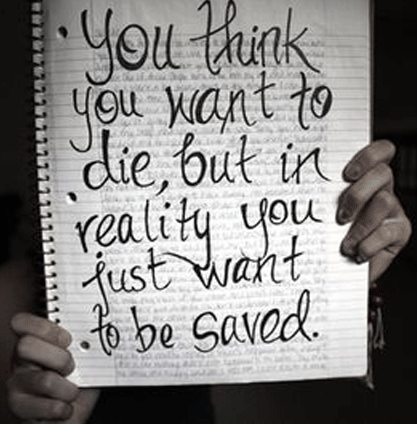
When I ranted about how the media’s incessant desire to get the story was not allowing the people of Newtown to mourn, I did not expect that I’d be mourning the death of a friend a month later. As I’ve tried to come to terms with Aaron’s death, I’ve found myself slipping between personal grief and meta reflection, my primary coping mechanism for dealing. I’ve decided to craft this deeply personal, reflective blog post because I think that it makes sense to think about and discuss what mourning and vulnerability mean in a culture of public-ness.

Last week, I read the story of a Newtown woman who was photographed grieving at a vigil. She voiced her struggle in becoming an icon of the tragedy, understanding the importance of the story but also wanting to be respected as an individual going through her own struggles. This story resonated with me.

Aaron Swartz was a friend of mine. When I woke up three Saturdays ago to learn about his death, I went into complete shock. I spent the day talking with mutual friends, reading heartfelt stories on the internet, and crying. I woke up the next day and while lying in bed, penned my own memorial for my blog. I always struggle with what my blog is, wanting it to be a way of communicating with people who know me while also recognizing that it’s read by many strangers. Still, it’s the best vessel to share with a community of geeks that I love. So I posted my reflections there.

I should’ve known that my blog post would attract the attention of the press. But I wasn’t really processing reality and I hadn’t yet begun to realize that the story would become a mainstream one. On one hand, I was glad. People should know who Aaron was and why what he did was important. On the other hand, I watched as the story took on a life of its own, not just a rallying cry for geeks, but a portrait that I could barely recognize.

I started getting questions from journalists and I panicked. I wrote as politely as I could that I couldn’t do it, I couldn’t be their source. But I also struggled with the very fact of their asking. Yes, I blogged about him, but what right do I have to speak for Aaron? To tell Aaron’s story? I was Aaron’s friend, but like many friends in my world, we ebbed and flowed in terms of closeness over the last 9 years. I was not his lover, I was not his professional collaborator. I had only met his father once and only met his current partner briefly. I knew only a small subset of his social circle. I knew – and adored – a facet of Aaron. But who was I to tell his story? I found myself fretting over how my blog post had created a signal that I didn’t want to to convey. I wanted to express my grief and my fear over how parts of my community were reacting, not claim proximity or define Aaron.

As the funeral rolled around, I scratched my head as to whether or not to go. I hate funerals, but I also knew that many people I cared deeply about were struggling even more than me. And none of us live in the same city. And part of me wanted to support them and show respect. But then I heard people who didn’t know Aaron talking about going because it was “the right thing to do” which was basically code for the notion that everyone who was everyone was going to be there. It also became clear that it was going to be a media event with the possibility of protestors and counter-protesters. And I balked. I couldn’t stomach the idea of simultaneously trying to mourn and trying to deal with a collective performance of mourning. So I stayed put, in a daze.

And then the memorials started up and I was asked to speak. And I realized that I was so not there yet. I was still at the stage of cry and hug. And I was struck by how some of those who he spent his last days with were able to channel their own emotional struggle into a far more productive output than I could possibly muster. I was in awe of their strength, of their commitment. Because I relished the activist in Aaron and I was completely intellectually with them in their efforts to use this moment to make a difference, to speak out against the structural inequities and abuses of power that Aaron was fighting for. But I wasn’t able to be there; I was still in a dark place that wasn’t productive. So I pushed my own escape valve, a privileged valve I’ve learned to use whenever things got dark. I spent my frequent traveler points and went to Miami to hug the sun and the beach and get a grip on my mental state.

I’ve spent a lot of years struggling with my own demons and one of the best parts of growing old for me is that I’ve developed coping mechanisms to identify and deal with my emotional state before I put myself or anyone else at risk. I’m good at getting control over me before running full-speed with my activist goals. This is something that I’m very proud of. But I also look back with a lot of uncertainty because I don’t know how I would’ve gotten here without the internet as it was when I was coming of age.

As I’ve said many times, the internet has been my saving grace. I usually publicly point to the ways in which I have learned about new opportunities and been challenged to think about a world that was bigger than the one that I was inhabiting on a daily basis. But embedded in those positive-minded narratives is the fact that the internet allowed me to be vulnerable and safe in a productive way. I spent countless hours anonymously talking to strangers about my demons without being tracked or identified or outed. I used LiveJournal to be deeply vulnerable among friends in an environment where we all understood that it was a site where you shared your struggles and everyone respected that. I lashed out in ways that helped create friendships as a byproduct of getting help. And I started blogging in a context where putting yourself out there enabled a small community of caring folks to listen and be supportive in all sorts of unique ways.

Today, I don’t have that luxury. My internet is painfully public. My interactions online are heavily constrained by pressures I get from others. When I post something controversial or incomplete, I am consistently publicly attacked and I’m regularly told that this is what I get for choosing to speak in public. I am told that as a public figure, I deserve whatever I get. So when I choose to make myself vulnerable in public, I have to brace myself for attacks. Even my attempt to mourn Aaron generated messages by strangers attacking me for clearly having not been a real friend or else he wouldn’t have died. I’ve learned to roll with these attacks, but they still sting. And I don’t know that my younger self could’ve handled them well. But what I know is that I no longer have an internet where I feel safe to deal with my demons. There are still places where people can carve out that space, but somehow, it never feels safe enough to me anymore.

I realize that this nostalgia for the past is interwoven with a whole set of different issues that make this a self-absorbed lament. But Aaron’s death threw it in my face. Because, on the day that Aaron died, the geeks that I grew up being vulnerable with all let down their guards and wailed through the media that they knew best. And then his death went from creating a weekend of collective sadness and storytelling to an event that took on a life of its own. And I’m left with a discomforting question: where are geeks allowed to be vulnerable today?

With each new geek death by suicide, folks ask what we should do about the depression in our community. I can’t help but think that we’re paying the costs of the public-ness that we’ve helped create. We’ve made geek culture something to watch, an economic engine, a dependency. And in doing so, we haven’t enabled safe spaces to grow. We’ve created communities connected around ideas and actions, relishing individualistic productivity for collective good. But we haven’t created openings for people to be weak and voice their struggles and demons. In short, we don’t know how to support vulnerabilities and rather than debugging the problem, we just hope that if we don’t pay too much attention to them, they’ll go away.

But the pressures of public-ness are forcing us to pay an ugly price. In NYC alone, we’ve lost two geeks in two years because their worlds spun out of control in ways that didn’t leave them with enough strength to grapple with their demons while also trying to make the world a better place. Throughout this country, there are geeks and hackers facing serious pressures by structural power as a byproduct of the public-ness we’ve created. And many of them are also facing serious demons. I’m definitely among those who want to hold political entities accountable for capitalizing on vulnerabilities in their pursuit of the status quo, but I am also hoping that the geek community can figure out a way to make sure that those who are struggling have enough support to fight both their demons and their oppressors. Before we lose another one. The problem is that I genuinely don’t know how.

Print Friendly, PDF & Email