Asimov, reductionist approach to human interaction and YASNS

Yet Asimov’s reductionist approach to human interaction may be his most lasting influence. His thinking is alive and well and likely filling your inbox at this moment with come-ons asking you to identify your friends and rate their “sexiness” on a scale of one to three. Today’s social networking services like Friendster and Orkut collapse the subtle continuum of friendship and trust into a blunt equation that says, “So-and-so is indeed my friend,” and “I trust so-and-so to see all my other ‘friends.'” These systems demand that users configure their relationships in a way that’s easily modeled in software. It reflects a mechanistic view of human interaction: “If Ann likes Bob and Bob hates Cindy, then Ann hates Cindy.” The idea that we can take our social interactions and code them with an Asimovian algorithm (“allow no harm, obey all orders, protect yourself”) is at odds with the messy, unpredictable world. The Internet succeeds because it is nondeterministic and unpredictable: The Net’s underlying TCP/IP protocol makes no quality of service guarantees and promises nothing about the route a message will take or whether it will arrive.

This need for people to behave in a predictable, rational, measurable way recalls Mr. Spock’s autistic inability to understand human emotion without counting dimples to discern happiness or frown lines to identify sorrow. It’s likewise reminiscent of scientology, which uses quantitative charts of personality traits, such as “lack of accord” and “certainty,” to help people become 100 percent happy, composed, and so on.

[From Cory Doctorow’s Rise of the Machines in the current Wired magazine.]

With iRobot about to hit the theatres, Cory’s article addresses how Asimov “turned androids into pop culture icons – and invented the science of robotics in the process.” His account is pretty critical and insightful, reminding me that the science fiction literature that i love should not be considered a complete prescriptive tool because the stories written often fail to address the complexities that exist in everyday life.

eve ensler’s the good body

San Francisco is the home of the premier of Eve Ensler’s new play: The Good Body. Like The Vagina Monologues, this play is a series of monologues. Only, this time, Eve is addressing the entire female body image in general. I’ve heard some of the monologues – they are absolutely fantastic. I strongly encourage anyone who can to attend; it should be a powerful play.

Whether undergoing Botox or living under burkhas, women of all cultures and backgrounds feel compelled to change the way they look in order to fit in with their particular culture, in order to be accepted, in order to be good. In The Good Body, Ensler explores their experiences with monologues representing women from Bombay to Beverly Hills. Delivering narratives collected in locker rooms, cell blocks, boardrooms, and bedrooms, Ensler frames their stories with her own personal journey from a self-loathing teenager to a (sometimes) self-accepting adult. Interspersed throughout are riotous excerpts from Ensler’s lifelong dialogue with her belly-a sassy and conniving antagonist in its own right.

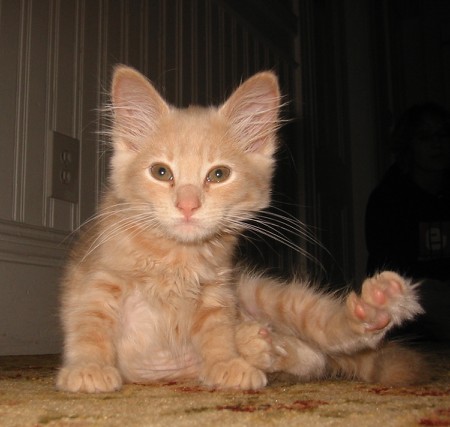
introducing baby kitty

Marble, my cat, has been quite lonely lately. Thus, we got a brilliant idea to bring a sister into her world. Of course, she hasn’t yet accepted this baby kitten, but we’re still hopeful. They say it should take 2 weeks. Marble has stopped hiding, but still won’t get very close. And while i was sleeping last night, Marble came in to sleep with me and found baby kitty and a little hissing fight broke out on my tummy. Introducing baby kitty….

While she looks like super kitty here, i should note that she’s a little bigger than my hand and curls up between my neck and shoulder. She’s super small.

I should note that baby kitty has no formal name yet. I’m inclined to call her Theo; my roommates are fighting for atrocious and disturbing names. She’s just too precious for that. Still not sure…

Oh, and out of complete cuteness, baby kitty woke me at 7AM by licking my eyelids. If it weren’t 7AM, this would’ve been very very very cute. Baby kitty though is a complete joy. She’s happy, relaxed and still spazzy enough to play at times. Now, i just need to convince Marble that this is her friend.

BlogOn: The Business of Social Media


UC-Berkeley will be hosting BlogOn: The Business of Social Media. An all-star cast of speakers are coming to talk about blogs, social networks, syndication and whatnot. Basically, it looks like a great gathering for those interested in social media.

Furthermore, they have discounts for bloggers and i’m very psyched to announce that they have scholarships for students and economically-disadvantaged bloggers. I wish more organized events recognized the importance of getting bright minds involved who don’t have the economic freedom to usually participate in these conversations.

Supernova?

This week is Supernova, my first non-academic tech event in a while. I realized that i have no idea who will be attending. I could be patient and wait, but i’m kinda curious. Who that reads this can i expect to see there?

Fahrenheit 9/11

Michael Moore’s Fahrenheit 9/11 is to appear in theaters next Friday. Say what you want about Moore (i certainly have issues with his work), but get out there and support the film. His battle to get it to theaters has been rife with censorship and unnecessary drama due to the radical anti-Bush content contained in the film. Supporting a film on opening weekend is a political statement; it says to distributers and the public that this movie matters so much that we are willing to put our dollars where our mouths are. For that reason, i believe that everyone should get out there next weekend, see it and make up their own minds. Do not let censorship reign.

anyone here from Singapore?

I’m utterly fascinated with the CaPiTaLiZaTiOn that i see coming out of teen Friendster profiles and blogs in Singapore. But i so desperately want to know more. Does anyone know?

1) How does this work? Do people use the shift key to get that or is it somehow built in?
2) Why is it used? What does it mean?
3) Who all uses it? Age, location, etc.

Stanley Milgram’s biography

There are two researchers who i think absolutely everyone doing social anything should know: Stanley Milgram and Erving Goffman. Thus, i was overjoyed when i learned that there’s a biography on Milgram (tx David). Many folks know Milgram for his work on small worlds (later called “6 degrees” by others). Milgram also developed a set of psychological experiments (written up in Obedience to Authority) that helped show how people will always follow any orders they are given and that those in power are so removed from the situation that they can demand horrifying tasks that will then be executed (think Nazis… or maybe a prison scandal). In some of his lesser known work, Milgram wrote about ideas like familiar strangers where people who recognize each other build up a very interesting social bond. Some of his short essays are collected in The Individual In A Social World