Yearly Archives: 2009

Race and Social Network Sites: Putting Facebook’s Data in Context

A few weeks ago, Facebook’s data team released a set of data addressing a simple but complex question: How Diverse is Facebook? Given my own work over the last two years concerning the intersection of race/ethnicity/class and social network sites, I feel the need to respond. And, with pleasure, I’m going to respond by sharing a draft of a new paper.

But first, I want to begin by thanking the Facebook data team for actually making this data available for public dialogue. Far too few companies are willing to share their internal analyses, especially about topics that make people uncomfortable. I was disappointed that so many academics immediately began critiquing Facebook rather than appreciating the glimpse that we get into the data they get to see. So thank you Facebook data team!

There are many different ways to collect quantitative data involving categories like race, ethnicity, class, gender, sexuality, etc. None of them are perfect. Even asking people to self-identify can be fraught, especially when someone is asked to place themselves into a box. Ask a self-identified queer boi to identity into the binaries of “female/male” and “gay/straight” and you’ll see nothing short of explosive anger. Race certainly isn’t any prettier, let alone ethnicity or class. The salience of these qualities also depends on what we’re trying to measure, what we’re trying to say. For example, if we’re talking about people who experience being targets of racism, should we concern ourselves more with self-identification or external labeling? At the coarsest level, we often assume race to boil down to skin color, meaning that we have to take into account how people read race, how they experience race, how they identify with race. We must always remember that race is a social construct and one’s experiences of race are shaped by how one perceives themselves in relation to others and how others perceive them. And the very notion of race differs across the globe.

Of course, this is bloody messy. And ethnicity and class are even harder to locate because self-identification isn’t always the best measure. Heck, while Americans have learned to self-identify with race (thanks to countless forms), we aren’t typically asked to self-identify with ethnicity or class. So these are pretty murky territories. As a result, scholars and demographers and marketers and many others have different ways of trying to measure these categories. None are perfect. We can debate endlessly about which is better but, personally, I think that does the conversation a disservice.

In trying to measure race (and, partially, ethnicity) of its users without having self-identification, Facebook decided to use a statistical technique known as mixture-modeling to make a best guess as to the racial makeup of its user base. They go to great lengths explaining what they did, but it is this graph that we should be attentive to:
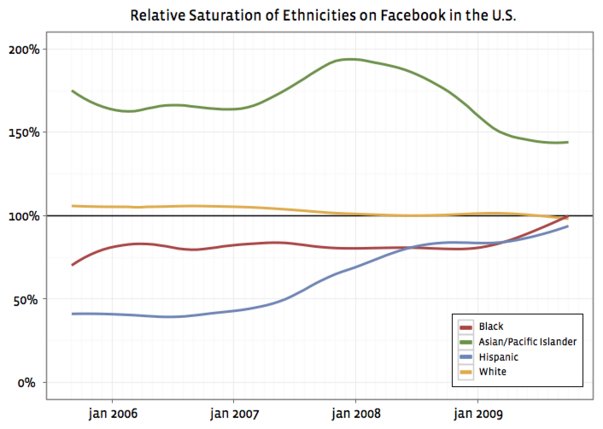
This graph highlights that those American users most likely to be white were overrepresented on Facebook until last year while those most likely to be Asian have been overrepresented as far back as they are measuring. Yet, the two lines that should pique our interest are the blue and red lines, highlighting that those most likely to be black and Hispanic have been underrepresented until very recently. In other words, 2009 is the year in which Facebook went “mainstream” among all measured racial/ethnic groups in the U.S.

Folks keep asking me if this surprises me. It does not. This very much matches what I’m seeing in the field. (It also confirms what I was seeing in 2006-2007.) But it also doesn’t tell the whole story. Numbers never do. MySpace has definitely declined among young users in the U.S., especially in the last 12 months, but race – and ethnicity and socio-economic status – still inflect people’s experiences with these technologies. Just because Facebook has become broadly adopted does not mean that what everyone experiences on Facebook is the same. I would LOVE LOVE LOVE to see Facebook data that broke down app usage by demographic data (age, location, gender, and their measure of race). Given what I’m seeing in the field, I’d expect you’d see variation. I’d also expect to see variation in terms of how the service is accessed – via mobile, web, 3rd party APIs, etc. As young people tour me through their Facebook experience, I’m regularly reminded that different groups have wholly different experiences with the same service. As Facebook has become a platform, it is no longer reasonable to simply think about access. There’s also a different issue at play… perception. People perceive certain practices to be universal because “everyone they know” is doing it that way. One of the hardest parts of my job is to explain to people that what they are seeing, what they are experiencing, is not the same as what others are. Even if they’re using the same tools.

When the “digital divide” conversations started up, folks boiled down the discussion to being one of access. If only everyone had access, everything would be hunky dory. We’re closer to universal access today than ever before, but access is not bringing us the magical utopian panacea that we all dreamed of. Henry Jenkins has rightly pointed out that we see the emergence of a “participation gap” in that people’s participation is of different quantity and quality depending on many other factors. Social media takes all of this to a new level. It’s not just a question of what you get to experience with your access, but what you get to experience with your friend group with access. In other words, if you’re friends with 24/7 always-on geeks, what you’re experiencing with social media is very different than if you’re experiencing social media in a community where your friends all spend 12+ hours a day doing a form of labor that doesn’t allow access to internet technologies. Facebook’s data provides a glimpse into how Facebook access has become mainstream. It is the modern day portal. But I would argue that what people experience with this tool – and with the other social media assets they use – looks very different based on their experience.

Many folks think that I care about access. Don’t get me wrong – access is important. But I’m much more concerned about how racist and classist attitudes are shaping digital media, how technology reinforces inequality, and how our habit of assuming that everyone uses social media just like we do reinforces social divisions that we prefer to ignore. This issue became apparent to me when doing fieldwork because of the language that young people were using to differentiate MySpace and Facebook. Adoption differences alone were never the whole story. Ever since I released my controversial blog essay 2.5 years ago, I have been working to write up my data and analysis in a meaningful way. Doing so has not been easy. I’ve been very uncomfortable handling my own data, trying to treat it in a manner that is respectful of the teens that I interviewed and the dynamics that I witnessed. Thankfully, Lisa Nakamura and Peter Chow-White gave me the space to work out these issues. The fruit of my labor will be published in an upcoming Routledge anthology edited by them called Digital Race Anthology. With their permission, I am sharing with you a working draft of the article that I have struggled to produce:

“White Flight in Networked Publics? How Race and Class Shaped American Teen Engagement with MySpace and Facebook”

In this article, I explore the themes I’ve been discussing for years but focus specifically on the language that young people used to differentiate MySpace and Facebook and how that language can be understood through the historical dynamics of segregation in the U.S. My decision to use the “white flight” frame is meant to be provocative, to encourage the reader to think about the rhetoric that we’re currently using and its parallels to earlier times. For example, how we employ “safety” as a way of marking turf and segmenting populations.

Given the conversations prompted by Facebook’s data, I felt the need to share this work-in-progress. Please feel free to comment or share your thoughts in whatever format makes sense to you.
“Do you See What I See?: Visibility of Practices through Social Media”

Knowing that I was going to speak at two different events within a week of one another to distinctly different audiences needing to hear a similar message, I decided to craft one talk for both Supernova and Le Web. This talk is one of my more serious talks, looking at problematic practices in social media and inviting the audience to do something about it. Fundamentally, it’s a talk about visibility… about our ability to see what’s happening in the world thanks to the Internet. And about our needs to ask ourselves what kind of world we want to live in.

As always, I’ve made my crib available:

“Do you See What I See?: Visibility of Practices through Social Media”

If you’d prefer to listen to what I actually said (since I’m terrible at sticking to the crib), you might want to check out the video from Le Web or the video from Supernova (with the beautifully complementary talk by Adam Greenfield). Enjoy!

Sociality Is Learning

This post was originally written for the DML Central Blog. If you’re interested in Digital Media and Learning, you definitely want to check this blog out.

As adults, we take social skills for granted… until we encounter someone who lacks them. Helping children develop social skills is viewed as a reasonable educational endeavor in elementary school, but by high school, educators switch to more “serious” subjects. Yet, youth aren’t done learning about the social world. Conversely, they are more driven to understand people and sociality during their tween and teen years than as small children. Perhaps its precisely their passion for learning sociality that devalues this as learning in the eyes of adults. For, if youth LIKE the subject matter, it must not be educational. Unfortunately, I fear that we are doing a disservice to youth by not acknowledging the social learning that takes place during this period. Worse, what if our efforts to curtail social interactions out of a preference for “real” learning have professional costs?

Very few of us work in professions where we are forced to focus on one anti-social task all day, every day. Even academics, a notoriously hermitic bunch, have to interact with students, fellow faculty members, and perhaps grant makers at some point. Most of us are constantly relying on and honing our social skills, developing new techniques to communicate our message, navigate office politics, manage someone’s expectations, and keep the peace. Those in service jobs face this in an acute way, having to manage irate customers and balance many people at once. Social skills are the bread and butter of professional life. So how do we learn them?

It’s easy to point to middle school as ground zero of youth drama. The rise of status hierarchies combined with budding sexuality throws all sorts of relationships upside down. Bullying, social categories, and popularity are all there. But the key to “surviving” middle school is learning how to navigate these muddy waters with an intact self-esteem. It’s not that jealousy and other social dramas disappear after middle school; it’s that they get much more nuanced as people’s skills improve. But for people to improve their skills, they must learn how to manage unpredictable and uncomfortable social situations. These aren’t skills learned in abstract; they’re learned through practice.

Over the last three decades, youth lives have gotten increasingly structured. Many youth spend little to no time in unstructured social settings, otherwise known as “hanging out.” The practice of hanging out is consistently demonized by educationally-minded folks as a waste of time. Yet, it is in that space where youth learn to navigate social situations, make sense of impression management, and develop the social skills necessary to be productive adults.

Social media has created an interesting rupture in the landscape. Youth turn to it to reclaim unstructured social encounters, to create a public space that allows them to simply hang out with their friends, peers, and cohort. The flirting, gossiping, and joking around that takes place is not proof that social media is useless, but proof that it’s extremely valuable. Without other spaces in which to gather, youth have developed their own. They want to be social, but we also need them to develop social skills. What’s fascinating is that they’re learning to do so in a mediated landscape, developing norms that will persist through adulthood. It’s not like all social encounters between adults are face-to-face; learning how to interpret a Facebook post is a great skill to have when entering an email-centric corporation.

Rather than demonizing social media or dismissing its educational value, I believe that we need to embrace the environments that youth are using to gather and help them learn to navigate the murky waters of sociality. We cannot “fix” their social worlds, but we can provide the scaffolding that they need to help learn to make sense of sticky social situations. We can serve as listeners, guides, and cheerleaders. We can be there when they’re trying to make a decision about a best way to handle a situation and play devil’s advocate when they need to work through complicated dynamics. But to be there for youth, we have to treat them with respect and value what they’re learning. We have to value the importance of learning about sociality. And we need to be able to listen as confidants, not judges.

We can continue to demonize social spaces, dismiss hanging out, and overly regulate our kids. But I believe this does them a disservice. Being a successful adult in society requires social skills. And we desperately need to give youth space to learn them. They’re committed to learning; why aren’t we supporting them in doing so?

Originally posted here.

—-

French translation by Marie Helene Visconti:

La socialité est un apprentissage:

En tant qu’ adultes, nous considérons les compétences sociales comme données… jusqu’à ce que nous rencontrions quelqu’un qui en manque. Aider les enfants à développer des compétences sociales est vu comme un projet éducatif raisonnable en élémentaire, mais dans le secondaire, les éducateurs passent à des sujets plus sérieux. Cependant, les jeunes n’ont pas fini d’apprendre sur le monde social. Inversement, ils sont plus amenés à comprendre les gens et la socialisation pendant la préadolescence et l’adolescence que lorsqu’ils étaient petits enfants. Peut-être est-ce leur passion à apprendre la socialisation qui dévalue ceci comme apprentissage dans le regard des adultes. Parce que si les jeunes aiment le sujet, il ne doit pas être éducatif. Malheureusement, je crains que nous ne rendions pas service aux jeunes en ne reconnaissant pas l’apprentissage social qui se produit durant cette période. Pire, et si nos efforts pour réduire les interactions sociales à cause d’une préférence pour le « vrai » savoir avaient un coût professionnel.

Bien peu d’entre nous travaillent dans des professions où nous sommes forcés de nous focaliser sur une tâche solitaire toute la journée, chaque jour. Même les universitaires, un groupe d’ermites notoires, doivent interagir avec les étudiants, leurs collègues et peut-être les donateurs à certains moments. La plupart d’entre nous nous appuyons constamment sur nos compétences sociales que nous aiguisons, développant de nouvelles techniques pour communiquer notre message, naviguer dans la politique d’entreprise, gérer les attentes de quelqu’un et maintenir la paix. Ceux qui sont dans le secteur des services sont confronté à celà de façon aigüe, ayant à gérer des consommateurs irrités et à s’occuper de plusieurs personnes en même temps. Les compétences sociales sont le pain et le beurre de notre vie professionnelle. Alors comment les apprenons nous ?

Il est facile de désigner le collège comme point de départ du drame de la jeunesse. La montée des hiérarchies de statuts combinée avec la sexualité bourgeonnante met sans dessus dessous toutes sortes de relations. Le harcèlement, les catégories sociales et la popularité sont pleinement là. Mais la clé pour « survivre » au collège est d’apprendre à naviguer dans ces eaux troubles en gardant l’estime de soi intacte. Ce n’est pas que la jalousie et les autres drames sociaux disparaissent après le collège ; c’est qu’ils deviennent plus nuancés à mesure que les gens amélioent leurs compétences. Mais pour que les gens améliorent leurs compétences, ils doivent apprendre à gérer les situations sociales imprévisibles et inconfortables. Ces compétences ne sont pas apprises en théorie ; elles sont apprises par la pratique.

Pendant les trois dernières décades, la vie des jeunes s’est structurée de façon croissante. Beaucoup de jeunes passent de peu à aucun temps dans des environnements non structurés socialement, autrement dit à « traîner ». La pratique de l’activité traîner est constamment diabolisée par les personnes à l’esprit éducatif en tant que perte de temps. Cependant, c’est dans cet espace que les jeunes apprennent à naviguer dans des situations sociales, à maîtriser la gestion de l’impression et à développer les capacités sociales nécessaires pour être des adultes protecteurs.

Les média sociaux ont créé une rupture intéressante dans ce paysage. Les jeunes se tournent vers eux pour retrouver des rencontres sociales non structurées, pour créer un espace public qui les autorisent à tout simplement traîner avec leurs amis, pairs et cohorte. Le flirt, les potins et les plaisanteries qui y prennent place ne sont pas la preuve que les médias sociaux sont inutiles, mais la preuve qu’ils ont une immense valeur. Sans d’autres espaces pour se rassembler, la jeunesse a développé les siens. Ils veulent être sociaux, mais nous avons aussi besoin qu’ils développent des capacités sociales. Ce qui est fascinant, c’est qu’ils sont en train d’apprendre à le faire dans un paysage médiatique, développant des normes qui persisteront à l’âge adulte. Ce n’est pas comme si toutes les rencontres sociales entre adultes se passaient en face à face ; apprendre à interpréter un post facebook est une compétence précieuse à posséder lorsqu’on entre dans une entrepise organisée autour du mail.

Plutôt que diaboliser les média sociaux ou nier leur valeur éducative, je crois que nous devons nous engager dans l’environnement que les jeunes utilisent pour se réunir et les aider à naviguer dans les eaux troubles de la sociabilité. Nous ne pouvons pas arranger leurs mondes sociaux, mais nous pouvons fournir les échafaudages dont ils ont besoin pour apprendre à se débrouiller des situations sociales délicates. Nous pouvons servir d’auditeurs, guides et cheerleaders. Nous pouvons être là quand ils sont en train d’essayer de décider de la meilleure façon de gérer une situation et jouer l’avocat du diable lorsqu’ils ont besoin d’évoluer à travers des dynamiques complexes. Mais pour être là pour les jeunes, nous devons les traiter avec respect et valoriser ce qu’ils sont en train d’apprendre. Nous devons reconnaître l’importance d’apprendre sur la sociabilité. Et nous devons être capables d’écouter en confidents, pas en juges.

Nous pouvons continuer à diaboliser les espaces sociaux, interdire l’activité « traîner » et excessivement réguler nos enfants. Mais je crois que nous leur rendons alors l’inverse d’un service. Etre un adulte qui réussit en société demande des compétences sociales. Et nous avons un besoin crucial de donner aux jeunes l’espace pour les apprendre. Ils sont motivés pour apprendre; pourquoi ne les soutenons nous pas?

spectacle at Web2.0 Expo… from my perspective

Last week, I gave a talk at Web2.0 Expo. From my perspective, I did a dreadful job at delivering my message. Yet, the context around my talk sparked a broad conversation about the implications of turning the backchannel into part of the frontchannel. In the last week, I’ve seen all sorts of blog posts and tweets and news articles about what went down. At this point, the sting has worn off and I feel that it would be responsible to offer my own perspective of what happened.
First, context. Web2.0 Expo is an expensive conference filled with all sorts of webby types, entrepreneurs, and business folks interested in technological development. It’s a conference known for great talks by high profile people. Most of the talks are pretty conversational in nature – there are plenty of staged interviews and casual presentations.

Because of the high profile nature of Web2.0 Expo, I decided to write a brand new talk. Personally, I love the challenge and I get bored of giving the same talk over and over and over again. Of course, the stump speech is much more fluid, much more guaranteed. But new talks force folks to think differently and guarantee that I target those who hear me talk often and those who have never seen me talk before.

A week before the conference, I received word from the organizers that I was not going to have my laptop on stage with me. The dirty secret is that I actually read a lot of my talks but the audience doesn’t actually realize this because scanning between my computer and the audience is usually pretty easy. So it doesn’t look like I’m reading. But without a laptop on stage, I have to rely on paper. I pushed back, asked to get my notes on the screen in front of me, but was told that this wasn’t going to be possible. I was told that I was going to have a podium. So I resigned to having a podium. Again, as an academic, I’ve learned to read from podiums without folks fully realizing that I am reading.

When I showed up at the conference, I realized that the setup was different than I imagined. The podium was not angled, meaning that the paper would lie flat, making it harder to read and get away with it. Not good. But I figured that I knew the talk well enough to not sweat it.

I only learned about the Twitter feed shortly before my talk. I didn’t know whether or not it was filtered. I also didn’t get to see the talks by the previous speakers so I didn’t know anything about what was going up on the screen.

When I walked out on stage, I was also in for a new shock: the lights were painfully bright. The only person I could see in the “audience” was James Duncan Davidson who was taking photographs. Otherwise, it was complete white-out. Taken aback by this, my talk started out rough.

Now, normally, I get into a flow with my talks after about 2 minutes. The first two minutes are usually painfully rushed and have no rhythm as I work out my nerves, but then I start to flow. I’ve adjusted to this over the years by giving myself 2 minutes of fluff text to begin with, content that sets the stage but can be ignored. And then once I’m into a talk, I gel with the audience. But this assumes one critical thing: that I can see the audience. I’m used to audiences who are staring at their laptops, but I’m not used to being completely blinded.

Well, I started out rough, but I was also totally off-kilter. And then, within the first two minutes, I started hearing rumblings. And then laughter. The sounds were completely irrelevant to what I was saying and I was devastated. I immediately knew that I had lost the audience. Rather than getting into flow and becoming an entertainer, I retreated into myself. I basically decided to read the entire speech instead of deliver it. I counted for the time when I could get off stage. I was reading aloud while thinking all sorts of terrible thoughts about myself and my failures. I wasn’t even interested in my talk. All I wanted was to get it over with. I didn’t know what was going on but I kept hearing sounds that made it very clear that something was happening behind me that was the focus of everyone’s attention. The more people rumbled, the worse my headspace got and the worse my talk became. I fed on the response I got from the audience in the worst possible way. Rather than the audience pushing me to become a better speaker, it was pushing me to get worse. I hated the audience. I hated myself. I hated the situation. I wanted off. And so I talked through my talk, finishing greater than 2 minutes ahead of schedule because all I wanted was to be finished. And then I felt guilty so I made shit up for a whole minute and left the stage with 1 minute to spare.

I walked off stage and immediately went to Brady and asked what on earth was happening. And he gave me a brief rundown. The Twitter stream was initially upset that I was talking too fast. My first response to this was: OMG, seriously? That was it? Cuz that’s not how I read the situation on stage. So rather than getting through to me that I should slow down, I was hearing the audience as saying that I sucked. And responding the exact opposite way the audience wanted me to. This pushed the audience to actually start critiquing me in the way that I was imagining it was. And as Brady went on, he said that it started to get really rude so they pulled it to figure out what to do. But this distracted the audience and explains one set of outbursts that I didn’t understand from the stage. And then they put it back up and people immediately started swearing. More outbursts and laughter. The Twitter stream had become the center of attention, not the speaker. Not me.

Yes, I cried. Yes, I left Web2.0 Expo devastated. I hate giving a bad talk but I also felt like I was being laughed at. People tried to smooth it over, to tell me that I was OK, that it wouldn’t matter, that they liked the talk. But no amount of niceness from friends or strangers could make up for the 20 minutes in which I was misinterpreting the audience and berating myself. Nothing the audience could say could make up for what I was thinking about myself while on stage. So I went for a massage. And I spent 90 minutes trying to tell myself that I am a lovable creature. And when that wasn’t working, I told myself to suck it up and deal. I knew that if I could convince myself to look like everything was OK that eventually I would believe it. Or at least that it would all go away.

Being on stage involves raw emotions. I have never gotten over the rawness of it all. I no longer vomit before every talk (although I used to) but my stomach does try to do the macarena. Or, more likely, the ridiculous dance done by 80s hair bands as they thrash about. I can’t eat before I give a talk. And I visit the bathroom a bazillion times. Even when I’m brilliant on stage, I’m nervous as hell. But it’s also emotionally and physically exhausting. I walk off the stage high as a kite and then, two hours later, crash. Giving talks drains me. It’s brutal to try to publicly convey information, to be the center of attention. I much much much prefer to be the one observing than the one speaking. But I feel like giving talks is important. So I speak. But it ain’t easy. And so when I walk off a stage not feeling invigorated, all I get is the raw drain, the gut-wrenching, nauseating feeling of pure misery. 20 minutes of being punched in the face, kicked in the stomach, and the shameful sensations one gets when one is forced to watch a Lars von Trier film. That’s how I felt at Web2.0 Expo.

So…. the Backchannel?

Now that you’ve been forced to read my inner neuroses on public display, let’s talk about making the backchannel the frontchannel. First off, let’s be clear: I could not and did not see the Twitter stream from stage. Nothing was conveyed to me until the end. The stream was not a way for the audience to communicate to the speaker, but for the audience to communicate with itself. Lots of folks have talked about making the stream available to the speaker. Have any of you seen ustream? This is filled with “speakers” reading the stream and it’s very choppy. There’s no way that a speaker can simultaneously consume a stream and convey a message. Sure, a message every 30 seconds or so, no problem. But a stream? No way. And certainly not a long message… and, on stage, 140 characters is long.

Let me highlight a comment that Dan from HonestlyKid.net left on my blog earlier this week:

It seems that the more subtle the speaker’s point, the more impatient and nasty the audience became. While it’s easy enough to blame the new tech in the room for this shoddy behavior, I’m not sure we’re seeing anything new at all here. It certainly didn’t feel new to me from where I sat. Consider the recent Town Hall meetings around health care – substantive discussions of important issues were subsumed in cat calls and shouted rumors.

That said, having participated in this bad behavior, I noticed something else about the way it felt to put something on that wall. The twitterwall subverted twitter’s more symmetric conversation model of communication. Posting to the wall was like creating and sharing a public secret about the speaker (a little like political grafiti except it wasn’t anonymous).

The wall made a spectacle of the crowd’s impatience and anxiety feeding on the speaker’s inability to respond. That spectacle united us not as a single group receiving challenging ideas from a thoughtful orator but as quite separate individuals struggling to listen, read, respond, and make sense of the event. We moved from web conference to twitter circus.

I think that Dan nailed it. I think that the backchannel is perfectly reasonable as a frontchannel when the speaker is trying to entertain, but when the goal is to convey something with depth, it encourages people to be impatient and frustrated, to feed on the speaker. There’s a least common denominator element to it. I was not at Web2.0 Expo to entertain, but to inform. Yes, I can be an entertaining informant, but there’s a huge gap between the kind of information that Baratunde tries to convey in his comedic format and what I’m trying to convey in a more standard one. And there’s no doubt I packed too much information into a 20 minute talk, but my role is fundamentally to challenge audiences to think. That’s the whole point of bringing a scholar to the stage. But if the audience doesn’t want to be challenged, they tune out or walk out. Yet, with a Twitter stream, they have a third option: they can take over.

The problem with a public-facing Twitter stream in events like this is that it FORCES the audience to pay attention the backchannel. So even audience members who want to focus on the content get distracted. Most folks can’t multitask that well. And even if I had been slower and less dense, my talks are notoriously too content-filled to make multi-tasking possible for the multi-tasking challenged. This is precisely why I use very simplistic slides that evokes images for the visual types in the room without adding another layer of content. But the Twitter stream fundamentally adds another layer of content that the audience can’t ignore, that I can’t control. And that I cannot even see.

Now, I’m AOK with not having complete control of the audience during a talk, but it requires a fundamentally different kind of talk. That was not what I prepared for at all. Had I known about the Twitter stream, I would’ve given a more pop-y talk that would’ve bored anyone who has heard me speak before and provided maybe 3-4 nuggets of information for folks to chew on. It would’ve been funny and quotable but it wouldn’t have been content-wise memorable. Perhaps that would’ve made more sense? Realistically though, those kinds of talks bore me at this point. So I probably would’ve opted not to give a talk at all. Perhaps I’m not the kind of speaker you want if you want a Twitter stream? But regardless, what I do know is that certain kinds of talks do not lend themselves to that kind of dynamic. I would *NEVER* have given my talk on race and class in such a setting. I shudder to think about how the racist language people used when I gave that talk would’ve been perceived on the big screen.

Speaking of which… what’s with the folks who think it’s cool to objectify speakers and talk about them as sexual objects? The worst part of backchannels for me is being forced to remember that there are always guys out there who simply see me as a fuckable object. Sure, writing crass crap on public whiteboards is funny… if you’re 12. But why why why spend thousands of dollars to publicly objectify women just because you can? This is the part that makes me angry.

Now, I don’t mind being critiqued. I think that being a public figure automatically involves that. I’ve developed a pretty thick skin over the years, but there are still things that get to me. And the situation at Web2.0 Expo was one of those. Part of the problem for me is that, as a speaker, I work hard to try to create a conversation with the audience. When it’s not possible or when I do a poor job, it sucks. But it also really sucks to just be the talking head as everyone else is having a conversation literally behind your back. It makes you feel like a marionette. And frankly, if that’s what public speaking is going to be like, I’m out.

I don’t want to be objectified when I’m speaking – either as a talking head or a sexual toy. I want to inspire, to invite you to think, to spark creative thoughts in your head. At Web2.0 Expo, I failed. And I failed publicly. I’m still licking my wounds. But I can take the fall. I can’t take the idea that this is the future.

So I have a favor to ask… I am going to be giving a bunch of public speaking performances at web conferences in the next couple of months: Supernova and Le Web in December, SXSW in March, WWW in April. I will do my darndest to give new, thought-provoking talks that will leave your brain buzzing. I will try really really hard to speak slowly. But in return, please come with some respect. Please treat me like a person, not an object. Come to talk with me, not about me. I’m ready and willing to listen, but I need you to be as well. And if you don’t want to listen, fine, don’t. But please don’t distract your neighbors with crude remarks. Let’s make public speaking and public listening an art form. Maybe that’s too much to ask for, but really, I need to feel like it’s worth it again.

For those looking for the text of my Web2.0 Expo talk, it’s here: “Streams of Content, Limited Attention: The Flow of Information through Social Media.”

Call for descriptions: online safety programs

The Risky Behaviors and Online Safety track of the Youth and Media Policy Working Group Initiative at the Berkman Center for Internet & Society at Harvard University is creating a Compendium of youth-based Internet safety programs and interventions. We are requesting organizations, institutions, and individuals working in online youth safety to share descriptions of their effective programs and interventions that address risky behavior by youth online. We are particularly interested in endeavors that involve educators, social services, mentors and coaches, youth workers, religious leaders, law enforcement, mental health professionals, and those working in the field of public or adolescent health.

Program descriptions will be made publicly available. Exemplary programs will be spotlighted to policy makers, educators, and the public so that they too can learn about different approaches being tried and tested. Submissions also will be used to inform recommendations for future research and program opportunities.
Submissions should be documentations of solutions, projects, or initiatives that address at least one of the following four areas being addressed:

  • Sexual solicitation of and sex crimes involving minors
  • Bullying or harassment of minors
  • Access to problematic or illegal content (including pornographic and violent content)
  • Youth-generated problematic or illegal content (including sexting and self-harm sites)

We are especially keen to highlight projects that focus on underlying problems, risky youth behavior, and settings where parents cannot be relied upon to help youth. The ideal solution, project, or initiative will be grounded in research-driven knowledge about the risks youth face rather than generalized beliefs about online risks. Successful endeavors will most likely recognize that youth cannot simply be protected, but must be engaged as active agents in any endeavor that seeks to help youth.

Please forward this call along to any organizations and individuals you think would be able to share information about their successful experiences and programs.

Should you have any questions, please contact us: ymps-submissions@cyber.law.harvard.edu.

Web2.0 Expo Talk: Streams of Content, Limited Attention

I prepared a new talk today for Web2.0 Expo that I wanted to share with you:

“Streams of Content, Limited Attention: The Flow of Information through Social Media”

The talk is about the shifts in information flow thanks to new kinds of technology, focusing on some of the challenges that we face because of the shifts going on.

Unfortunately, my presentation at Web2.0 Expo sucked. The physical setup was hard and there was a live stream behind me. I knew something was wrong because folks started laughing in the audience. Unable to see anything (the audience, the stream), I found myself closing down. And so I collapsed and read the whole thing, feeling mega low on energy and barely delivering my points. Le sigh. I feel like I failed the audience so, if you were in the audience, I’m sorry. But hopefully you’ll get more out of reading the presentation than I got out of giving it.

Hanging Out, Messing Around, and Geeking Out

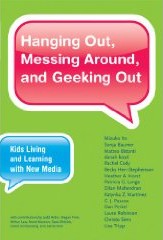
I am delighted to announce that “Hanging Out, Messing Around, and Geeking Out: Kids Living and Learning with New Media” is now in the wild and available! This book was written as a collaborative effort by members of the Digital Youth Project, a three-year research effort funded by the John D. and Catherine T. MacArthur Foundation and conducted at the University of California, Berkeley, and the University of Southern California. The project was spearheaded by Mimi Ito and my late advisor Peter Lyman. I had the honor of being one of the members of this group and led one of the chapters in this book (the one on “Friendship”). If you’re trying to understand the diversity of youth practices involving new media, this is a book for you!

Conventional wisdom about young people’s use of digital technology often equates generational identity with technology identity: today’s teens seem constantly plugged in to video games, social networks sites, and text messaging. Yet there is little actual research that investigates the intricate dynamics of youth’s social and recreational use of digital media. “Hanging Out, Messing Around, and Geeking Out” fills this gap, reporting on an ambitious three-year ethnographic investigation into how young people are living and learning with new media in varied settings-at home, in after school programs, and in online spaces. By focusing on media practices in the everyday contexts of family and peer interaction, the book views the relationship of youth and new media not simply in terms of technology trends but situated within the broader structural conditions of childhood and the negotiations with adults that frame the experience of youth in the United States.

Integrating twenty-three different case studies-which include Harry Potter podcasting, video-game playing, music-sharing, and online romantic breakups-in a unique collaborative authorship style, “Hanging Out, Messing Around, and Geeking Out” is distinctive for its combination of in-depth description of specific group dynamics with conceptual analysis.

You can also download a PDF of the book, thanks to MIT Press. All proceeds from purchases of the book go to the Peter Lyman Graduate Fellowship in New Media at the University of California-Berkeley.

This project was one of many funded by the MacArthur Foundation to explore digital media and learning. New projects in this area are being aggregated through the Digital Media and Learning Hub. If you are interested in this area of work, you should also consider attending the first annual Digital Media and Learning Conference in February in San Diego.

Choosing the Right Grad School

Lately, I’ve been getting all sorts of emails from folks applying to grad school who are seeking advice. I noticed that I was starting to say the same thing over and over again so I thought maybe it’d be better off to write some of it down in a more publicly consumable way. So here goes…

Choosing the Right Grad School

If there are faculty or students out there reading this, I’d love your comments and suggestions too. I know that we all have different advice we give to potential grad students so I know that this isn’t the end-all-be-all. Please feel free to comment, send links to your own advice columns, or just tell me that I’m wrong. There are loads of potential students out there lost and confused so hopefully this’ll help in some small way.

Also, make sure that you read PhD Comics for a good laugh and Eszter Hargittai’s Ph.Do column for some sound advice on being a PhD student.

(Note: I’ve created a separate page because I plan on updating this as my thoughts on the matter change.)

Some thoughts on Twitter vs. Facebook Status Updates

The functional act of constructing a tweet or a status update is very similar. Produce text in roughly 140 characters or less inside a single line text box and click a button. Voila! Even the stream based ways in which the text gets consumed look awfully similar. Yet, the more I talk with people engaged in practices around Twitter and Facebook, the more I’m convinced these two things are not actually the same practice. Why? Audience.

There are two critical structural differences between Facebook and Twitter that are essential to understand before discussing the practices: 1) social graph directionality; 2) conversational mechanisms.

Facebook’s social graph is undirected. What this means is that if I want to be Friends with you on Facebook, you have to agree that we are indeed Friends. Reciprocity is an essential cultural practice in Facebook (although they are trying to rip out the functional requirement as it relates to status updates, arguably to compete with Twitter). Twitter, on the other hand, is fundamentally set up to support directionality. I can follow you without you following me. Sure, I can’t DM you in this case, but I’m still consuming your updates. Yes, yes, yes, privacy settings complicate both of these statements. But for the majority of users of each site, this is the way it goes. Stemming from this are a whole lot of social norms about who’s following who and who’s consuming who’s content. It’s pretty clear that the Celebrity will get followed without reciprocating on Twitter, but there’s also a tremendous opportunity for everyday individuals to develop a following. It’s not just the Celebrities who are following different people than the people who follow them; it’s nearly everyone (except for those who think that auto-follow bots relieve social tensions).

On Facebook, status updates are placed on one’s Wall. This allows anyone else (among those with permission) to comment on the update. This creates a conversational space as it is quite common for people to leave comments on updates. Conversely, on Twitter, to reply to someone’s tweet, one produces an at-reply on their own stream. Sure, the interlocutor can read it in their stream of at-replies, but it doesn’t actually get seen or produced on their own page. Thus, a person’s Twitter page is truly the product of their self-representation, not the amalgamation of them and their cohort.

So, practices.. how does this affect practices?

Those using Facebook are primarily concerned with connecting with those that they know (or knew in high school). The status updates are an invitation to conversation, a way of maintaining social peripheral awareness among friends and acquaintances. They’re about revealing life as it happens so as to be part of a “keeping up” community.

Arguably, Twitter began this way, if only because the geeks and bloggers who were among the early adopters were a socially cohesive group. Yet, as the site has matured, the practices have changed (and I’ve watched a whole lot of early adopters who weren’t part of the professional cohort leave). For the most visible, Twitter is a way of producing identity in a public setting. This is where you see personal branding as central to the identity production going on there. It’s still about living in public, but these folks are aware of being seen, of having an audience if you will. Twitter also enables a modern incarnation of parasocial relations. Sure, there are one-sided relationships on Facebook too, but they are far more the norm on Twitter. I can follow the details of a Celebrity’s life without them ever knowing I exist. At the same time, there’s the remote possibility of them responding which is what complicates traditional parasocial constructs. Angelina Jolie could never see me reading about her in the gossip mags and commenting on her latest escapades, but, if she were on Twitter, she could sense my watching her and see my discussion of her. That’s part of what is so delightfully tempting for Celebs.

In short, the difference between the two has to do with the brokering of status. With Facebook, the dominant norm is about people at a similar level of status interacting. On Twitter, there’s all sorts of complicated ways in which status is brokered. People are following others that they respect or worship and there’s a kind of fandom at all levels. This is what Terri Senft has long called “micro-celebrity.” Alice Marwick has been extending Terri’s ideas to think about how audience is brokered on Twitter (paper coming soon). But I think that they’re really critical. What makes Twitter work differently than Facebook has to do with the ways in which people can navigate status and power, follow people who don’t follow them, at-reply strangers and begin conversations that are fundamentally about two individuals owning their outreach as part of who they are. It’s not about entering another’s more private sphere (e.g., their Facebook profile). It’s about speaking in public with a targeted audience explicitly stated.

As you can see, I’m not quite there with my words on this just yet, but I feel the need to push back against the tendency to collapse both practices into one. How audience and status is brokered really matters and differentiates these two sites and the way people see and navigate this.

One way to really see this is when people on Twitter auto-update their Facebook (guilty as charged). The experiences and feedback on Twitter feel very different than the experiences and feedback on Facebook. On Twitter, I feel like I’m part of an ocean of people, catching certain waves and creating my own. Things whirl past and I add stuff to the mix. When I post the same messages to Facebook, I’m consistently shocked by the people who take the time to leave comments about them, to favorite them, to ask questions in response, to start a conversation. (Note: I’m terrible about using social media for conversation and so I’m a terrible respondent on Facebook.) Many of the people following me are the same, but the entire experience is different.

Over the last few years, I’ve watched a bunch of self-sorting. Folks who started out updating on Twitter and moved to Facebook and vice versa. The voices they take on don’t change that much, but they tend to find one medium or the other more appropriate for the kinds of messaging they’re doing. One or the other just “fits” better. When I ask them why, they can’t really tell me. Sometimes, they talk about people; sometimes they talk about privacy issues. But most of the time, one just clicks better for reasons they can’t fully articulate.

Different social media spaces have different norms. You may not be able to describe them, but you sure can feel them. Finding the space the clicks with you is often tricky, just as finding a voice in a new setting can be. This is not to say that one space is better than the other. I don’t believe that at all. But I do believe that Facebook and Twitter are actually quite culturally distinct and that trying to create features to bridge them won’t actually resolve the cultural differences. And boy is it fun to watch these spaces evolve.

teaching, nursing, and second wave feminism

I am deeply grateful for all that was accomplished by second wave feminism. I love living in a world in which my job opportunities are not constrained because of what’s between my legs. That said, I also struggle with the externalities of the accomplishments in the 1970s. This week, I found myself thinking about the role of teaching and nursing in society and the relationship between feminism and those professions.

When my mother was entering the professional world, there were pretty much three options for women: teacher, nurse, secretary. Many women did not work and those who did were highly motivated, passionate, and underpaid. When barriers were eradicated, women left these professions to seek jobs in other fields that were better respected. Nurses were often just as knowledgeable about medicine as doctors and yet doctors were more greatly valued. Not surprisingly, as the years went b, many women who wanted to enter medicine chose to become doctors instead of nurses because the professional rewards were so much greater. When the sex barriers collapsed, women sought out “men’s jobs” because they were higher paying, higher prestige, and more flexible.

Since the 1970s, the number of brilliant, motivated individuals working as teachers and nurses in particular declined rapidly. Many women left these professions because they had many more opportunities and many men refused to do “women’s work.” Don’t get me wrong – there are some amazing teachers and nurses out there, but sexist constraint meant that the most brilliant, most passionate women inevitably went to these professions while that is no longer the case.

The problem is what has happened since then. I certainly don’t want to go back to the dark ages where women had no choice. But while we’ve opened up doors for women, we haven’t addressed how sexism framed nursing and teaching in ways that are causing us tremendous headaches in society today. Teachers are underpaid and undervalued because we took women’s work for granted. When teaching stopped being women’s work, we didn’t rework our thinking about teaching. As a society, we still have little respect for teachers and nurses and we pay them abysmally. This is deeply rooted in the sexism of the past but the ripple effects today are costly.

Let me addressing education specifically for a moment. Rather than addressing the issue head-on and finding market solutions that value teachers, we have created a cultural expectation of altruistic teachers. We run long NYTimes stories on individuals who grew miserable in their first career and came to teaching to make a difference. In fact, good teachers are almost always discussed as saints who gave up everything for the good of the students. While those individuals should be commended, shouldn’t this also be discussed as market failure? For each brilliant, highly motivated teacher out there, how many are there who aren’t particularly qualified or good at their job? And, more importantly, what are the costs of not incentivizing potentially amazing teachers to enter the profession by any means other than guilt?

I get uncomfortable thinking about the societal consequences of second wave feminism, especially since I’ve personally benefited from it so much. I don’t blame the feminists or the women who pushed forward to make change. But I do blame society as a whole for not taking stock of what was implicitly devalued and making strides to rework things. Even when nursing and teaching were “women’s work,” they were challenging professions that contributed greatly to society. I’m glad that women are not limited to just those jobs today, but it’s not because those jobs are worthless. We desperately need them and we need to rework our value systems to actually value such jobs. While women have made tremendous strides in the last 30 years, society has not done nearly as good of a job reworking how it thinks of historically women’s work.