NOTICE: Email sabbatical will start December 9

If you don’t know me, you probably don’t know that I work obscene hours for most of the year and then take a proper vacation. As in no internet, no work, no geeking out on research. For me to continue doing the work that I do, I have to refresh. In order to refresh, I go offline. No email, no Twitter, no blogging. And only pre-downloaded Wikipedia-ing (because how can you tour foreign countries without wanting to know weird information about the universe?).

More importantly, I have learned that vacation isn’t vacation if you come home to thousands of pending emails. Cuz then you spend most of vacation worrying about the work that’s piling up. So, over six years ago, I started instituting “email sabbaticals” in my life. While I’m away, my lovely procmail file (aka “filtering software”) will direct all of my email to /dev/null (aka “the permanent trash”). I will not be reachable. The only person that I stay in contact with while I’m gone is my mother because it’s just too cruel to my mom to disappear entirely. Twitter and my blog will also loudly proclaim my MIA-ness. But the bigger issue is that I will return to a zero-inbox. Nothing sent to me during my email sabbatical will survive. All senders will receive a lovely bounce message saying that their message will never get through. In this way, no one can put things in my to-do queue while I’m trying to take a break. I need to recharge and there’s no way to recharge when the pile-up grows ever unmanageable.

From December 9-January 12, you will not be able to reach me. More importantly, you won’t be able to put things in my to-do queue. So, if you need something from me, holler now. Or wait until I come back. But please recognize that I need a break.

Social Science PhD Internships at Microsoft Research New England (Spring & Summer 2011)

Due to overwhelming interest, we are no longer accepting applications for this year’s internships. Please apply next year!

Microsoft Research New England (MSRNE) is looking for PhD interns to join the social media collective for Spring and Summer 2011. For these positions, we are looking primarily for social science PhD students (including communications, sociology, anthropology, media studies, information studies, etc.). The social media collective is a collection of scholars at MSRNE who focus on socio-technical questions, primarily from a social science perspective. We are not an applied program; rather, we work on critical research questions that are important to the future of social science scholarship.

MSRNE internships are 12-week paid internships in Cambridge, Massachusetts. PhD interns at MSRNE are expected to devise and execute a research project during their internships. The expected outcome of an internship at MSRNE is a publishable scholarly paper for an academic journal or conference of the intern’s choosing. The goal of the internship is to help the intern advance their own career; interns are strongly encouraged to work towards a publication outcome that will help them on the academic job market. Interns are also expected to collaborate with full-time researchers and visitors, give short presentations, and contribute to the life of the community. While this is not an applied program, MSRNE encourages interdisciplinary collaboration with computer scientists, economists, and mathematicians. There are also opportunities to engage with product groups at Microsoft, although this is not a requirement.

Topics that are currently of interest to the social media collective include: privacy & publicity, online safety (from sexting to bullying to gang activities), transparency & surveillance, conspicuous consumption & brand culture, news & information flow, and locative media. That said, we are open to other interesting topics, particularly those that may have significant societal impact. While most of the researchers in the collective are ethnographers, we welcome social scientists of all methodological persuasions.

Applicants should have advanced to candidacy in their PhD program or be close to advancing to candidacy. (Unfortunately, there are no opportunities for Master’s students at this time.) While this internship opportunity is not strictly limited to social scientists, preference will be given to social scientists and humanists making socio-technical inquiries. (Note: While other branches of Microsoft Research focus primarily on traditional computer science research, this collective does no development-driven research and is not looking for people who are focused solely on building systems at this time. We welcome social scientists with technical skills and strongly encourage social scientists to collaborate with computer scientists at MSRNE.) Preference will be given to intern candidates who work to make public and/or policy interventions with their research. Interns will benefit most from this opportunity if there are natural opportunities for collaboration with other researchers or visitors currently working at MSRNE.

Applicants from universities outside of the United States are welcome to apply.

PEOPLE AT MSRNE SOCIAL MEDIA COLLECTIVE

The collective is organized by danah boyd (http://www.danah.org) and includes postdocs Alice Marwick (http://www.tiara.org/) and Mike Ananny (http://www.stanford.edu/~mja/). Full-time spring faculty visitors will include Nicole Ellison of MSU (https://www.msu.edu/~nellison/) and Mary Gray of Indiana University (http://www.indiana.edu/~qcentral/). Summer full-time faculty visitors are TBD.

Previous interns in the collective have included Amelia Abreu (UWashington information), Scott Golder (Cornell sociology), Alice Marwick (NYU media studies), Omar Wasow (Harvard African-American studies), Sarita Yardi (GeorgiaTech HCI). Previous and current faculty MSR visitors to the collective include: Beth Coleman, Bernie Hogan, Christian Sandvig, Eszter Hargittai, Helen Nissenbaum, James Grimmelmann, Judith Donath, Jeff Hancock, Kate Crawford, Karrie Karahalios, Lisa Nakamura, Nalini Kotamraju, Nancy Baym, and Tarleton Gillespie.

If you are curious to know more about MSRNE, I suspect that many of these people would be happy to tell you about their experiences here. Previous interns are especially knowledgeable about how this process works.

APPLICATION PROCESS:

To apply for a PhD internship with the social media collective:

1. Fill out the online application form: https://research.microsoft.com/apps/tools/jobs/intern.aspx Make sure to indicate that you prefer Microsoft Research New England and “social media” or “social computing.” You will need to list two recommenders through this form.

2. Send an email to dmb -at- microsoft-dot-com with the subject “PhD Intern Application” that includes the following four things:
a. A brief description of your dissertation project.
b. An academic article you have written (published or unpublished) that shows your writing skills.
c. A pointer to your website or other online presence (if available).
d. A short description of 1-3 projects that you might imagine doing as an intern at MSRNE.

We will begin considering internship applications on November 19 and consider applications until all social media internship positions are filled.

Due to overwhelming interest, we are no longer accepting applications for this year’s internships. Please apply next year!

Risk Reduction Strategies on Facebook

Sometimes, when I’m in the field, I find teens who have strategies for managing their online presence that are odd at first blush but make complete sense when you understand the context in which they operate. These teens use innovative approaches to leverage the technology to meet personal goals. Let me explain two that caught my attention this week.

Mikalah uses Facebook but when she goes to log out, she deactivates her Facebook account. She knows that this doesn’t delete the account – that’s the point. She knows that when she logs back in, she’ll be able to reactivate the account and have all of her friend connections back. But when she’s not logged in, no one can post messages on her wall or send her messages privately or browse her content. But when she’s logged in, they can do all of that. And she can delete anything that she doesn’t like. Michael Ducker calls this practice “super-logoff” when he noticed a group of gay male adults doing the exact same thing.

Mikalah is not trying to get rid of her data or piss of her friends. And she’s not. What she’s trying to do is minimize risk when she’s not present to actually address it. For the longest time, scholars have talked about online profiles as digital bodies that are left behind to do work while the agent themselves is absent. In many ways, deactivation is a way of not letting the digital body stick around when the person is not present. This is a great risk reduction strategy if you’re worried about people who might look and misinterpret. Or people who might post something that would get you into trouble. Mikalah’s been there and isn’t looking to get into any more trouble. But she wants to be a part of Facebook when it makes sense and not risk the possibility that people will be snooping when she’s not around. It’s a lot easier to deactivate every day than it is to change your privacy settings every day. More importantly, through deactivation, you’re not searchable when you’re not around. You really are invisible except when you’re there. And when you’re there, your friends know it, which is great. What Mikalah does gives her the ability to let Facebook be useful to her when she’s present but not live on when she’s not.

Shamika doesn’t deactivate her Facebook profile but she does delete every wall message, status update, and Like shortly after it’s posted. She’ll post a status update and leave it there until she’s ready to post the next one or until she’s done with it. Then she’ll delete it from her profile. When she’s done reading a friend’s comment on her page, she’ll delete it. She’ll leave a Like up for a few days for her friends to see and then delete it. When I asked her why she was deleting this content, she looked at me incredulously and told me “too much drama.” Pushing further, she talked about how people were nosy and it was too easy to get into trouble for the things you wrote a while back that you couldn’t even remember posting let alone remember what it was all about. It was better to keep everything clean and in the moment. If it’s relevant now, it belongs on Facebook, but the old stuff is no longer relevant so it doesn’t belong on Facebook. Her narrative has nothing to do with adults or with Facebook as a data retention agent. She’s concerned about how her postings will get her into unexpected trouble with her peers in an environment where saying the wrong thing always results in a fight. She’s trying to stay out of fights because fights mean suspensions and she’s had enough of those. So for her, it’s one of many avoidance strategies. The less she has out there for a jealous peer to misinterpret, the better.

I asked Shamika why she bothered with Facebook in the first place, given that she sent over 1200 text messages a day. Once again, she looked at me incredulously, pointing out that there’s no way that she’d give just anyone her cell phone number. Texting was for close friends that respected her while Facebook was necessary to be a part of her school social life. And besides, she liked being able to touch base with people from her former schools or reach out to someone from school that she didn’t know well. Facebook is a lighter touch communication structure and that’s really important to her. But it doesn’t need to be persistent to be useful.

Both of these girls live in high-risk situations. Their lives aren’t easy and they’re just trying to have fun. But they want to have fun with as little trouble as possible. They don’t want people in their business but they’re fully aware that people are nosy. They’re very guarded in general; getting them to open up even a teensy bit during the interview was hard enough. Given the schools that they’re at, they’ve probably seen far more trouble than they’re letting on. Some of it was obvious in their stories. Accounts of fights breaking out in classes, stories of classes where teachers simply have no control over what goes on in the room and have given up teaching, discussions of moving from school to school to school. These girls have limited literacy but their street smarts are strong. And Facebook is another street where you’ve got to always be watching your back.

Related tweets:

  • @tremblebot: My students talk abt this call it “whitewashing” or “whitewalling.” Takes forever for initial scrub then easy to stay on top of.
      @techsoc: College students too! Altho their issue is more peers & partners. One spent 1 hr a day deleting everything BF might be jealous of

        @futurescape: I know someone who deactivated account all festivals, important occasions for her so that people cannot leave comments etc

Facebook & helicopter parenting

I recently received an email from a teen that I speak with that piqued my interest. I thought I’d share it with you:

My friend (17 yo girl) isn’t allowed on Facebook because she has helicopter parents.  She has one anyway under a pseudonym. She is also battling depression and has been going through many therapists. When I saw her a few days ago, she excitedly told me about how great her new therapist was. Her therapist lets her go on Facebook during the sessions.  While she uses Facebook, the therapist watches her use the site.  They have discussions around her photos and her friend’s status updates.  Apparently this is how the majority of her therapy sessions begin. This friend is prone to exaggeration, but the way she told the story passed my personal bullshit filter.

I regularly hear parents talk about how they want to keep their kids off of Facebook for any number of reasons. It kills me to hear this because they don’t understand that their pushing their kids to choose between social status and parental obedience. I don’t know whether or not this story is true, but it wouldn’t surprise me. I’ve watched too many teens be pushed into a corner by over-protective parents who think that they’re doing the right thing for their kids. But there’s nothing like social ostracization to increase depression. And I’ve heard too many stories from teens’ therapists about how parents are often a huge part of the problem.

If you’re a parent, please think twice before you get all control-freak on your teen kids. They need space to engage with friends in a healthy manner. And regardless of how you grew up, that means the Internet today. Exclusion isn’t a solution.

Combating Sexual Exploitation Online

Today, I testified in front of Martha Coakley and other members of the Massachusetts Attorney General Office as part of their Hearing on Sexual Solicitation Online. I spoke on behalf of my research (not as a part of Microsoft). I’ve spent the last 12 years working directly on issues related to violence against women and girls and so I felt that it was critically important to come to the table and express my concern about the approach many are taking with respect to technology. I was absolutely terrified but hopefully my message got through at least just a little bit.

I’ve posted my testimony online for anyone who wants to know what I said. Feel free to argue with me because I’d love to hear dissenting views on this issue.

“Combating Sexual Exploitation Online: Focus on the Networks of People, not the Technology”

Also, you should know that the Massachusetts AG’s office is taking written testimony until Friday October 22. So if you have something to say about this issue, I’d strongly encourage you to submit your own testimony.

“Pep Rally” – a truly exogenous trending topic on Twitter

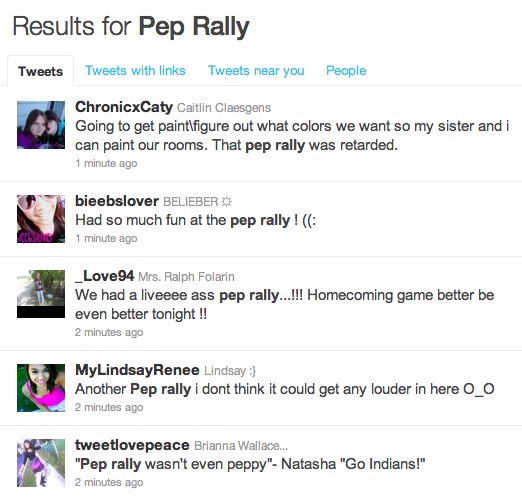
Logging onto Twitter to check out a few things quickly before running off to a homecoming football game, I couldn’t help but notice something important: “Pep Rally” was trending as a US trending topic. I immediately clicked on through and found countless teens commenting on their school pep rallies. These teens were posting about pep rallies that were happening at different schools across the east coast. The fact that teens are on Twitter still comes as a surprise to some but what surprised me about this trending topic is that it’s the first truly exogenous trending topic I’ve seen teenagers produce.

There are two types of trending topics on Twitter: endogenous and exogenous. Endogenous TTs happen when a topic has a viral spread. Once it becomes a TT, everyone jumps onto it to spread it even further. So when we see a hashtag like #intenyears we know it didn’t happen naturally. It spread by a group of people until it became a TT and then off it went. Most highly visible teen participation centers on endogenous TTs. Sure, there are lots of tweens who like Justin Bieber but he trends on Twitter because people actively work to make that topic (or a related hashtag) trend. Exogenous TTs happen when everyone is talking about the same thing simultaneously, not really responding to each other or to the trending topic per say but responding to a cultural moment. This often happens when there are major new events or TV shows that are broadcasting something of great interest. For example, when Michael Jackson died, Twitter users were talking about MJ not because the topic was hott on Twitter but because it was simply of great public interest. Same with teens responding to events happening at the Teen Choice Awards.

So then why am I so enamored with “pep rally” as a trending topic? It’s Friday in the middle of October. A lot of high schools will have homecoming games tonight. Whenever there’s a homecoming game in the States (and often for other games too), there are pep rallies at the end of the school day. Schools typically let out around 2.30PM. So around 3PM, I login to Twitter and voila, Pep Rally is a trending topic. Click on through and there are thousands of teens from all over the east coast (because time zones haven’t shifted yet) talking about having just gotten out of the pep rally. Some were talking about it being lame; others were talking about it being awesome. But they weren’t talking about the same pep rally. They were talking about their individual schools’ pep rallies. Collectively, many teenagers are experiencing pep rallies right now, but it’s not the same event that they’re experiencing. They’re talking about pep rallies, but what they’re referring to isn’t a shared event. Collectively, their discussions are trending. It’s a fascinating exogenous trending topic that isn’t even about the same event but rather about an activity that teens across EST (and now CST) are experiencing simultaneously but not coherently. Thus, the TT is more about marking a pattern of day (like “good night”) than a particular event. And, in this case, an event that is wholly teen-centric. And now, as I finish this post, I can see the pep rallies finish in CST and start in MST. Amazing. And delightful.

OK… enough talking about pep rallies. It’s time to go get ready for the homecoming games of the night. Hopefully I’ll wear the right colors this time. (I’m really not good at color coordinating for football games.)

Thank you Nashville!

I’m just finishing up the first 10 days of my fall sprint at intensive fieldwork. I’m a long way from being about to synthesize what I’m seeing but I wanted to share a few things since many of you are curious about my observations.

First off, Nashville is a great city to do fieldwork because of a mix of different dynamics taking place here. There’s the obvious suburban dynamics which are really notable here, especially given some of the extraordinarily wealthy suburbs which their posh football fields and McMansions. But even in the low income regions, there are really interesting things going on, both in the city and in the suburbs. On one hand, you have amazing local organizations dedicated to youth culture. The public library’s facility for teens is better than anything I’ve seen in any public library in the States and boy do teens flock there after school to play with the Wii, get free snacks, do homework, get on the computer, and even read books. The energy after school is fantastic. The library and rec center are where many teens go after school to wait for their parents to pick them up or because they live close to these places and find them to be more fun than going home (for a whole host of reasons). Of course, the teens that go to these places aren’t necessarily representative of all teens in Nashville. One teen told me that the types of people who went to the library are “ghetto” which is why she won’t go there. Still, many of the teens that I met there are trying to stay out of trouble and it was great to see a place for them to go. Likewise, Rocketown, a club founded by Christian musician Michael W. Smith is a popular place for youth trying to keep out of trouble. And there’s a Youth Opportunity Center and a whole host of other organizations working to create activities and opportunities for teens. And, unlike many regions I’ve been in, many of the retailers and fast food joints employ teens.

And then there’s the flipside… There are drug issues, namely pills (although oddly, heroin also seems to be coming back). And gangs. Sure, there are gangs in other cities, but the Kurdish Pride gang down here is quite unique. Kurdish Pride is filled with teens and young adults who come from middle/upper-class two-parent families and are doing well in school, but are engaged in a two-front gang warfare battle. On one hand, they’re trying to stand up to the black and Hispanic gangs here; on the other, they’re trying to show that they’re tough to their cousins back in Iraq, Iran, and elsewhere. Things escalated post 9/11 and I can’t imagine that all of this anti-Islamic fever is helping anything down here at all.

A lot of how Nashville is organized depends on transportation, with teens in the suburbs rarely making it into the city because of lack of transportation (and familial rejections of the bus). Malls and movies trump everything in terms of hang out spaces for suburban youth, with parks operating as a critical site for urban youth. All of the youth centers and whatnot are located downtown, although some of the megachurches have great youth programs in the suburbs. Things like football games and Young Life are still playing a huge role in the communities. The biggest socio-economic mixing seemed to have happened at the Opry Mills Mall (which shut down after the flood) and among kids who attend magnet schools or other specialty schools (of which there are some phenomenal ones here… sadly, though, the typical public schools leave much to be desired). As always, geography and mobility really shape the social dynamics.

Anyhow, I could go on and on about the social dynamics of Nashville which are totally fascinating and require much more nuance than I can offer in 3 paragraphs, but I’m sure what you really want to know is about technology. Simply put, technology is really fading into the background and is mostly being used on top of everything else that teens are doing. Teens who are more likely to be stuck at home (namely the teens from wealthier families) are much more consciously engaged in the technology for technology sake, much more likely to sit and chat on Facebook because it’s Facebook. Cell phones are everywhere with texting at unbelievable levels across socio-economic divisions. But teens are treating technology with the same level of emotional connection as they treat their clothes. Some are obsessively passionate about it and some just see it as a functional thing that they may or may not want to engage with.

Some fun little things that I found intriguing… All of the MySpace Top 8 stuff has reappeared in Facebook under “siblings” as teens list their closest friends as their brothers and sisters (which requires confirmation). While joining “groups” used to be a cool way of doing identity marking, it’s now all about clicking “Like” to funny things that get passed around. Relationships aren’t official until they’re “Facebook official.” MySpace isn’t dead among teens but the socio-economic issues around it are extremely pronounced and those who are on MySpace are typically also on Facebook at this point. MySpace and YouTube are ground zero for law enforcement doing gang intelligence. Particularly interesting given that Facebook is heavily used by the Kurdish Pride kids to connect with family back in Iraq; both sides post photos with guns to show toughness and connection. And I confirmed the reality that Facebook is pretty darn public for these teens – available to everyone that they know. And they know very little about how to manage their settings but feel like Facebook’s defaults must be what they should use.

I also heard some pretty crazy heart-wrenching stories. For example, complications to the sexting picture in the news. A boy that I met shared his cell phone with his mother.  He takes the phone during the day and she takes it at night.  His mother appears to be promiscuous (“gets around”).  All day long, he receives naked photos of older men to his cell phone intended for his mother. He’s terrified that his friends will see those pictures and think that they’re intended for him.  He’s super embarrassed about his mother but too uncomfortable to confront her.

Anyhow, there’s a lot more in all of my notes that I still need to process and think through what I have before I can offer more conceptual reactions but I wanted to share a little bit of what I’ve seen. And thanks to everyone who has been so supportive and welcoming. There are some truly dedicated folks in Nashville trying to make a difference and it really warms my heart to see so many dedicated folks working to help teens.

More soon! (Next stop… Raleigh and Durham.)

Call for Papers: Digital Media & Learning Conference

Interested in Digital Media & Learning? Well, the 2011 Digital Media & Learning Conference is looking for some interesting talks, papers, and sessions. They’ve just launched the call for proposals. (I’m on the conference committee.)

The Digital Media and Learning Conference is an annual event supported by the MacArthur Foundation and organized by the Digital Media and Learning Research Hub at University of California, Irvine. The conference is meant to be an inclusive, international and annual gathering of scholars and practitioners in the field, focused on fostering interdisciplinary and participatory dialog and linking theory, empirical study, policy, and practice.

The second conference will be held between March 3-5, 2011 at the Hilton Long Beach Conference and Meeting Center in Long Beach, California. The theme will be “Designing Learning Futures”. The Conference Chair will be Katie Salen. The conference committee includes Kimberly Austin, danah boyd, Sheryl Grant, Mark Surman, Trebor Scholz and S. Craig Watkins. Keynote presentations will be given by Alice Taylor and Muki Hansteen-Izora. We are also planning a book exhibit and technology demos.

musing on child naming and the Internet

I am of the age where many of my friends are having kids and so I’ve been exposed to more conversations about what to name one’s child than I ever could’ve imagined. I’m sure people have always had long contested discussions with their partners and friends about naming, but I can’t help but laugh at the role that the Internet is playing in these conversations today. I clearly live in a tech-centric world so it shouldn’t be surprising that SEO and domain name availability are part of the conversation. But I’m intrigued by the implicit assumption in all of this… namely, that it’s beneficial for all individuals to be easily findable online and, thus, securing a fetus’ unique digital identity is a tremendous gift.

Over the summer, Omar Wasow worked on a project at MSR about transparency and the implications of putting criminal records online. We were both flabbergasted by all of the efforts underway to publish arrest records as well as sentencing records. Omar is interested in whether or not publishing criminal arrest records negatively affects individuals’ ability to rejoin society once they’ve served their sentences. Does this information affect people’s ability to get a job? To rent an apartment? Etc. One thought we had was that it’s a lot easier to live down a record if you have a common name and, thus, are just one of many in a sea being searched.

Most parents don’t want to imagine the implications of searchable arrest records on the lives of their future spawn, but I can’t help but think that it’s pretty absurd to believe that all kids are going to want to be self-branded highly-visible easily-searchable adults. Sure, we all want our kids to be successful, but what if they’re not? And what if they don’t want to stand out? I always thought it was horrific when parents would name their kids ridiculous names that were destined for torturous middle school nicknames, but what does it mean to take it to the next level such that they stick out like sore thumbs online? It’s a lot easier to live down middle school than to live down a persistent digital identity.

I’m not at all sure if it’s better to give a kid a unique name so that they can stand out like a shining star or to go with a more generic name so that they can quietly stay invisible if they want. There’s definitely something to be said for naming a child at puberty instead of at birth, but, well, that’s not really how American society is structured.

Anyhow, I don’t really have any answers on this topic but it sure is entertaining to watch it unfold all around me. If you’ve got any advice that I can offer to my friends from your own experience, please holler cuz it sure is causing lots of folks heartburn.

Favorite myth-making news articles?

The book that I’m writing is focused on myths that we have about teens and social media. I’m trying to find some good quotes from news media that perpetuate these myths and I’m hoping that you might be able to help. The more salacious and outraged, the better.  I’m looking for articles in mainstream venues that talk about all of the reasons in which social media is bad, bad, bad.  What are your favorite news articles that reinforce these widespread beliefs?

  • Myth #1: The digital is separate from the “real” world.
  • Myth #2: Social media makes kids deceptive.
  • Myth #3: Social media is addictive.
  • Myth #4: Kids don’t care about privacy.
  • Myth #5: The Internet is a dangerous, dangerous place.
  • Myth #6: There’s nothing educational about social media.
  • Myth #7: Kids are digital natives.
  • Myth #8: The Internet is the great equalizer.

….

Before you ask… These are indeed the rough ideas that my book is organized around.  I’m not settled on any of the phrasings so if you’ve got feedback, I’m all ears.  I’m not yet ready to publicly describe what’s in each chapter but the structure is pretty simple.  I start with a widespread belief and then I use my data to complicate it, highlighting both why we have these myths and why they are focused on the wrong issues.  Hopefully it’ll be a fun read for everyone. <grin>