Author Archives: zephoria

bloody governor

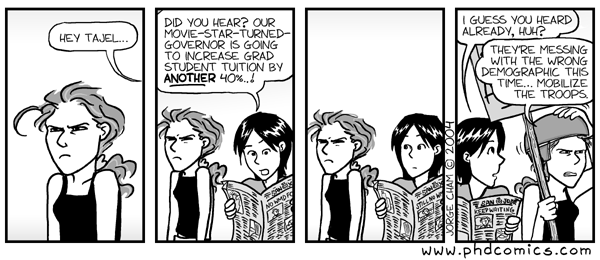
As everyone i know is panicking because of the job market and heading back to school, our f%#king governor is _yet again_ hiking the tuition (by 40%), reducing services and making it harder for California citizens to get an education. Of course, i will acknowledge that he’s quite constrained because 3/4 of the State’s budget is allocated by Propositions. One thing i learned living in California is how ridiculous it is to do budgeting by voting.

Take a scenario that i witnessed at Brown. A survey went out. How many of you think that cable TV should be freely accessible in dorms? Well, most people shrugged their shoulders. Even if they didn’t watch TV, why not, right? Of course, implementing this meant that money got cut for computing services. No one told us what would be lost based on our decisions.

::grumble::grumble:: At least Piled Higher and Deeper made me smile about the situation:

messing with my blog

So, i decided to mess with my blog a bit. I’m trying to merge connected selves & this blog and i’m making a bit of a mess out of it. My apologies for screwing up any RSS feeds. And a HUGE apology because i’m going to break practically every link and trackback out there. 🙁 Sorry hoor!

Friendster moving away from dating?

John Batelle is kindly spreading gossip that Friendster is moving away from dating. I know that they’re hiring pretty rapidly (i keep hearing from folks who are interviewing there). Also, the customer service thing this morning makes me think that they’re finally taking ahold of customer service… maybe?

I think it will be interesting to see what this means. The Fakester Revolution folks have died down. Many of the early hipsters who flooded Friendster have gotten bored and left (i.e. only login when necessary). Its popularity in Asia is soaring. And i have to imagine that the reason that nothing has changed in forever (either speed-wise or functionality-wise) is an indicator that large changes are in the works.

A while back, i posited that “One year from now, i suspect that the current incarnation of Friendster will have faded from people’s memories, a fad that was fun to play with…” Given these rumblings, i’m curious to see if Friendster is willing and able to take this fad to the next level, if they will take hold of the evolution. Because, so far, i’ve only seen improvements on (or destructions of) the original ideas.

[Note: evolving social networks software doesn’t simply mean expanding into other domains beyond dating…]

calling all digital community creators

Ars Electronica has a new category this year: Digital Communities. The idea is to hilight and support the fantastic creations made in the non-commercial sector around digital communities. If you’re a digital community creator, consider submitting your project!

Also, to anyone who happens to stumble upon this, i’m just curious which digital community projects you think should be considered for this Prix.

a peculiar customer service note from Friendster

I received a peculiar email message this morning from “Friendster Customer Service.” The message was polite and informing me that there is no “Friendster virus” and that the Bulletin Board Rumors were a hoax. They thanked me for my concern.

At first, i thought it was spam and went to delete it. And then i realized that it appeared sincere. They were thanking me for my concern even though i never wrote Friendster about said hoax. I looked at the headers and it looks like it really did come from Friendster. My next guess was that Friendster thought to mail out all of its users with the note.

There’s a problem. The message that i received, which appears real, doesn’t go to any of the email addresses that i use for Friendster. It goes to my primary address – the email address i use to communicate with friends, colleagues and whatnot. I never wrote customer service at Friendster even though i’ve used this address to communicate with various people who work at Friendster. But never about a hoax.

I’m a bit baffled. I have a feeling that Friendster is not very likely to explain why they are writing me at my personal address to thank me for my concern for a hoax that i didn’t report. Thus, i thought i’d see if anyone else received a similar message.

How very strange.

Update: Customer service responded. Although i’m still a bit weirded out. A few months back, i sent a message to someone who works at Friendster. I accidentally left off one of the letters in the email address so it didn’t go through to the person intended and got added into the Customer Service bin; it didn’t bounce; it didn’t get forwarded on. Apparently, Customer Service made a mistake this morning. Not sure who else got that message, but the reason that they had that address was because of that not bounced message. This is still disconcerting to me.

justice, fairness, power and privilege

While Marko’s reflection on Clay’s writing prompted me to go off on a tangent about privilege, Joi jumps in to ask are blogs just? and Clay offers a return. The foundational components of this question requires teasing out whether things are fair and/or just and what impact that has on the relevant social groups.

While Joi really unpacks the notion of justice, Clay retorts by pointing out that he’s really focused on fairness. In his argument, though, he notes the economic (lack of) cost involved in blogs. This is what prompted my tangent, but perhaps i should return here. When something costs time and time is a precious commodity, is it truly fair (or equalizing)? Clay also argues that there is no vetting (“subject to expert appraisal or correct”) process. Perhaps not officially, but public blogging is one of (counter)critique and, thus, there is a feeling of a power hierarchy that makes people feel the need to be properly appraised in order to participate. Finally, Clay notes that the threshold for having a blog is only slightly higher than the threshold for getting online. I wish that this was true. This is where issues of social pressure, time, literacy, confidence, etc. come into play. Consumption and production are fundamentally different and there are different forms of pressure when engaging with either. There is no way that one can possibly say that the threshold for consumption is equivalent to the threshold for production.

As a moral question, fairness is inherently intertwined with power and privilege. Thus, this statement by Clay worries me:

To a number of people (including Joi?) evidence of injustice, even in fair systems, calls for some sort of remedy. I can’t imagine a system that would right the obvious but hard to quantify injustice of the weblog world that wouldn’t also destroy its dynamism.

Does this mean that privilege should beget privilege because it makes for cool, dynamic technology? I, for one, would love to hear Clay/Joi discuss the relevance of power and privilege in this discussion.

(For those who are reading this in RSS land, make sure to read the comments on Joi’s blog. Apprently this philosophical discussion is a bit too heady for some and thus the comments are a riot.)

blogging is a privilege

Marko critiques Clay in Is the Blogging World Fair? which, in turn, made me think critically about the questions of equality in blogging. Mind you, i’ve only recently started going meta on blogging and bloggers (blame Joi for making my mind swirl on blogs).

I love hearing that blogging is a great equalizer… from straight white men.

Privilege is a funny thing. Often it opens up opportunities that we don’t even realize. Take time, for example. Who has the time to sit online and read, write and discuss all day? A working mother? A migrant worker? Time is money. Very few people have both time and money and most people spend most of their time trying to make ends meet or trying to calm their nerves from the stress induced by the former. Having time to “waste” is privilege.

Next, take voice. Who is taught that they have the right to vocalize any thought about the world to the rest of the world? A proper lady does not spoke unless spoken to. Who has the privilege to critique those in power?

Take a look at the public self-referential blogging culture. We’ve often noted that there are few women. Yet, what percentage are people of color or queer? More notably, what percentage are of working class? And btw: the goal isn’t to be able to successfully name one… but when i look around the blogging world, i will think that it is an equalizer the day that people are represented at least proportionately to their representation in the rest of the world. Until then, i’m committed to my belief that there are factors embedded in the blogging culture that only draw specific types of people. And that those factors edge along notions of privilege. Until we decipher how our technologies promote privilege, we cannot create equalizing technologies.

skype and insta-access

When i tried to frame my hesitation over Skype, i was sent through the wringer both online and offline. I felt like a heretic. As such, Dave Weinberger’s frustration today made me grin.

Even IM tends to drive me batty and i turn it off when i need to work. (Of course, somehow, i feel as though i’m allowed to blog while i’m writing a paper even if i’m not allowed to be interactive.) Voice takes things to the next level. I have no qualms ignoring IMs while i’m working or telling people that i’m working and can’t talk. I don’t give out my IM to the world at large; i don’t allow IMs from people i don’t know; and i rarely have time/hand power to just chat on IM. Voice is a whole new level of not-OK.

Just because VOIP solves certain economic problems (particularly for members of a diaspora) does not mean that it alters my conniption fits about my relationship with voice interactions. I *hate* the phone and i HATE being interupted while working even more. Of course, there are exceptions and i usually answer my cell for friends, even if only to say that i can’t really talk right now. But the idea of getting random calls from strangers is about the most horrifying thing that i can imagine. Eek! I definitely feel for Dave…

religion and AA

There’s a discussion going on at We Quit Drinking over whether or not one can view AA as a religion. Personally, i draw parallels between the two regardless of whether or not i would label AA as a religion.

First, i take severe issue with Webster’s definition of religion (used in the debate):

1. Belief in and reverence for a supernatural power or powers regarded as creator and governor of the universe.
2.A personal or institutionalized system grounded in such belief and worship.
3.The life or condition of a person in a religious order.
4.A set of beliefs, values, and practices based on the teachings of a spiritual leader.
5.A cause, principle, or activity pursued with zeal or conscientious devotion.

This proposed definition sits at the heart of the discussion, which is a bit problematic. First, it is *very* easy to read Western hierarchical organized religion into this definition. It is hard for me to tell if that is the intention of the definer or if that is simply my own Wester predilection. My own religious beliefs are very much not Zoroastrian in foundation (i.e. not Jewish/Islamic/Christian). Thus, i have to look particularly close at this definition to find myself; it is not the first read that one might do. In fact, it is precisely that Western version that most of the discussion focuses on. Only in Western religions are religions exclusive and define ‘right’ and ‘wrong’ or ‘one true way.’ I view myself as religious but i don’t identify with any of those classifications.

I’ve never found a definition of religion that feels comfortable to me. That said, Bob Jesse of the Council on Spiritual Practices offered me the best perspective i’ve ever heard, noting that religions have three tiers of participation: scriptures, traditions/rituals, primary religious experiences. Community forms out of religions because of shared scriptures, traditions/rituals and goals to experience primary religious experiences. Anyhow, i could go on about this but i’d like to return to Alcoholics Anonymous for a moment.

AA is a fantastic organization that helps many people. In many ways, i feel as though its effectiveness comes from its clear parallels to religious organizations. There are a set of scriptures, traditions/rituals that bind people together and a goal of reaching a primary state of ecstasy from sobriety. Just like civic and religious groups, AA brings people together from all walks of life, allowing for an education in tolerance.

It’s funny because i know the debate on We Quit Drinking fundamentally surrounds how people feel about the term religion. It’s a hefty word with a lot of connotations that make people run screaming. Also, people automatically conjure Western religion when they think religion which can be truly limiting. At one point, one of the debaters noted that AA is not about worshipping a higher power. Yet, in many ways, AA is precisely about that. Only, the higher power is not a white bearded man in the sky. The higher power is found within you. Rather than drowning out that power, AA is about finding the strength internally to worship yourself, those around you and the ground you walk on. It’s about finding your own unique path and following it one day at a time.