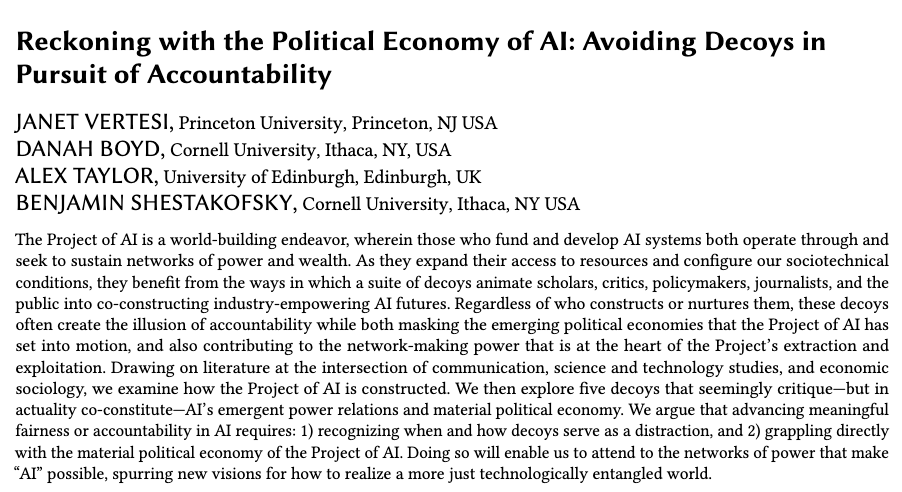
The Project of AI is a world-building endeavor, wherein those who fund and develop AI systems both operate through and seek to sustain networks of power and wealth. Janet Vertesi, Alex Taylor, Ben Shestakofsky, and I teamed up to try to disentangle the technical systems we call “AI” from the political-economic project that is sustaining this effort. Today, at FAccT, Janet presented our new paper: “Reckoning with the Political Economy of AI: Avoiding Decoys in Pursuit of Accountability.” (also available on arxiv). We do a few things in this paper that might be appealing. First, we try to map out how to understand AI, not as a set of technical artifacts, but the culmination of various economic and political forces, organizational logics, and interpersonal networks. (To anchor this, we draw on four distinct theoretical traditions, recognizable to scholars through Manuel Castells, Neil Fligstein, Donald Mackenzie, and Anna Tsing.) Then, we speak directly to scholars and practitioners interested in accountability and highlight how important it is to avoid “decoys” that distract our attention from the political economic agendas at play. Put most bluntly: we won’t create accountability by futzing with the technical affordances; we need to attend to the political and economic agendas.
If watching a video is more your jam, Janet presented a preview of this work at CITP Princeton a month ago and that video is now online.
While I’m not at FAccT (saaaad panda), I have been out and about. Ten days ago, I gave a talk at the Oxford Internet Institute to celebrate their 25th anniversary. Since I had given three co-authored paper talks at OII’s 10th (the ones that turned into Critical Questions for Big Data, It’s Just Drama, and Networked Privacy), I decided that it only made sense to give a 25th anniversary talk that wove together the past, present, and future of the internet that mixed together stories of social media, AI, and teenagers. “Dreaming of a Networked World” picks up themes from the FAccT paper, but the second half also includes new data from the Project Vibes team (led by Michele Ybarra) about teens’ attitudes towards AI. (Hint: it’s a doozy!)
It’s hard to believe that I’ve now been at Cornell for a year. It’s been an adventure! I taught three classes (Data & Society, Trust & Safety, and Theories to Think With). I have lots of irons in the oven, but I’m also now prepping for the launch of Data Are Made, Not Found. Book talks are confirmed in DC, Cambridge, Seattle, Boulder, and NYC. (Berkeley and Toronto are almost locked too.) I’m also talking with people about other cities. I can’t wait to share more. In the meantime, I would be ever so grateful if you could take the time to either pre-order the book or reserve a copy with your local library.
Have an amazing summer! More soon!
