No one paid me to disagree with Jonathan Haidt. It was teenagers who taught me that he was wrong.

According to recently released discovery materials, Meta directly targeted Jonathan Haidt by trying to stir up academics to oppose him. The odd thing is that many of us scholars who disagree with him knew nothing about this and weren’t involved in it. And so now scholars like the amazing Candice Odgers are being doubted about the sincerity of their critique. WTAF upside down world are we living it?

What’s super frustrating is that many scholars in the teens-tech-mental health space are repeatedly accused of fabricating research or being corporate shills when our research is politically inconvenient. I know that I have been. Repeatedly. And it sucks.

When I was still in graduate school, I was asked to serve on the Internet Safety Technical Task Force. One of my responsibilities was to oversee the research effort. I worked with other scholars to track down all studies that focused on content, contact, and conduct related harms involving the internet. The politicians were primarily interested in the question of pedophiles. When I provided the report to then Attorney General Richard Blumenthal, he told me to go find different data. He did not like what I had found. I didn’t know what to say.

Predation is real. It’s devastating. But it’s a more complex dynamic than most people’s mental image allows for. And when it comes to internet-enabled predation, the biggest risk is not teenagers using the latest social media site. The biggest risk is single moms using online dating apps. Pedophiles seek out these women to get access to their children. It’s sick. But no one wants to hear that. They want to focus on the digital tools young people use.

After our report was published, I started getting calls from journalists. I earnestly and naively responded to all of them. One of the journalists was from PBS Frontline. She called me up repeatedly, drilling me on questions about arguments in the report. I responded by providing study after study to every inquiry, pointing her to different researchers who were experts on different parts of this puzzle. After a few weeks of this, I got what would be the last call from her. She started out by apologizing to me.

Unbeknownst to me, some of Richard Blumenthal’s ardent supporters for his Senatorial campaign were outraged that I dared to challenge the politician’s arguments about internet safety. They were determined to prove that I was falsifying data on behalf of the tech industry. The Frontline reporter told me she was assigned to uncover my duplicitousness. She had concluded I hadn’t done anything but report on the scientific insights of the field. She spiked the story, but she warned me that I had pissed off some very powerful people and I would probably have to deal with being demonized going forward for standing up for research. Ugh.

Ironically, I first started truly despising Facebook-the-company while I was working on that task force. I got to watch up close how the company built a coordinated campaign against MySpace, intentionally creating the impression that MySpace was dangerous while Facebook was safe. And I witnessed teenagers process this through the language of racism and classism, prompting me to write a very controversial essay that turned into my paper “White Flight in Networked Publics?” I was fascinated – and disgusted – by the executive who seemed to do the dirty work on behalf of the CEO and COO, unbeknownst to others in the company. I called him the bulldog. The bulldog continued to harass all sorts of different people.

These days, I have absolutely nothing nice to say about Meta-the-company despite knowing a few amazing people who work there. I think the company is unethical to the core. And the products have enshittified so badly that they’re unrecognizable compared to what teenagers used to use. Hence my argument that “Social Media is Now Parasocial Media.” But I still stand by my research on teens and the research of others who have done rigorous analyses putting teens’ lives into context. Teenagers live in the world we create for them – and they use what’s available to them, regardless of how they feel about it. In the past, teens turned to Facebook to socialize and make sense of public life. Today, Facebook is dead to teens and Instagram feels more like some sketchy version of MTV. Socialization is on group chats, some of which unfold on WhatsApp. But most teens have nothing nice to say about Facebook.

Many teenagers in our contemporary world are struggling. I’ve gotten to see that upfront through my work at Crisis Text Line, which I adore. And I’ve gotten to consistently witness how the problems that they face cannot be explained by their tech use. Because of this, removing tech from their lives will not solve the major problems. And for some, like many of the teens who text Crisis Text Line in their darkest moments, losing access to a cell phone will eradicate an essential lifeline.

I have no interest in defending tech companies, but I am deeply committed to defending teenagers’ agency and choices in the world that we have given them. I am determined to make sure that those teens who don’t have supportive parents have pathways to get help. And my research has repeatedly led me to conclude that when we fail to empower teenagers to transition into adult worlds, we do them more harm. And when we focus on the tech, we fail to help those who need the help the most.

Many of the problems that I have with tech use are actually about adult tech use. Too many adults treat their phones as a pacifier to help them self-regulate. They’ve taught this bad habit to their kids. Too many adults fail to role model healthy sociality digitally and in-person friendship. Too many adults use their phones to be distracted from their own children. And then we’re surprised by the mirrors that teens offer back at us. “I learned it from watching you, dad.”

What kills me in the contemporary teens-and-tech debate is that there’s no space for actual research or critical nuance. You’re either opposed to the tech companies or in their pockets. And this week’s absurd discovery reinforces this infuriating polarity, painting those of us who are critical of Jonathan Haidt as being corporate shills. I find this especially frustrating because I did work in tech for a lot of my career. I played the role of friction inside many companies (although never Meta). I repeatedly got threatened by tech executives for challenging corporate mantras or providing research that contradicted their interests – and yet I persisted. Cuz many tech companies are far more complicated than people realize.

Still, I’ve had to grit and bear as I am attacked by other scholars for taking money from tech (as if any money in late-stage capitalism is clean money). And I had to stomach calls from representatives of the National Academies that I can’t even talk with their committee members because Jonathan Haidt told them that I was a corporate shill. And I’ve had to not weigh in on numerous recent debates because my peers and news outlets tell me I am tainted. In this political climate, I am unable to convince people that my research stems from the lessons I learned from teens, not what I learned from tech. I’ve mostly shrugged. But when journalists started going after Candice, I lost my mind and felt the need to share my story. The idea that she is being painted as a corporate shill is ludicrous.

Cuz here’s the thing… It IS possible to despise the tech companies AND understand why teenagers use their products and find value from doing so. Listen to teenagers; they get these contradictions. Their hatred of the tech companies is growing exponentially even as they use the tools those companies provide. (You should see their attitudes towards AI companies. Oooh-whee…) It’s also possible to care about kids’ mental health AND think that the solution doesn’t start and stop with tech. And it’s possible to do rigorous research AND discover that tech isn’t the biggest monster in teens’ lives that anti-tech advocates think it is.

Truth be told, I’d have no problem if certain social media platforms would be banned for everyone. I think that many of the products in this space have devolved into garbage. My objection is a teen-specific ban. I oppose legal controls of teenagers because adults are trying to cope with the guilt about their own failings. We are living through an era of anxious parents. It’s heartbreaking the costs of this anxiety.

Of course, if politicians want to implement an age-specific ban to target those most harmed by social media platforms, I’d be totally fine with banning elders from social media. That would do society a lot of good. Just think of what it would mean in terms of identity theft and fraud, not to mention disinformation. But that’s the rub. We believe that adults’ freedom of choice needs to never be constrained, but that it’s perfectly OK to micromanage teenagers. THIS is what I object to. I believe that teenagers deserve rights and agency. I think it’s utterly asinine that the United States never ratified the UN Rights of the Child. This doesn’t make me a corporate shill. This makes me an advocate for teenagers.

As I wrote over a decade ago, we’ve made ridiculous decisions that have undermined teenagers’ ability to socialize and connect with friends. And it keeps getting worse. Teens have lost the right to roam. In many parts of the country, they’re overscheduled and have nowhere to go to hang out with friends besides each other’s homes. Teenagers don’t have sustained access to mental health services (and they often have to go through their parents’ insurance to get access). They’re living through a polycrisis. And what they’re seeing in the world of adults is depressing. There’s a lot that we can do to help young people. But much of it starts locally. Much of it starts with adults checking their own behaviors. Much of it starts with intentionally investing in the social lives of young people. Giving them options. Creating space for them. Ensuring that they have robust social fabrics. Tech is a relief valve, and an increasingly terrible one. But taking tech away won’t do squat to address the underlying issues. And, worse, banning social media is basically an advertisement for it. Cuz right now, social media is dying a slow death among teens cuz it sucks so much. But teens are still looking for spaces in which they can connect and socialize and make sense of the world around them. What will it take for us to actually invest in young people?

Dear Civil Servants and the Ventriloquists behind the proposed residence rules

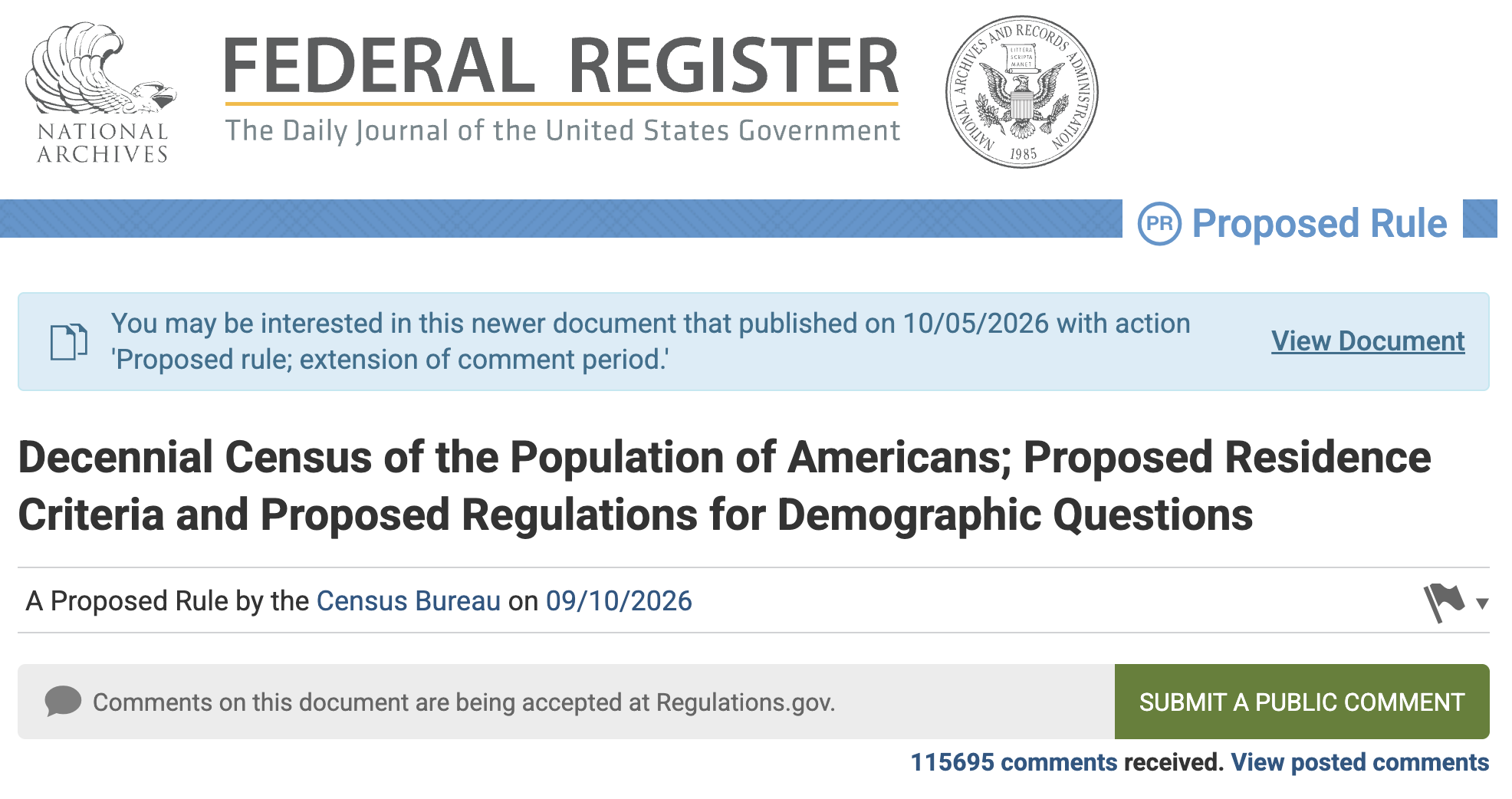
The “Census Bureau” is currently seeking comments to a proposed new set of residence rules for the 2030 census. Comments are due on November 2, 2026. In reality, the actual proposal is a tirade written by the current administration pretending to be in compliance with the rules governing agencies like the Census Bureau. Over 100,000 people have submitted comments so far because the changes are monstrous. If implemented, the Census Bureau would not collect data about race/ethnicity (thereby undermining current laws), would not collect data about certain categories of non-citizens (thereby undermining the Constitution), and would be forced to do a whole host of other weird untested things that would utterly destroy the quality of the data. Needless to say, this is not a proposal from the experts at the Census Bureau who are devoted to ensuring that everyone counts once, and only once, and in the right location. To learn more about the insanity of the proposal, check out the information at Hands Off Our Census.

I decided to write a comment myself (and I encourage you to do so as well). Because comments are being stripped of their identifying information, I wanted to share my comment publicly. In writing this letter, I decided to focus on the absurdity of this whole endeavor. Enjoy!


Department of Commerce, Census Bureau
Re: 15 CFR Parts 60 and 70, [Docket No. 260903-0005], RIN 0607-AA75

Dear Civil Servants and the Ventriloquists behind this proposal –

First, let me speak directly to the civil servants who are reading this: thank you! You produce the data that our country depends on. The American project is – and was always – a radical one. Historically, censuses were used by kings for conscription, taxation, and eradication. Our founding fathers decided to invert this history and anchor our country’s democratic republic in a census. In Article 1, Section 2 of the US Constitution, Congress is tasked with conducting a census and allocating representation using the result. You have been given the awe-inspiring responsibility of conducting this work. This is hard work that is critical to our democracy. Thank you for your service to our country.

I have had the privilege and honor of getting to learn from many of you over the last ten years. I have watched y’all do the impossible, despite natural disasters, despite a global pandemic, and despite never-ending political pressure. I have watched you do this important work, even while being treated abysmally by politicians and other stakeholders. I have also learned how few members of the public get to witness your dedication to your mission. And I have watched political forces undermine your ability to communicate with the public by sharing your expertise and knowledge. I know how often you are told not to speak, including now. And I know that your silence does not mean that you don’t care. To the contrary, you care so deeply that you follow the orders you are given.

Part of what has always inspired me about your work is how committed you are to both process and the transparency of process. You are constantly working to improve the census in pursuit of the unattainable perfect count. You measure everything. Years ago, when George H.W. Bush’s appointee to run census communication learned about how you worked, he remarked, “Never before have I been part of an organization that produces the whips with which it gets flogged. It’s masochism.” Every time you change your processes, you document and document and document. You have always published research to justify each change – and gone to great lengths to show how each change is to be done. Too few of us in the public have ever appreciated your thoughtfulness. As always, you don’t know what you’ve got until it’s gone.

The proposed residence rules, entitled “Decennial Census of the Population of Americans; Proposed Residence Criteria and Proposed Regulations for Demographic Questions,” are unlike anything that I’ve ever seen come from the Census Bureau. The justification is explicitly partisan. The proposal is filled with recommendations that are likely unconstitutional and appear designed to undermine existing laws. Many of the details are nonsensical, contradictory, and filled with operational holes. Moreover, the proposal lacks even a modicum of research intended to justify the changes. I’ve watched civil servants be forced to speak the messages of previous administrations, but this is ghastly. I can’t imagine how painful it is for you to have been forced to issue a series of changes that are untested, unresearched, and unjustified. And I suspect you’re reading this comment – along with the other 100,000+ comments – with frustration, knowing that your professional expertise and the legitimacy of your work is being undermined by political forces outside of your control.

I know that you take your duties seriously. Through my time spent with other civil servants, I learned about the history of official statistics – and the role that the United States has played in advocating and implementing the fundamental principles of official statistics. These include: 1) Relevance, Impartiality, and Equal Access; 2) Professional Standards, Scientific Principles, and Professional Ethics; 3) Accountability and Transparency; 4) Prevention of Misuse; and 5) Confidentiality. These commitments ensure that the data that you produce on behalf of the American people are both legitimate and of high quality.

The proposed residence rules repeatedly violate these commitments, making it clear that these were not written by civil servants, but by political appointees hiding behind civil servants. In responding to this request for comment, I want to make four points:

  1. Civil servants at the Census Bureau have a professional duty to produce the census using the best knowledge of the day.
  2. The executive branch should not be allowed to use the residence rules to undermine Congress’ authority, existing laws, or the Constitution.
  3. Rules that are vague and unclear violate the spirit of the Administrative Procedures Act.
  4. Silencing civil servants, refusing to provide documentation, and upending precedent without cause undermines the legitimacy of democracy’s data.

Civil servants at the Census Bureau have a professional duty to produce the census using the best knowledge of the day.

The data produced for the 2020 census were not perfect. No data ever are. But they were the best that civil servants could produce given the pandemic, natural disasters, funding limitations, and repeated political dramas. And those data were still better than all censuses in the 19th and 20th centuries. How was that possible?

One of the ways that the census is resilient is that civil servants learn from the past and are constantly evolving. Every decade, new methodologies for data collection and processing are developed and tested. Redundancy is valued at the bureau, despite pressure for efficiency.

The Constitutional architects gave Congress the responsibility to conduct a census in Article 1, Section 2 of the US Constitution. Congress institutionalized the census in 1902 by making the Census Bureau a permanent agency to ensure that our country could benefit from stability and ongoing expertise. For the last century, the Census Bureau repeatedly evolved its work, documenting each change after extensive research. This allows the scientific community to evaluate the work, and it ensures that the public can trust the process.

The changes being proposed are driven by partisan politics, not scientific expertise or statistical knowledge. The bureau’s advances in disclosure avoidance methods are being summarily dismissed, despite the ongoing work by the bureau to ensure that these methods are rigorous and sound. The bureau’s strategic use of administrative data is being twisted to achieve partisan goals without consideration for who might be missed or how this approach might upend existing processes. Civil servants know that the tax records are incomplete and will result in an undercount, but these rules disregard that local knowledge.

Congress expects the Census Bureau to leverage its professional expertise to produce data that our country can rely on. These rules undermine that.

The executive branch should not be allowed to use the residence rules to undermine Congress’ authority, existing laws, or the Constitution.

By placing the Census Bureau inside the Department of Commerce, Congress delegated substantial authority to the Executive Branch. This does not, however, mean that the Executive Branch can use the census to undermine Congress.

The Constitution requires a census that counts every resident of the United States. The first Trump Administration intended to subtract undocumented peoples from the apportionment count, despite previous rulings that rejected this approach (e.g., Federation for American Immigration Reform (FAIR) v. Klutznick (1980)). What makes these residence rules especially galling is that the census is being forced to intentionally ignore people who are clearly taxed residents of the United States, undermining even the most extreme interpretation of Article 1, Section 2. This is an approach that is common in authoritarian countries, where the state chooses not to see certain people that are politically undesirable.

Congress has also passed numerous laws over the last century that rely on census data. Many of these laws require data about race and ethnicity, including the Voting Rights Act and other civil rights laws, as well as many federal funding formulae and funding thresholds. These residence rules undermine Congressional statutes.

The census is fundamentally the responsibility of Congress under Article 1 of our Constitution. But what we are seeing with these residence rules is an act of “policymaking by other means” – policy through which the Administration not only violates the history of census taking since 1790, but also the simple language of the Constitution. In other words, rather than working through our legislative bodies, the White House is contorting the data collection processes to make it impossible to uphold laws or ensure Constitutional compliance. Not only does this usurp Congress’ power, but it undermines the legitimacy of the Census Bureau.

Rules that are vague and unclear violate the spirit of the Administrative Procedures Act.

Civil servants have a duty to the American people, not to any specific political party. They must follow direct orders, but they must also comply with the law. The Administrative Procedure Act (APA) makes it clear that the public has the right to review the policies of federal agencies. This federal register notice exists because of the APA. However, it is not meaningfully compliant with the APA. By submitting these rules to public scrutiny in the Federal Register, the Census Bureau and the Department of Commerce are obligated to provide justification and explanation for the proposed rules.

Many rules have no explanation. Why is the “census enumeration period” set between January 3-April 1? Others are incomplete and inconsistent. How do you determine which date during the census enumeration period matters most? What happens when people’s “usual place of residence” does not match their tax records? Other information is missing entirely. What happens when the bureau cannot collect the information necessary to link a person to a tax record? The entire section on tax records is not operationalizable as currently written. This raises questions about how these residence rules will be interpreted.

Other components of the residence rules are purely spiteful spectacle. The treatise against disclosure avoidance in this rulemaking is not rooted in empirical analysis, but partisan claims after courts repeatedly rejected efforts to dismantle the novel approach to disclosure avoidance that was implemented in 2020. There is no effort to explain how civil servants can produce the data that states want and uphold Title 13 of the US Code. This rulemaking does not relieve civil servants of their lifetime legal oath. No civil servant that I knew was willing to risk up to 5 years in jail and $250,000 in fines for every piece of data that published because a political appointee wanted that data unmasked.

I can only presume that civil servants have been ordered to not speak to external stakeholders – or even attend events – because they know that the changes issued in these residence rules are indefensible, vague, and impossible to implement as written.

The residence rules introduce more questions than answers. Federal Register Notices are only meaningful when they include details in a manner that provide clarity. That is not what is happening here. The issued residence rules are too incomplete and unjustified to allow for meaningful debate about the substance of the changes. This is in violation of the spirit of transparency and the requirements under the APA.

Silencing civil servants, refusing to provide documentation, and upending precedent without cause undermines the legitimacy of democracy’s data.

This administration has repeatedly shown its disdain towards civil servants and the administrative state. Civil servants face ongoing harassment on the job and are accused of being the “deep state” for doing their jobs. Neither Republicans nor Democrats have respected the expertise of civil servants in recent decades, but civil servants have kept their chins high and continued to work on behalf of the American people. Despite persistent criticism, civil servants at the Census Bureau have always been willing to explain their processes and procedures. Their technical answers can infuriate external stakeholders, but they have never stopped trying to explain scientific and statistical matters. Until now.

Silencing civil servants does not strengthen our government; it weakens it. The public needs to be able to hear from – and speak to – those who work on our behalf. The public needs to be given the opportunity to understand the scientific and statistical choices that govern democracy’s data. This is what makes the work of the Census Bureau legitimate.

Many of those who work for the federal government are naturalized US citizens. When I spoke with them about why they chose to work for the federal government, I repeatedly learned that they came to the US from countries where corruption, abuse, and falsified data were common. They were grateful to their adopted homeland – and they wanted to give back. They wanted to help strengthen our democracy by serving the American people.

As Congress and the public reckons with these proposed residence rules, it’s imperative that they recognize that the civil servants are being pushed into a corner, unable to leverage their expertise and experience. Many have left in response. Others are staying, not because they agree with what they are being told to do but because they believe that they have a duty to the American public. Everyone who reads this letter needs to recognize that we need civil servants to do their job, but we also need to make sure that their job is doable. Civil servants come to the Census Bureau because they have skills and knowledge that makes democracy’s data robust. We, the people, need to ensure that they are able to leverage those skills and that knowledge.

We do not live in an authoritarian country, and we should not emulate one. Silencing civil servants is a notoriously common authoritarian move. This cannot be acceptable.

In Conclusion…

This federal register notice is a political move pretending to be a procedural one. Political appointees are using civil servants as puppets while undermining their expertise and experience. These rules are a breach of precedent and norms, undermining decades of procedures while creating more confusion than clarity. This is not a standard notice reflecting partisan disagreement. This is the documentation of an administration working to use the Census Bureau to undermine the Constitution, Congress’ authority, and existing law.

The issues raised in this federal register notice do not belong in such a document. If the Administration wants to make these changes, it should seek regulatory change in Congress. Congress, after all, is Constitutionally responsible for the census.

And for all the civil servants who are reading this, once again thank you. I dream of a day when your voices can be heard and your expertise is valued. Until then, I am grateful for your commitment to doing the impossible.

Sincerely,
danah boyd
Geri Gay Professor of Communication, Cornell University
Author of Data Are Made, Not Found: A Story of Politics, Power, and the Civil Servants Who Saved the US Census

What’s Up with 4-3-5?

A few weeks ago, I launched my new book – Data Are Made, Not Found: A Story of Politics, Power, and the Civil Servants Who Saved the US Census. To my sheer delight, many friends have stepped up to host events and join me on stage and I’m now touring the country to spread the word about the census. (Seattle, DC, LA, Bay Area, Chicago, Ann Arbor: I’m headed your way real soon!) But when the team at Data & Society offered to host the first virtual event, I jumped at the chance. And I asked Dan Bouk, my dear friend and fellow D&Ser and census nerd to join me. He offered to make the idea of Jenga Politics understandable through a silly demonstration. I delighted in this, but I also begged a favor: would he consider crafting a silly song for the event?

Y’see… Dan has this knack for breaking into song in meetings. And not just any song. He creates and then sings ridiculously geeky songs that bring a smile to everyone’s faces. So, did Dan deliver? OMG did he ever. He crafted a song about the census, Congress, and Jenga politics set to Dolly Parton’s 9-to-5. “Tumble down the pieces and bring down the mission… Congress has the power but just does nothing…”

When he broke into song at the event “Protecting Democracy’s Data”, I was left feeling very very verklempt. To my delight, the video is now online so you can watch it too and feel all the adorbs feels. (If you just want to hear Dan sing, fast forward to 13:17.)

Part of what makes this song especially perfect is that Dan is riffing off of the fact that the House of Representatives is set to 435 members, thanks to a decision from a century ago. He would know. At Data & Society, Dan penned a report about how a 1929 law intended to stop Congresspeople from squabbling ended up cementing an algorithm and, with it, the number 435. His report – “House Arrest: How an Automated Algorithm Constrained Congress for a Century” – is a stark reminder of how laws intended to fix one problem can create ripple effects. It’s also a reminder of how, when things like the census become infrastructural, we lose track of what is at stake.

George Washington barely spoke during the Constitutional conventions. He understood his power and influence and thought he should keep his mouth shut. He did speak up at one critical juncture, however. When the Constitutional architects were discussing how Congresspeople should represent 40,000 people, he objected. He argued that the number should be lowered to 30,000 people. His argument was simple. If you want people to trust their representatives, they need to be closer to the people. They need to represent fewer people. Today, members of the House represent roughly 1,000,000 people. Needless to say, trust is broken.

We have collectively forgotten this history. We take the number 435 for granted. As we move into the midterm elections, I can’t help but wonder what it would be like if our House was comprised of 11,000 representatives. It’s hard to imagine. But how would wrangling that kind of body change how we governed? Of course, there’s a big gap between 435 and 11,0000. The amazing team at the Academy of Arts & Sciences argues that we need to restore the “Restore the Founders’ vision of Congress as the ‘People’s House'” (complete with an amazing explainer video).

Of course, no matter how many reps we select or what algorithm we choose, the way that we allocate political power in the United States starts with the census data. This is what Dan calls Democracy’s Data. I wrote Data Are Made, Not Found because I want people to understand all that it takes to make democracy’s data. If you haven’t snagged a copy yet, I implore you to do so (or to ask your library to make one available for you).


Here’s some recent content related to my book that you might enjoy:

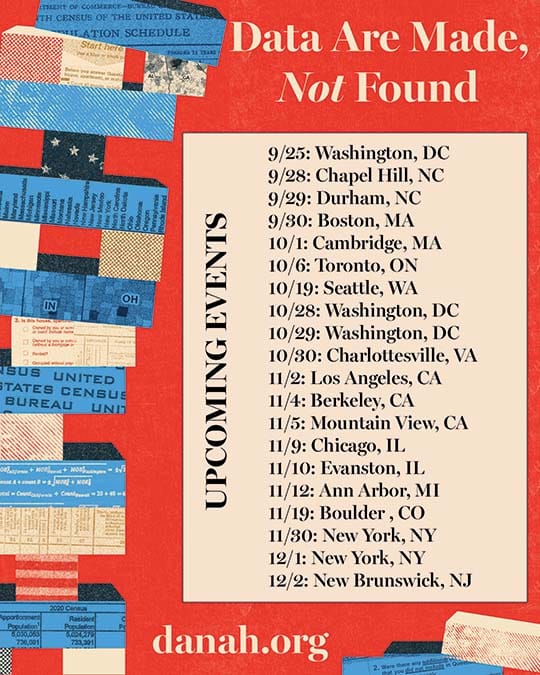
The book tour is shaping up nicely! Below are the next month’s worth of events. I hope you can join me for one of them (or check out my website for additional dates). Please help me spread the word!

Today’s the Day!

Ten years ago, I started asking questions about the census. Little did I know that I entered a Hotel California-esque vortex. Each question led to another question as I started to discover just how infrastructural the census is. Want to understand American democracy? The census is the key. Curious how to ensure data quality? The census has insights. Invested in responsible AI? The census has lessons. And on and on it went.

Well, today is the official publication day of Data Are Made, Not Found: A Story of Politics, Power, and the Civil Servants Who Saved the US Census, which is my attempt to use storytelling to explain the power and beauty of the census. The book is an account of the 2020 census, a love letter to civil servants, and a how-the-sausage-is-made story. Three arguments are woven through the book like red threads:

  • Data are made (not found). How they are made really matters. And making data is more than meets the eye.
  • “Jenga politics” is configuring our government and world, creating precarities that we must learn to see before it’s too late. Everyone loses when the tower falls, even if only one player gets blamed.
  • The key to data’s legitimacy rests in the social fabric that surrounds the data, moreso even than the quality of the data itself. We must invest in social fabrics to ensure that data is robust, trusted, and able to anchor high-stakes decisions.

While census nerds are bound to smile at some parts of the book (and get mad at me for others), this book isn’t just meant for census nerds. It’s meant for anyone who cares about democracy, American politics, and government. And it’s meant for anyone passionate about data, AI, and our sociotechnical world. All too often, we take the systems that undergird our society for granted. We must learn to see the infrastructures of our society to protect them. And democracy’s data is precisely that: data infrastructure.

In the US, we might speak of the importance of the Constitution. The census is at the top: in Article 1, Section 2. Yet many who care about the Constitution or politics know little about how the census works. Our data infrastructure is being politicized and our Census Bureau is being battered. Despite being ordered to oversee a census, Congress has absconded with its responsibilities.

Civil servants work on behalf of the American people. And yet, Democrats have long pushed to outsource government to the private sector, arguing that bureaucrats are too incompetent to do the work. Meanwhile, Republicans have worked to obliterate the administrative state, blaming the so-called “deep state” for spiting them. The public has heard politicians’ messages and often believes that civil servants are malfeasant or stupid, incompetent or useless. Meanwhile, Iceland has a Monument to the Unknown Bureaucrat. (Why don’t we?)

I want the American people to understand and appreciate the hard work that civil servants do on our behalf to uphold American democracy. If you’re reading this, please take a moment to reach out to any civil servant you know and thank them for their service. And if you don’t yet know a civil servant, it’s time to adopt one. They need our collective support so that they can work on our collective behalf, regardless of who is in power.

But brace yourself. The battles around the census are about to get much more intense. After all, the key decisions connected to the 2030 census are going to unfold over the next two years. The Congress that is elected this November will make all of the critical decisions. They might choose to abscond with their responsibility and simply not act, but that too is a choice. Even right now, there’s a Federal Register Notice out there that will radically upend how the 2030 census will operate. Learn more at Hands Off Our Census.

Anyhow, I have a lot more to say. Heck, I edited 350K words down to a reasonable sized book in the hopes that you’d come along for the ride. The book is now here. And it’s in English and French, audiobook and ebook. I want it to be easy for anyone to read it. And if purchasing the book isn’t viable for you, ask your library for a copy. Libraries are awesome!

I’m also going to run around the US this fall (and France in January!) talking about this work. So come talk with me. Ask questions. Help me celebrate the important work of civil servants. And help us all work to ensure that the census is able to continue serving as democracy’s data. Details of the book tour will be kept up-to-date on my website.

Finally… If you’ve gotten this far, thank you. Getting a book into people’s hands isn’t easy, especially now. I could use your help. If you can, help spread the word. Let other people who care about democracy and data know about this project. If you read the book, write a review or tell a friend. Word-of-mouth really matters. Thank you.

Today’s Census News is a Big Deal

When with Congress and the public recognize how important the census is?

tl;dr: “American democracy depends on the census. Trump is undermining it” is my new op-ed at the Guardian. Check it out!

For census geeks, this summer has been one eeeek after another. Planks of the Jenga tower keep getting pulled out. First, the White House announced that the Census Bureau must stop using sophisticated techniques to protect the public’s confidentiality; they were told to go back to the 1960s and suppress data or round. The result will be less data, less quality data, and/or less privacy. It’s bad all around. We are starting to see the impact: critical data has been delayed.

And then a group of political operatives weaseled themselves into the bureau to produce a report that “shows” that immigrants voted in the election. Never mind that even their report shows that it had no impact on the election. Or that the quality of the data were shite. Or that they violated every norm of the Census Bureau to produce a report without names, data quality metrics, or methods. Folks were reasonably up-in-arms about what this means for the undermining of our country’s data systems.

And, then today, the Census Bureau released what they had leaked a month ago… The new “residence rules” for the 2030 census. While they are following protocol in how they are releasing them, the changes are gobsmacking. The White House is ordering the bureau to not collect data about race (or ethnicity or sexual orientation) by saying that this is the way to protect the privacy of the data and to ensure that the census is “colorblind.” It’s also ordering the bureau to not collect data about certain categories of non-citizens, despite the Constitutional requirement to count everyone. And there are lots of other weirdo changes in there. Like counting people based on where they live during the winter rather than where they live for the majority of the year (presumably to give states with “snow bird” populations extra people).

What bugs me the most about all of this is that the Constitution gave Congress the responsibility to govern the census. Will they? Or have they absconded with their responsibilities entirely?

And what will it take for Congress and the public to realize that every important decision about the 2030 census is about to take place NOW. Whenever I talk to people about the census, their eyes glaze over. And when I push, they tell me that it can all be fixed in 2029. It can’t be. This piece of data infrastructure is the core of American democracy – and the critical questions are happening now.

Oh, how I wish that more people would care to learn about what’s happening with the census. (Of course I do – I wrote a whole book about it.) It’s just sooooo important. But it’s also so infrastructural. And infrastructures are boring. But they shouldn’t be!

Want to learn more?

1 month until new book!

In one month, my new book will be in folks’ hands. “Data Are Made, Not Found: A Story of Politics, Power, and the Civil Servants Who Saved the US Census” tells the story of what it takes to produce democracy’s data – and how hard it was to do this in 2020 during a pandemic and while struggling with what I call “Jenga politics” (when various forces keep taking out planks and putting more pressure on top). It’s an ethnography, a love letter to civil servants, and a warning to us all about how brittle our democratic project is. It’s also a reminder that we can fight for our democracy. It’s also a reflection on how the legitimacy of high-stakes data stems from the social fabric that surrounds it, not any inherent property of the data. (Hint: data politics are not just a concern for the census… they also concern our AI future.)

This book is over 10 years in the making. I really really reallyhope I can convince you to buy a copy. Or to ask your library to order a copy so you can check it out! (Pretty please with a cherry on top!)

PLEASE pre-order my book if you can. The book will be available in English and French. You can listen to it as an audiobook or read it on your e-reader. If you pre-order it from Chicago University Press, you can get 30% off by using the code UCPNEW. Or feel free to turn to Bookshop | Amazon | Barnes & Noble or your local book store. Or just request the book from your local library.

Come to a talk near you! I will also be embarking on a book tour in the hopes of meeting other people who care about data and/or what it takes to make American democracy work. As of now, the tour starts on September 22 in Ithaca before continuing on to DC, Chapel-Hill+Durham, Cambridge+Boston, Toronto, Seattle, DC again, SF+Berkeley, Ann Arbor, Boulder, New Brunswick, NYC, and some virtual events. If you’re near one of these cities, check out my website for times and dates. And stay tuned for more! I’d love to see you!

Help get the word out! If you’ve read this far (thank you!) and you’d love to help me out, here are some great ways that you can help me:

  • Encourage two friends to pre-order the book in their favorite format. Pre-orders really reallly make a difference in the ability to get the word out.
  • Reserve a copy with your local library, both so that they order the book and so that others might get exposed to it when they’re browsing.
  • Once you have the book in hand, write a review on your favorite platform. Reviews on booksellers’ sites and places like Goodreads can be really helpful! But also your own newsletter!
  • Host a book club conversation! If you do, let me know. I’d love to pop in to say hi or share a note with your club.
  • Let me know of other opportunities where I could help get the word out!

I’m very open to doing virtual meet-and-greets with groups of readers. Or to stop by at other gatherings while I’m in tour. Please reach out!

And thanks y’all for your ongoing support. I can’t wait to hear what you think of the book!

New Paper Alert (plus a fun talk involving youth + AI)

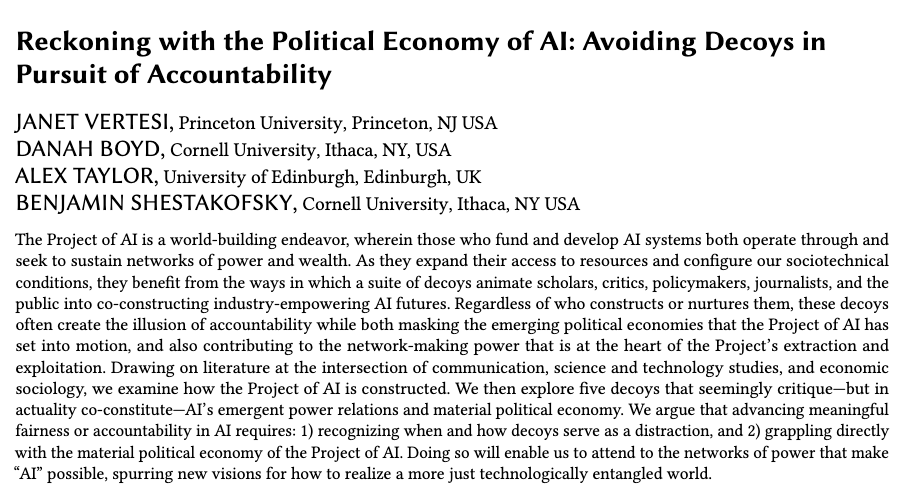
The Project of AI is a world-building endeavor, wherein those who fund and develop AI systems both operate through and seek to sustain networks of power and wealth. Janet Vertesi, Alex Taylor, Ben Shestakofsky, and I teamed up to try to disentangle the technical systems we call “AI” from the political-economic project that is sustaining this effort. Today, at FAccT, Janet presented our new paper: “Reckoning with the Political Economy of AI: Avoiding Decoys in Pursuit of Accountability.” (also available on arxiv). We do a few things in this paper that might be appealing. First, we try to map out how to understand AI, not as a set of technical artifacts, but the culmination of various economic and political forces, organizational logics, and interpersonal networks. (To anchor this, we draw on four distinct theoretical traditions, recognizable to scholars through Manuel Castells, Neil Fligstein, Donald Mackenzie, and Anna Tsing.) Then, we speak directly to scholars and practitioners interested in accountability and highlight how important it is to avoid “decoys” that distract our attention from the political economic agendas at play. Put most bluntly: we won’t create accountability by futzing with the technical affordances; we need to attend to the political and economic agendas.

If watching a video is more your jam, Janet presented a preview of this work at CITP Princeton a month ago and that video is now online.

While I’m not at FAccT (saaaad panda), I have been out and about. Ten days ago, I gave a talk at the Oxford Internet Institute to celebrate their 25th anniversary. Since I had given three co-authored paper talks at OII’s 10th (the ones that turned into Critical Questions for Big Data, It’s Just Drama, and Networked Privacy), I decided that it only made sense to give a 25th anniversary talk that wove together the past, present, and future of the internet that mixed together stories of social media, AI, and teenagers. “Dreaming of a Networked World” picks up themes from the FAccT paper, but the second half also includes new data from the Project Vibes team (led by Michele Ybarra) about teens’ attitudes towards AI. (Hint: it’s a doozy!)

It’s hard to believe that I’ve now been at Cornell for a year. It’s been an adventure! I taught three classes (Data & Society, Trust & Safety, and Theories to Think With). I have lots of irons in the oven, but I’m also now prepping for the launch of Data Are Made, Not Found. Book talks are confirmed in DC, Cambridge, Seattle, Boulder, and NYC. (Berkeley and Toronto are almost locked too.) I’m also talking with people about other cities. I can’t wait to share more. In the meantime, I would be ever so grateful if you could take the time to either pre-order the book or reserve a copy with your local library. 

Have an amazing summer! More soon!

Where Has Social Media Gone?

tl;dr: Read “Social Media Is Now Parasocial Media”

The lovely folks at the Social Media + Society journal asked me to contribute to their anniversary issue by reflecting on the trajectory of social media. Ooof. Snark exuded from my pores as I tried to figure out what I might say. But then I thought about how my students don’t know about an era of social media without recommended content, algorithmically curated feeds, and an infinite scroll of cotton candy content. They never encountered a world of social media where people were focused on sharing with their friends rather than becoming influencers. They don’t realize how much the “social” in social media has changed.

As I tried to unpack in my mind what social media has become, I kept coming back to how the dominant practice has shifted to consumption rather than production. Media scholars have always argued that consuming TV is social even if you watch alone because of the power of using TV content in social settings, like the water cooler. I don’t want to negate this collective experience to TV, although the content we consume online is so fragmented that there is no unifying consumption pattern despite there being meaningful networked-based consumption practices. But still, there’s something tangibly different about the social-ness of consuming to discuss vs. consuming in a dialogic engagement.

In putting pen-to-paper, I kept coming back to how odd the term “social media” now feels to me. And of course I’m biased because I lived through the contestations over how to label the various websites that we’ve come to know as social media. So I had a very particular understanding of the term, one that no longer exists.

“Social Media Is Now Parasocial Media” is my attempt to reckon with the evolution of social media into a format that I feel is no longer meaningfully social. It’s open-access so check it out. And if you have feels, push back! I’d love to hear your thoughts!!!

Pre-Order “Data Are Made, Not Found”!

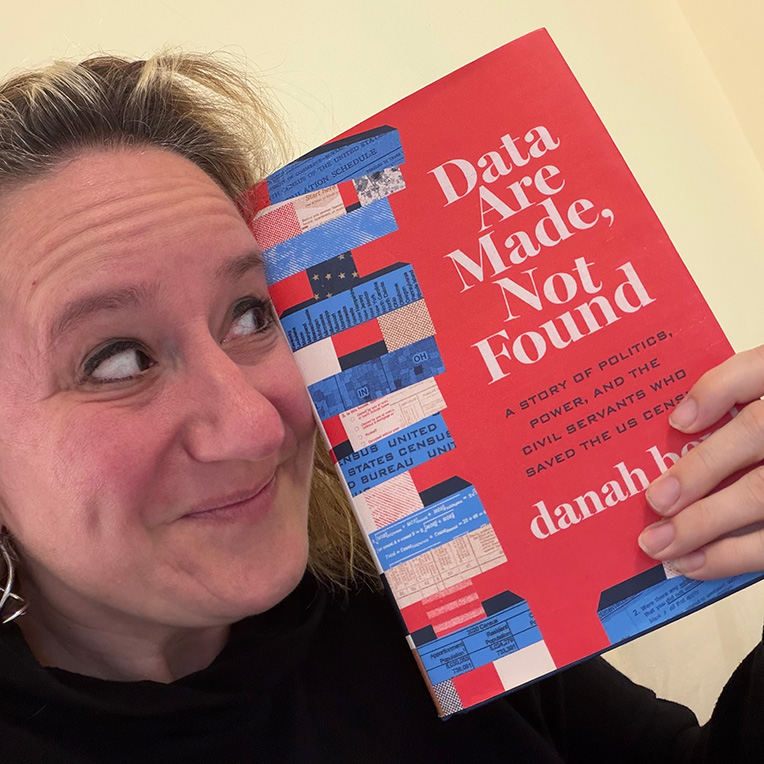
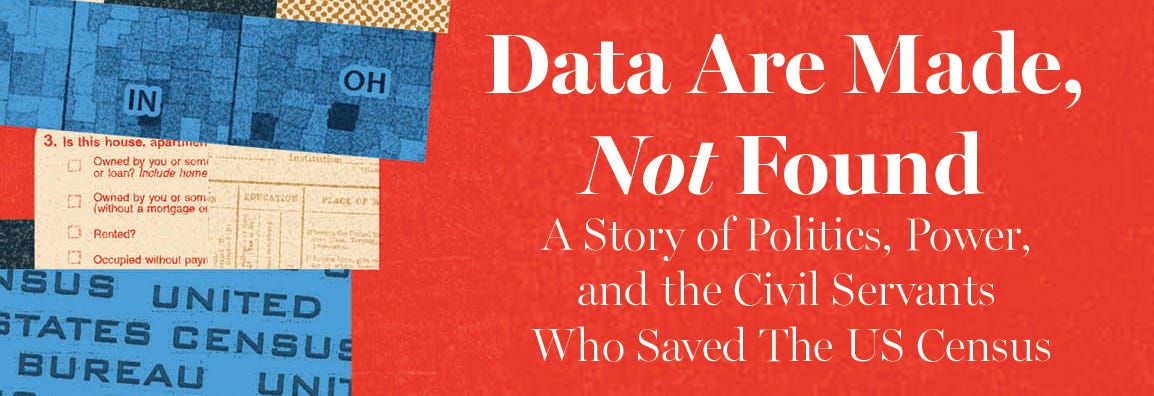
There’s something uniquely demoralizing about editing and editing and editing a book manuscript. The words all start to blur together and you start thinking that every sentence is crap, no one will ever want to read this, why bother completing the book. I was definitely in this state. And then… my publisher sent me the book cover and I squealed for joy at just how lovely it is. And it gave me hope. Check out this beauty:

And yes… that’s a wobbly Jenga tower comprised of pieces made from census documentation cuz one of the core arguments in the book is that we’re living in a world of “Jenga Politics” where different actors are pulling out pieces of our administrative infrastructure and putting pressure on top. Civil servants are exhausted, but they’re trying to keep the tower from falling.

And now that I’ve seen the beautiful cover, I can’t wait for you to read this book! And to come celebrate with me! I am starting to build a book tour so hopefully I will come to a city near you. But, in the meantime, here are some of the fun things I get to share:

  • My book won the J. Anthony Lukas Work-in-Progress Prize! Thank you to the kind people at Columbia Journalism School and the Nieman Foundation for Journalism at Harvard University for giving me wind beneath my wings!
  • Pre-Order the book! And if you order it from the University of Chicago Press website, you can save 30% by using the code UCPNEW. But feel free to order from your local bookstore or wherever else you want!
  • DC folks: Save the Date (9/25)! I am ecstatic that Politics & Prose is hosting me at their Wharf venue on September 25 at 7PM (the day after the book goes on sale!). I hope lots of folks will come out to celebrate! There will be books available! And a signing!
  • Virtual Folks: On the eve of the book launch (9/23), Dan Bouk and I will discuss the book in a virtual event hosted by Data & Society. More info on that will come shortly, but make sure to sign up to the D&S newsletter!

Fake Data, Upcoming Book, and the Political Economy of AI

“If we could see the miracle of a single flower clearly our whole life would change.” by maybe Buddha [img]

The world is on fire – and I’ve often been at a loss for how to constructively contribute to public discourse. For decades, I have shared knowledge gained through fieldwork to offer a different perspective on complex sociotechnical matters. Too often these days, I find myself banging my head against the wall while navigating the cacophony of anguish that is emerging in all directions. For better or worse, I chose this time to turn my attention locally. I have found joy trying to find my footing as a professor and think more directly about how to prepare the next generation. And amidst it all, I’ve also had a series of wins, which I thought I’d share.

  • “The State’s Politics of ‘Fake Data'” is a new paper that I wrote with Chuncheng Liu which starts from the premise that “all data are fake, but some are useful.” We look at the various ways in which purportedly (and often pejoratively) so-called “fake” data serve a purpose. And we do it by comparing insights we gleaned from both Chinese and American bureaucrats. It’s a fun paper!
  • My upcoming book has a title! – “Data Are Made, Not Found: A Story of Politics, Power, and the Civil Servants Who Saved the US Census.” And I’m in the final throes of getting the book ready to share with all y’all. If all goes well, the book will be released in September! And thanks to Hervé Le Crosnier, it will be simultaneously launched in French! <grin> The lovely people at Columbia Journalism School and the Nielsen Foundation have also shortlisted my book for the J. Anthony Lukas Work-in-Progress Prize. And I’m starting to prep a book tour and some op-eds and other things so if you have ideas, please holler. If you want to support me, please pre-order the book from University of Chicago Press or Amazon. There’s no book cover yet (and I’m fascinated that there’s a page count given that there’s still some editing to go), but omg omg omg it’s starting to become more real!

While putting the finishing touches on the book, I’ve been working on three new research projects. I am super grateful to the Sloan Foundation for naming me as a 2026 Sloan Research Fellow to support this work.

  • Political Economy of AI. I have multiple collaborations underway to grapple with the world-building project that is underpinning the contemporary AI project. Cornell Global Hubs is supporting one facet (so I’ll be coming to Edinburgh this summer). I also have two papers underway with amazing collaborators, an initiative at Cornell, and proposals out to a few venues to convene people. You’ll hear more on this shortly. So if this tickles your fancy, ping me!
  • Participatory Privacy Protections. I’m working with a phenomenal team of scholars on an NSF-sponsored grant to reckon with what it takes to achieve meaningful participatory engagement when rolling out privacy-enhancing technologies like differential privacy in various data contexts. This is building on earlier work on the consequences of epistemic disconnects and divergent statistical imaginaries.
  • Youth, Mental Health, and Tech. After years of avoiding doing new research on this topic, I’m working with an amazing team on an NIH-sponsored project to collect new data about young people’s relationship with tech, with mental health, and with their broader social world. Early focus groups are already super eye-opening. (Teaser: some youth see AI as yet-another example of how adults are trying to destroy their future.)

This semester, I’m going to keep chugging along on these different projects – while teaching “Theories to Think With” and “Trust & Safety in Online Platforms” – but I hope to have a lot more research and ideas to share shortly.

In the meantime, stay safe and protect your neighbors. And keep reading history… it’s a good reminder that this too shall change. (My book this week was Overthrow – which is basically the history of US’s obsession with regime change from the author who documented the CIA coup in Iran in 1953. Le sigh.)

PS: I also pay to maintain a newsletter at Ghost.io. Subscribe there to not miss anything!