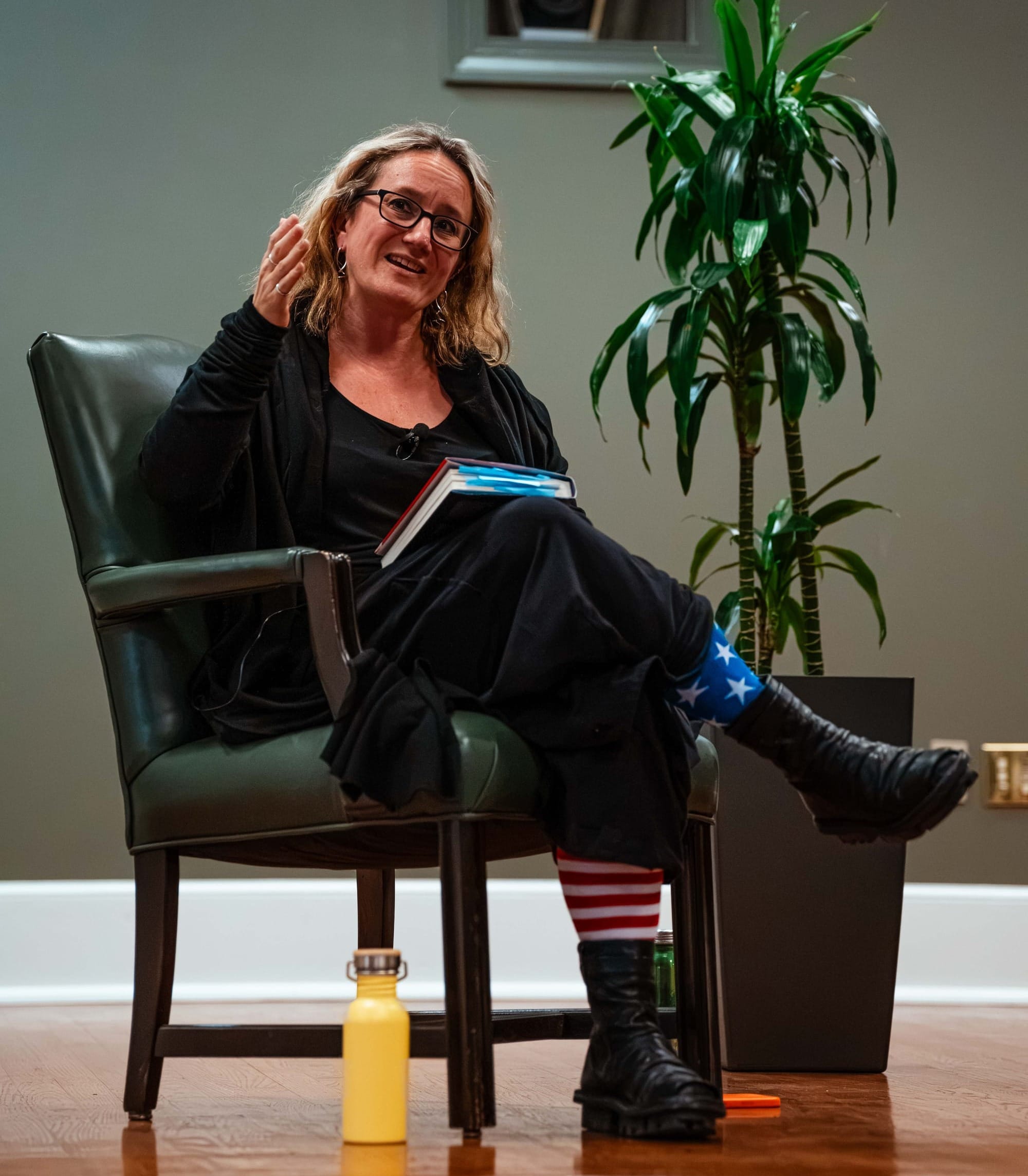
A few weeks ago, I launched my new book – Data Are Made, Not Found: A Story of Politics, Power, and the Civil Servants Who Saved the US Census. To my sheer delight, many friends have stepped up to host events and join me on stage and I’m now touring the country to spread the word about the census. (Seattle, DC, LA, Bay Area, Chicago, Ann Arbor: I’m headed your way real soon!) But when the team at Data & Society offered to host the first virtual event, I jumped at the chance. And I asked Dan Bouk, my dear friend and fellow D&Ser and census nerd to join me. He offered to make the idea of Jenga Politics understandable through a silly demonstration. I delighted in this, but I also begged a favor: would he consider crafting a silly song for the event?
Y’see… Dan has this knack for breaking into song in meetings. And not just any song. He creates and then sings ridiculously geeky songs that bring a smile to everyone’s faces. So, did Dan deliver? OMG did he ever. He crafted a song about the census, Congress, and Jenga politics set to Dolly Parton’s 9-to-5. “Tumble down the pieces and bring down the mission… Congress has the power but just does nothing…”
When he broke into song at the event “Protecting Democracy’s Data”, I was left feeling very very verklempt. To my delight, the video is now online so you can watch it too and feel all the adorbs feels. (If you just want to hear Dan sing, fast forward to 13:17.)
Part of what makes this song especially perfect is that Dan is riffing off of the fact that the House of Representatives is set to 435 members, thanks to a decision from a century ago. He would know. At Data & Society, Dan penned a report about how a 1929 law intended to stop Congresspeople from squabbling ended up cementing an algorithm and, with it, the number 435. His report – “House Arrest: How an Automated Algorithm Constrained Congress for a Century” – is a stark reminder of how laws intended to fix one problem can create ripple effects. It’s also a reminder of how, when things like the census become infrastructural, we lose track of what is at stake.
George Washington barely spoke during the Constitutional conventions. He understood his power and influence and thought he should keep his mouth shut. He did speak up at one critical juncture, however. When the Constitutional architects were discussing how Congresspeople should represent 40,000 people, he objected. He argued that the number should be lowered to 30,000 people. His argument was simple. If you want people to trust their representatives, they need to be closer to the people. They need to represent fewer people. Today, members of the House represent roughly 1,000,000 people. Needless to say, trust is broken.
We have collectively forgotten this history. We take the number 435 for granted. As we move into the midterm elections, I can’t help but wonder what it would be like if our House was comprised of 11,000 representatives. It’s hard to imagine. But how would wrangling that kind of body change how we governed? Of course, there’s a big gap between 435 and 11,0000. The amazing team at the Academy of Arts & Sciences argues that we need to restore the “Restore the Founders’ vision of Congress as the ‘People’s House'” (complete with an amazing explainer video).
Of course, no matter how many reps we select or what algorithm we choose, the way that we allocate political power in the United States starts with the census data. This is what Dan calls Democracy’s Data. I wrote Data Are Made, Not Found because I want people to understand all that it takes to make democracy’s data. If you haven’t snagged a copy yet, I implore you to do so (or to ask your library to make one available for you).
Here’s some recent content related to my book that you might enjoy:
- “Protecting Democracy’s Data” is a recording of my Data & Society event with Janet Haven and Dan Bouk
- Justin Hendrix and I talk “Jenga Politics” on the Tech Policy Press podcast
- Q&A with me from the team at Bolts
The book tour is shaping up nicely! Below are the next month’s worth of events. I hope you can join me for one of them (or check out my website for additional dates). Please help me spread the word!
- October 19, 6-8PM: Seattle, WA with Ron Jarmin
Town Hall, 1119 8th Ave, Seattle, WA 98101
Register to attend here - October 28, 4PM: Washington, DC with Bob Groves and Amy O’Hara
Georgetown University Center for Digital Ethics
Register to attend here - October 29, 3:30PM: Washington, DC
American University
Register to attend here - October 30, 2PM: Charlottesville, VA
University of Virginia - November 2, 3:30PM: Los Angeles, CA
University of Southern California
Register to attend here - November 3, TBD: Irvine, CA
University of California at Irvine - November 4, 12PM: Berkeley, CA (+ Zoom)
University of California at Berkeley, School of Information
Register to attend here - November 5, 7PM: Mountain View, CA with DJ Patil
Computer History Museum, Mountain View, CA
Register to attend here - November 9, 9:15AM: Chicago, IL
University of Illinois Chicago
Pre-registration required by Nov 6 - November 9, 4:30PM: Chicago, IL
University of Chicago, Data Science Institute
Details here - November 10, 12:30PM: Evanston, IL
Northwestern University
Register to attend here - November 12, 6:30PM: Ann Arbor, MI
Ann Arbor District Library
Event information here
